The Big Questions
Universal adult franchise means that every grown-up citizen of a country has the right to vote. In India, anyone who is 18 years or older can vote. It does not matter if they are rich or poor, what religion they follow, or if they are a man or a woman. Every vote has the exact same value. (Franchise simply means the right to vote given by the government).
An electoral system is a set of rules and steps used to conduct elections. It decides how people are allowed to vote, how those votes are counted, and how the winners are finally chosen to form a government.
India’s electoral system is managed by a special group called the Election Commission of India (ECI). First, citizens register their names on a voter list. On election day, they go to a polling booth. They use electronic machines called EVMs to cast a secret vote. The political party whose candidates win the most seats gets to form the government.
Early Chapter Activities
Let’s Explore (Page 118)
Yes, this was a very good move. At 18 years old, young people are considered adults. They go to college or start working, and they understand what is happening in the country. Giving them the right to vote early lets them share their voice and help decide the future of India.
In India, you can vote when you turn 18. To find out how long you have to wait, subtract your current age from 18. For example, if you are 11 years old right now, you have to wait 7 more years to vote (
Let’s Explore (Page 120)
The makers of our Constitution believed strongly in equality. Even if someone has never been to school and cannot read or write, they still have common sense. They still know what is good for their village and their family. Voting is a basic human right, not a prize for passing an exam. If only educated people were allowed to vote, the poor and uneducated would be completely ignored by the country’s leaders.
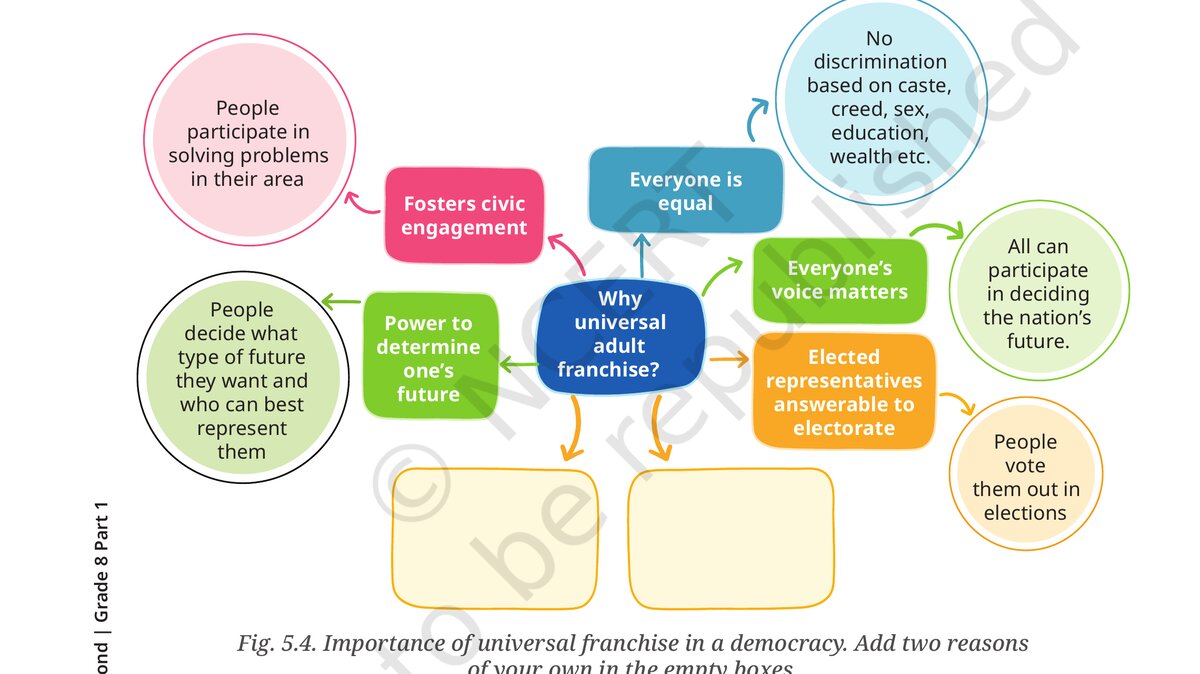
- Box 1: It makes sure the government cares about all people, not just the rich and powerful.
- Box 2: It makes ordinary citizens feel proud and responsible for their country.
Middle Chapter Activities (Elections and Case Studies)
Let’s Explore (Page 121)
- What role do they play: Measures like voting from home and wheelchair ramps make sure that every citizen, especially the elderly and those with disabilities, can cast their vote easily. This makes democracy truly fair.
- Personal experience: (Answers will vary). You might know older grandparents who benefited from home voting so they did not have to stand in long, tiring lines.
- Increasing participation: When voting is safe and easy, more people will come out to vote instead of staying home.
- How technology assists: Technology helps by putting Braille (raised dots for the blind) on voting machines, creating mobile apps to book wheelchairs, and providing digital voter ID cards.
Go to the website on a computer or phone. You will find supportive steps (interventions) like:
- Building ramps for wheelchairs at voting booths.
- Providing Braille on electronic voting machines (EVMs) so blind voters can read the buttons.
- Offering free transport to pick up and drop off voters with disabilities.
- Having special volunteers at the booth to guide and help them.
Let’s Explore (Page 123)
- Why people don’t vote (Challenges): Some people live very far away from their voting booth. Others have to go to work on election day and cannot get time off. Some simply feel that their single vote will not change anything.
To do this survey, ask 5 adults in your family or neighbourhood two simple questions: “Did you vote in the last election?” and “If not, what was the main reason?” Draw a table in your notebook to write down their answers. For your final report, suggest helpful ideas, like the government giving a mandatory paid holiday on election day, or putting voting booths much closer to people’s homes.
Let’s Explore (Page 125) — Suryodaya School Caselet
The important aspects are having candidates with clear goals, fair campaigning, a neutral Election Officer (Ms. Usha), a secret ballot system, and fair counting of the votes in front of a witness.
A secret ballot means no one else can see who you voted for. This is very important so students can vote honestly without being scared that their friends will get angry at them.
Students probably thought about which classroom problem was most important to them. They might have chosen Ahmed if they wanted clean classrooms, Gurmat if they wanted study help, or Ravi if they liked music and the arts.
Yes, the students have responsibilities. They must support Gurmat, follow the rules she helps create, and tell her about their problems so she can clearly speak to the teachers on their behalf.
Ms. Usha was the Election Officer. Her role was important because she made sure the rules were followed, no cheating happened, and every student got a fair and equal chance to vote.
Braille is a special way of reading for people who cannot see. Giving Neha a braille ballot meant she could vote secretly and by herself, just like everyone else in the class.
If many students did not vote, the winner might be chosen by only a very small group of people. The new class representative would not truly represent what the whole class actually wants.
Let’s Explore (Page 128)
Speak to your class teacher or principal to find out who has done election duty. Prepare a list of simple questions to ask them, such as: “What time did you wake up on election day?” or “What was the hardest part of managing the voting booth?” Listen carefully to their stories.
Let’s Explore (Page 131)
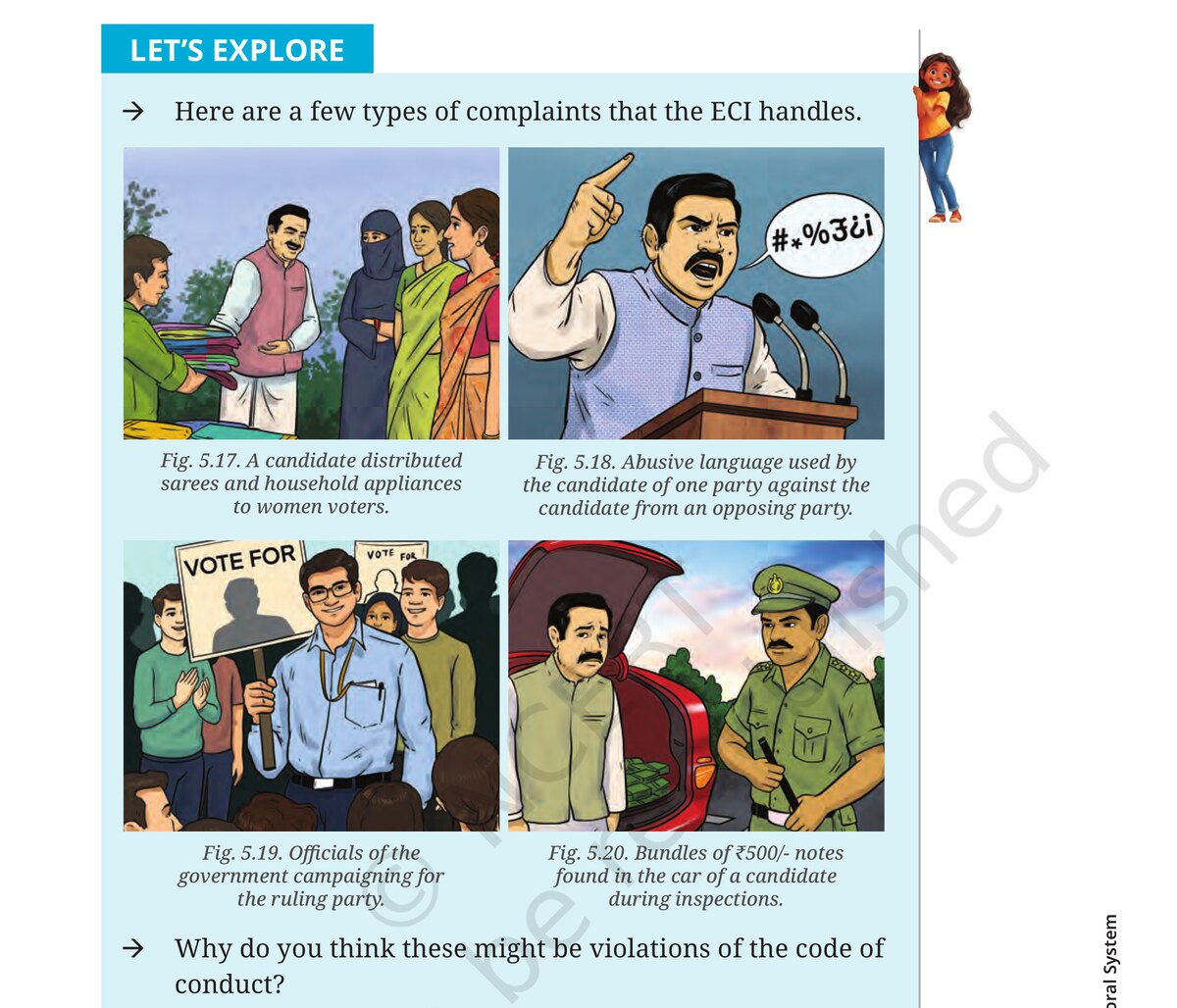
- Fig. 5.17 (Distributing sarees): This is a violation because giving gifts is like trying to buy or bribe someone’s vote. People should vote for good ideas, not for free items.
- Fig. 5.18 (Abusive language): This is a violation because leaders must be respectful. Using bad words creates anger and violence instead of a peaceful election.
- Fig. 5.19 (Government officials campaigning): This is a violation because government workers and police must remain neutral and fair to everyone. They cannot take sides.
- Fig. 5.20 (Bundles of notes in a car): This is a violation because carrying large amounts of secret cash usually means the candidate is planning to illegally buy votes.
Let’s Explore (Pages 132 & 134)
You can find this out by asking your parents or looking at a local newspaper. Write down the expected month and year, and note if it is to elect your local MLA (state) or local corporator/sarpanch (local body).
Ask an adult in your home for the names of your current Member of Parliament (MP) and Member of Legislative Assembly (MLA).
- Concerns of the MP: The MP focuses on big national issues, like railways, defense, and national highways.
- Concerns of the MLA: The MLA focuses on state and local issues, like city roads, local schools, water supply, and state hospitals.
Questions and Activities
Universal adult franchise is important because it treats every citizen as equal, no matter how much money they have or what religion they follow. It ensures that the government listens to all people, not just the powerful ones.
A ‘secret ballot’ means that when a person votes, no one else can see who they voted for. It is very important because it lets people vote bravely and freely, without anyone scaring them or forcing them to choose a certain leader.
- Direct Election: When citizens vote directly for their leaders. Example: Ordinary people voting for Members of Parliament (MPs) in the Lok Sabha.
- Indirect Election: When citizens do not vote directly. Instead, the leaders they already elected choose someone else. Example: MLAs voting to elect members of the Rajya Sabha.
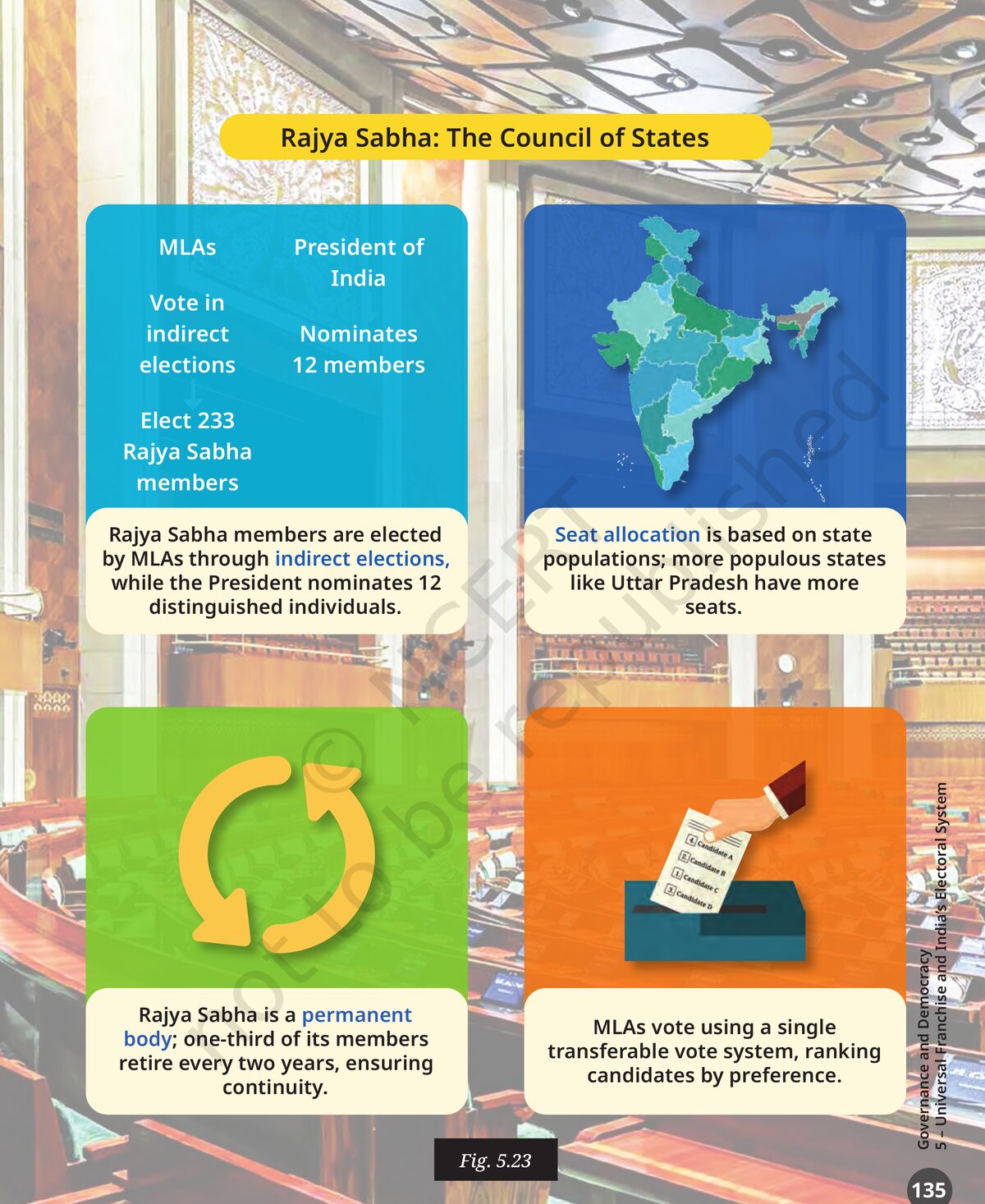
Members of the Lok Sabha are elected directly by the common citizens of India. Members of the Rajya Sabha are elected indirectly by the MLAs of different states (as shown in the diagram in Fig. 5.23), not by the common people.
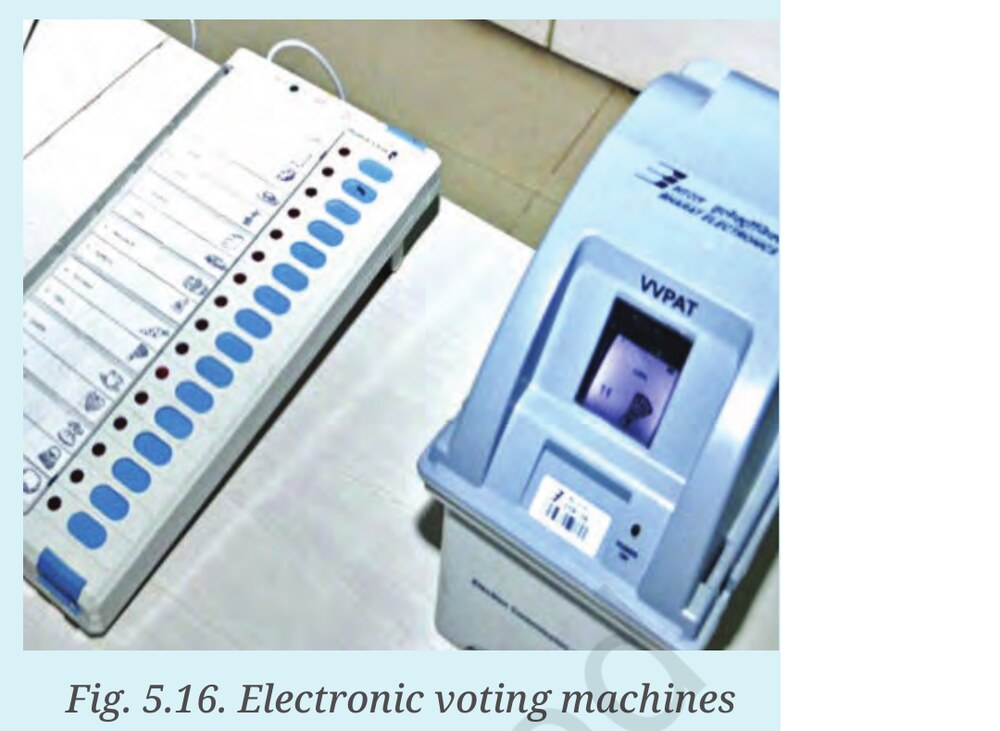
Electronic Voting Machines (EVMs), shown in Fig. 5.16, are better because they save a massive amount of paper, which protects trees. They also count votes much faster than human hands, and they make it much harder for bad people to cheat or tear the voting slips.
- Reasons: People in big cities might be too busy with office work, they might move houses often and forget to update their voter cards, or they might feel that politics does not affect their daily lives.
- Steps to take: The government can make voting easier by setting up more booths so lines are shorter. They can also use fun internet campaigns to remind young people to vote, and ensure all offices give a strict paid holiday on election day.
In the past, people from Scheduled Castes (SC) and Scheduled Tribes (ST) faced very unfair treatment and were kept poor and powerless. Reserving seats for them (like the 84 SC and 47 ST seats shown in the pie chart on page 129, next to the “Don’t Miss Out” note) ensures they have a strong voice in making the country’s laws. It helps protect their rights and guarantees they are a part of running India.
- Benefits: Social media helps important news reach young people very quickly. It also lets ordinary voters easily send messages to their leaders.
- Challenges: It is very easy to spread fake news. Bad people can make fake videos or tell lies to confuse voters before election day.
- The Future: In the digital age, elections will use a lot more technology to reach voters, but the government will need to create strict rules to stop fake news so that the truth is always clear.
To do this activity, open a web browser and type in the website address.
- Click on “Lok Sabha” and pick a year (like 2019 or 2024). Find your city’s name and see which candidate won and how many votes they got.
- Next, click on “State Assembly”, pick your state, and look at the results for your exact local area. Make a small chart in your notebook writing the winner’s name, their political party, and the year they won.