Prepared for PYQ Hub. Last reviewed 12 August 2026. If you notice an academic or display issue, tell us.
Introduction to Quadrilaterals
Question
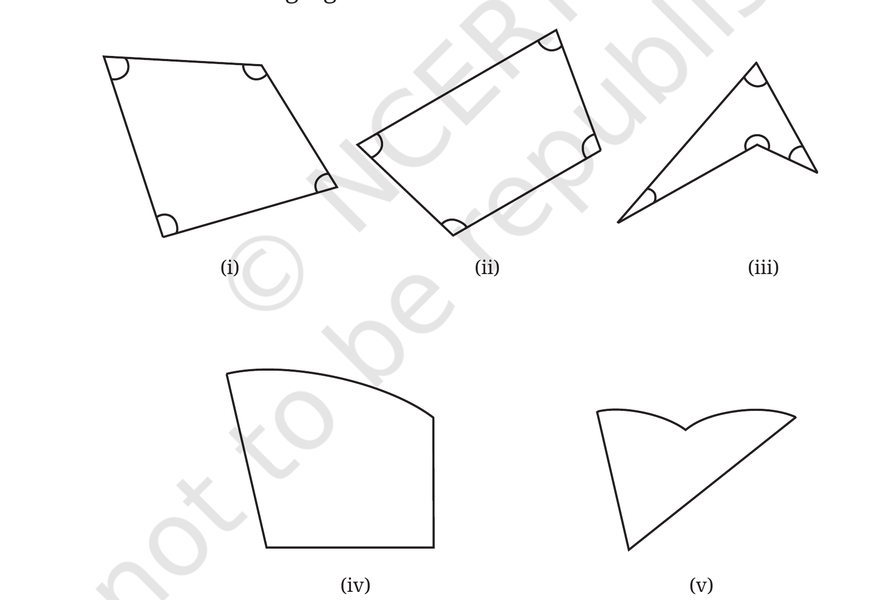
Observe the following figures. Figs. (i), (ii), and (iii) are quadrilaterals, and the others are not. Why?
Observe the following figures. (i)–(iii) are quadrilaterals; (iv) and (v) are not.
Solution
A quadrilateral is a closed two-dimensional figure made of exactly four straight sides. Figures (i), (ii), and (iii) are closed shapes bounded by exactly four straight line segments. Figure (iv) has a curved side, and figure (v) is not made of exactly four straight sides, which is why they are not classified as quadrilaterals.
4.1 Rectangles and Squares
Question
Are there other ways to define a rectangle?
Solution
Yes. The textbook initially defines a rectangle as a quadrilateral where all angles are 90 degrees and opposite sides are equal. However, we can also define it as a quadrilateral whose diagonals are of equal length and bisect each other, or simply as a quadrilateral where all four angles are 90 degrees.
A Carpenter's Problem
Question
A carpenter needs to put together two thin strips of wood, as shown in Fig. 1, so that when a thread is passed through their endpoints, it forms a rectangle. She already has one 8 cm long strip. What should be the length of the other strip? Where should they both be joined?
What is the length of the other diagonal?
What is the point of intersection of the two diagonals?
What should the angle be between the diagonals?
Fig. 1 — Wooden strips modelled as diagonals of a rectangleFig. 2 — Rectangle ABCD with diagonal 𝐴𝐶=8 cm
Solution
Length of the other diagonal: The other wooden strip must also be 8 cm long. This is because the diagonals of any rectangle are always equal in length.
Point of intersection: The two strips should be joined exactly at their midpoints. In a rectangle, the diagonals bisect each other, meaning they cross at their exact centers, dividing each diagonal into two equal parts.
Angle between the diagonals: The angle between the diagonals can be any arbitrary angle (except 0 or 180 degrees). As long as the two strips are equal in length and bisect each other, their endpoints will always form a rectangle regardless of the specific angle between them.
Deduction 1 — What is the length of the other diagonal?
Question
To find the length of the other diagonal of rectangle 𝐴𝐵𝐶𝐷 with 𝐴𝐶=8 cm, which triangles can we use?
Solution
Since 𝐴𝐵𝐶𝐷 is a rectangle, 𝐴𝐵=𝐶𝐷, ∠𝐵𝐴𝐷=∠𝐶𝐷𝐴=90∘, and 𝐴𝐷 is common to Δ𝐴𝐷𝐶 and Δ𝐷𝐴𝐵. So Δ𝐴𝐷𝐶≅Δ𝐷𝐴𝐵 by SAS. Therefore 𝐴𝐶=𝐵𝐷 (corresponding parts). The other diagonal is also 8 cm.
Deduction 2 — What is the point of intersection of the two diagonals?
Question
Since we need the relation between 𝑂𝐴 and 𝑂𝐶, and 𝑂𝐵 and 𝑂𝐷, which two triangles of rectangle 𝐴𝐵𝐶𝐷 should we consider?
Solution
Consider Δ𝐴𝑂𝐵 and Δ𝐶𝑂𝐷. The blue vertically opposite angles at 𝑂 are equal. Using ∠𝐵=∠𝐷=90∘ and the angle relations that give ∠1=∠2, we get Δ𝐴𝑂𝐵≅Δ𝐶𝑂𝐷 by AAS. Hence 𝑂𝐴=𝑂𝐶 and 𝑂𝐵=𝑂𝐷: the diagonals bisect each other at their midpoints.
Math Talk
Question
Can the following equalities be used to establish that Δ𝐴𝑂𝐷≅Δ𝐶𝑂𝐵?
No. ∠𝐴𝑂𝐵 and ∠𝐶𝑂𝐷 are not angles of Δ𝐴𝑂𝐷 and Δ𝐶𝑂𝐵 (the angles of these triangles at 𝑂 are ∠𝐴𝑂𝐷 and ∠𝐶𝑂𝐵). So the listed equalities do not give three corresponding parts of the two triangles, and cannot prove them congruent.
Deduction 3 — What are the angles between the diagonals?
The textbook draws two equal diagonals that bisect each other and meet at an angle of 60∘ (as marked in the figure at 𝑂).
Question
In Δ𝐴𝑂𝐵, since OA = OB, the angles opposite them are equal, say 𝑎. Can you find the value of 𝑎? Can you find all the remaining angles?
Solution
In Δ𝐴𝑂𝐵, the angle at 𝑂 is the given 60∘ between the diagonals. The other two angles are equal (𝑎 and 𝑎), so 𝑎+𝑎+60∘=180∘. Thus 2𝑎=120∘ and 𝑎=60∘.
The vertically opposite angle at 𝑂 is also 60∘. The adjacent angles on a straight line are 180∘−60∘=120∘ each. In each triangle with a 120∘ central angle, the base angles are (180∘−120∘)/2=30∘ each.
Question
Can we now identify what type of quadrilateral ABCD is? What can we say about its sides?
Solution
Yes, it is a rectangle. From the previous part (with the 60∘ angle between diagonals), each corner of ABCD is 30∘+60∘=90∘. Regarding its sides, because Δ𝐴𝑂𝐵≅Δ𝐶𝑂𝐷 and Δ𝐴𝑂𝐷≅Δ𝐶𝑂𝐵, their corresponding parts are equal. This means that the opposite sides are equal in length (𝐴𝐵=𝐶𝐷 and 𝐴𝐷=𝐶𝐵). Satisfying both conditions (all 90∘ angles and equal opposite sides) confirms it is a rectangle.
Question
Will ABCD remain a rectangle if the angles between the diagonals are changed? Can we generalise this? Take one of the angles between the diagonals as 𝑥. Can you find the other angles? What is the value of 𝑎 (in degrees) in terms of 𝑥?
Solution
Yes, ABCD will always remain a rectangle as long as the diagonals are equal and bisect each other, regardless of the angle 𝑥 between them.
The four central angles around the intersection point 𝑂 will be 𝑥, 𝑥 (vertically opposite), and 180∘−𝑥, 180∘−𝑥 (angles on a straight line).
In the isosceles Δ𝐴𝑂𝐵, the base angles 𝑎 can be found using the triangle angle sum property: 𝑎+𝑎+𝑥=180∘. Solving for 𝑎 yields 2𝑎=180∘−𝑥, so 𝑎=180∘−𝑥2=90∘−𝑥2.
Similarly, in the adjacent isosceles Δ𝐴𝑂𝐷, the base angles 𝑏 are found using 𝑏+𝑏+(180∘−𝑥)=180∘. Solving for 𝑏 yields 2𝑏=𝑥, so 𝑏=𝑥2.
The total angle at any vertex of the quadrilateral is 𝑎+𝑏, which equals 90∘−𝑥2+𝑥2=90∘. Thus, all four angles are 90∘.
Question
What can we say about AB and CD, and AD and BC?
Solution
𝐴𝐵=𝐶𝐷 and 𝐴𝐷=𝐶𝐵 because Δ𝐴𝑂𝐵≅Δ𝐶𝑂𝐷 and Δ𝐴𝑂𝐷≅Δ𝐶𝑂𝐵; corresponding sides of congruent triangles are equal.
Deduction 4 — What is the shape of a quadrilateral with all the angles equal to 90°?
Question
In the earlier definition, we stated that a rectangle has (a) opposite sides of equal length, and (b) all angles equal to 90°. Would we be wrong if we just define a rectangle as a quadrilateral in which all the angles are 90°?
Solution
No. A quadrilateral with four 90∘ angles has equal opposite sides, so this definition describes every rectangle.
Question
If you think that this definition is incomplete, try constructing a quadrilateral in which the angles are all 90° but the opposite sides are not equal. Are you able to construct such a quadrilateral?
Solution
No. A quadrilateral with four 90∘ angles must have equal opposite sides.
Question
Consider a quadrilateral ABCD with all angles measuring 90°. What can we say about the opposite sides of such a quadrilateral? Join BD. Triangles BAD and DCB seem congruent. Can we justify this claim? Two equalities can be directly seen in the triangles. What can we say about angle 1 and angle 2?
Solution
Opposite sides: We can definitively say that the opposite sides of this quadrilateral are equal in length (𝐴𝐷=𝐶𝐵 and 𝐷𝐶=𝐵𝐴).
Justifying congruence: We can justify that triangle BAD is congruent to triangle DCB. The two direct equalities we can see are the common side BD (shared by both triangles) and the 90° angles (angle A in triangle BAD and angle C in triangle DCB).
Angle 1 and Angle 2: Since angle B is a 90° angle, we know that angle 3 + angle 1 = 90°. Look at triangle BCD: the sum of its interior angles is 180°, so angle 3 + angle 2 + 90° = 180°. This simplifies to angle 3 + angle 2 = 90°. Because both angle 1 and angle 2 add up to 90° when combined with angle 3, they must be equal to each other (angle 1 = angle 2).
Conclusion: By the Angle-Angle-Side (AAS) congruence condition, triangle BAD is congruent to triangle DCB.
Question
Is it wrong to write triangle BAD is congruent to triangle CDB? Why?
Solution
Yes, it is incorrect. When writing a congruence statement, the order of the letters must exactly match the corresponding parts of the triangles. Vertex B in triangle BAD corresponds to vertex D in triangle DCB (because angle 1 = angle 2), and vertex A (90°) corresponds to vertex C (90°). Writing "triangle CDB" misaligns these corresponding vertices.
Question
Are the opposite sides of a rectangle parallel? Can you similarly show that AB is parallel to DC (𝐴𝐵∥𝐷𝐶)?
Solution
Yes, the opposite sides of a rectangle are parallel. To prove that AB is parallel to DC, treat the line segment AD as a transversal line cutting across lines AB and DC. The interior angles on the same side of this transversal are angle A and angle D. Since both are right angles, their sum is 90∘+90∘=180∘. Whenever the sum of interior angles on the same side of a transversal is 180∘, the lines are parallel. Therefore, 𝐴𝐵∥𝐷𝐶.
A Special Rectangle
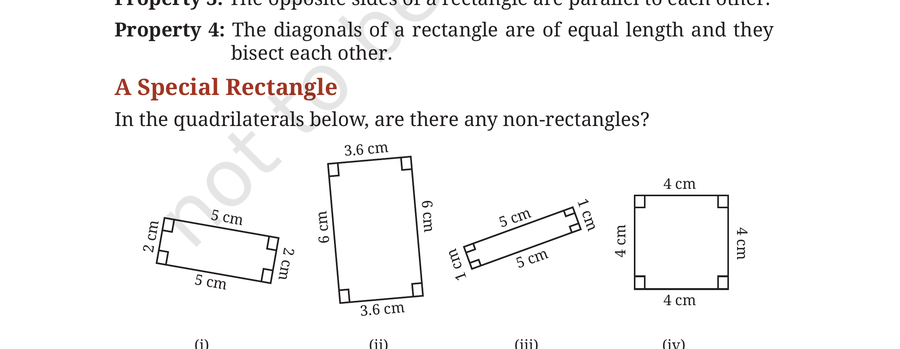
The textbook shows four quadrilaterals (i)–(iv), each with all angles 90∘ (side lengths are also marked).
Four quadrilaterals from the textbook — which (if any) are not rectangles?
Question
In the quadrilaterals below, are there any non-rectangles?
Solution
No, all four quadrilaterals shown (i, ii, iii, iv) are rectangles. This is because they all satisfy the definition of a rectangle: a quadrilateral where every interior angle measures 90°. Quadrilateral (iv) is a special type of rectangle where all four sides are equal, known as a square.
The Carpenter's Problem (Revisited for Squares)
Question
Let us consider the Carpenter's Problem again. If the wooden strips have to be placed such that the thread passing through their endpoints forms a square, what must be done? What more needs to be done to get equal sidelengths as well?
Solution
To ensure the endpoints form a rectangle, the two wooden strips (diagonals) must be equal in length and joined exactly at their midpoints (bisect each other). To go further and ensure it is a square (equal side lengths), the diagonals must also cross each other at exactly a 90° angle (right angles).
Deduction 5 — What should be the angle formed by the diagonals?
Question
To find the angle formed by the diagonals, what are the two triangles we should consider for congruence? Can this be used to find the angles BOA and BOC formed by the diagonals?
Solution
Triangles to consider: We should consider two adjacent triangles formed by the diagonals, such as Δ𝐵𝑂𝐴 and Δ𝐵𝑂𝐶. By the Side-Side-Side (SSS) congruence condition, these triangles are congruent because 𝐴𝐵=𝐵𝐶 (sides of a square are equal), 𝑂𝐴=𝑂𝐶 (diagonals of a square bisect each other), and 𝑂𝐵 is a common side to both triangles.
Finding the angles: Yes, this congruence helps us find the angles. Because the triangles are congruent, their corresponding angles are equal, meaning angle BOA = angle BOC. Since these two angles lie on a straight line, they must add up to 180°. Therefore, each angle must be exactly 90°. This proves the diagonals of a square intersect at right angles.
Question
Using this fact, construct a square with a diagonal of length 8 cm.
Solution
Draw a line segment of length 8 cm (first diagonal) and mark its midpoint 𝑂. Through 𝑂, draw a second line at 90∘ to the first. On this line mark points 4 cm from 𝑂 in both directions (so the second diagonal is also 8 cm and bisected at 𝑂). Join the four endpoints. The quadrilateral is a square.
Properties of a Square
Question
Verify if this is true by going through geometric reasoning in Deduction 1 and Deduction 2, and see if they apply to a square as well.
Solution
Yes. Every square is a rectangle, so Deductions 1 and 2 apply: its diagonals are equal and bisect each other.
In square 𝐴𝐵𝐶𝐷, diagonal 𝐴𝐶 is drawn. The angles formed with the sides are marked ∠1, ∠2, ∠3, and ∠4 (as in the textbook figure).
Question
What are the measures of angle 1, angle 2, angle 3, and angle 4? See if you can reason and/or experiment to figure this out!
Solution
Look at triangle ADC. We know that angle D is 90°. The sum of the interior angles of a triangle is 180°, which leaves 90° to be split between angle 1 and angle 3 (so angle 1 + angle 3 = 90°).
Because adjacent sides of a square are equal (𝐴𝐷=𝐷𝐶), triangle ADC is an isosceles triangle. In an isosceles triangle, the angles opposite the equal sides are also equal, so angle 1 = angle 3.
Dividing the remaining 90° equally gives angle 1 = 45° and angle 3 = 45°.
By applying the exact same logic to triangle ABC, we find that angle 2 = 45° and angle 4 = 45°. This establishes that the diagonals of a square bisect its corner angles.
Prop
Figure it Out (Page 94)
Question 1
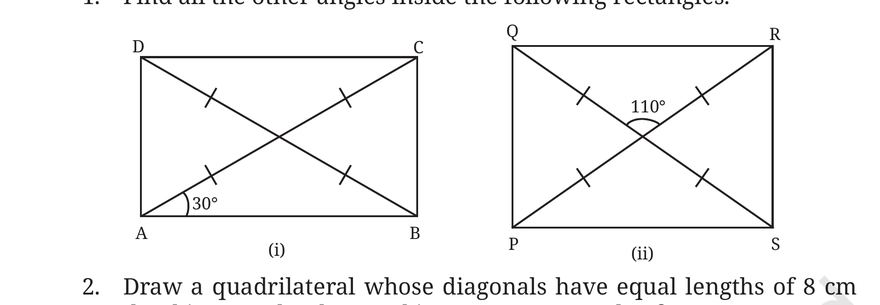
Find all the other angles inside the following rectangles. (i) Rectangle ABCD with intersecting diagonals. The angle between the bottom side AB and diagonal AC is 30°. (ii) Rectangle PQRS with diagonals intersecting at O; the figure marks a central angle of 110∘ between the diagonals.
Figure it Out Q1 — Rectangles with given angles
Solution
(i) In rectangle ABCD, all corner angles are 90°.
We are given ∠𝐶𝐴𝐵=30∘. Since the corner ∠𝐷𝐴𝐵=90∘, the other part of that corner is ∠𝐶𝐴𝐷=90∘−30∘=60∘.
In a rectangle, opposite sides are parallel, so alternate interior angles are equal. This means ∠𝐴𝐶𝐷=∠𝐶𝐴𝐵=30∘, and ∠𝐴𝐶𝐵=∠𝐶𝐴𝐷=60∘.
Similarly, the diagonals are equal and bisect each other, forming isosceles triangles. Triangle AOB is isosceles (𝑂𝐴=𝑂𝐵), so ∠𝐴𝐵𝐷=∠𝐶𝐴𝐵=30∘.
Because the corner ∠𝐴𝐵𝐶=90∘, we can find ∠𝐷𝐵𝐶=90∘−30∘=60∘. By alternate interior angles, ∠𝐴𝐷𝐵=60∘ and ∠𝐵𝐷𝐶=30∘.
(ii) In rectangle PQRS, the diagonals cross at O.
The figure marks a central angle of 110∘ (e.g. ∠𝑄𝑂𝑅). The vertically opposite angle ∠𝑃𝑂𝑆 is also 110∘, and ∠𝑅𝑂𝑄=110∘.
The angles on a straight line add up to 180°, so ∠𝑃𝑂𝑄=180∘−110∘=70∘. The vertically opposite angle ∠𝑅𝑂𝑆 is also 70∘.
The diagonals bisect each other and are equal, making Δ𝑃𝑂𝑄 an isosceles triangle (𝑂𝑃=𝑂𝑄). With central angle ∠𝑃𝑂𝑄=70∘, the remaining 110∘ is split equally between the base angles: ∠𝑂𝑃𝑄=55∘ and ∠𝑂𝑄𝑃=55∘.
Since the corner ∠𝑆𝑃𝑄=90∘, the other part is ∠𝑂𝑃𝑆=90∘−55∘=35∘. Because Δ𝑃𝑂𝑆 is also isosceles (central angle 110∘), ∠𝑂𝑆𝑃=35∘.
Using symmetry / alternate interior angles, the remaining angles are: ∠𝑂𝑅𝑆=55∘, ∠𝑂𝑆𝑅=55∘, ∠𝑂𝑅𝑄=35∘, and ∠𝑂𝑄𝑅=35∘.
Question 2
Draw a quadrilateral whose diagonals have equal lengths of 8 cm that bisect each other, and intersect at an angle of (i) 30° (ii) 40° (iii) 90° (iv) 140°.
Solution
Repeat these construction steps for each given angle:
Draw a horizontal line segment AB measuring exactly 8 cm. This is your first diagonal. Mark its exact midpoint, O, at the 4 cm mark.
Place a protractor at point O and mark the required angle (30° for part i, 40° for part ii, etc.). Draw a long line passing through O at this angle.
On this new line, use a ruler to measure 4 cm outwards from O in both directions. Mark these two endpoints C and D. You now have a second diagonal, CD, measuring 8 cm that is bisected by the first one.
Finally, use a ruler to connect the outer endpoints A, C, B, and D. The resulting shape is your required quadrilateral. (Note: for part iii where the angle is 90°, the resulting rectangle will be a square).
Question 3
Consider a circle with centre O. Line segments PL and AM are two perpendicular diameters of the circle. What is the figure APML? Reason and/or experiment to figure this out.
Perpendicular diameters PL and AM of a circle with centre O — figure APML is a square
Solution
The figure APML is a square.
Reasoning: Because PL and AM are diameters of the same circle, they must be equal in length. Because they intersect at the center of the circle (O), they cut each other exactly in half (bisect each other). A quadrilateral whose diagonals are equal and bisect each other is a rectangle. Furthermore, the problem states that the diameters are perpendicular, meaning they intersect at exactly 90°. A rectangle whose diagonals intersect at 90° is mathematically defined as a square.
Question 4
We have seen how to get 90° using paper folding. Now, suppose we do not have any paper but two sticks of equal length, and a thread. How do we make an exact 90° using these?
Solution
Take the two sticks and measure to find their exact midpoints. Place one stick across the other so that their midpoints perfectly overlap, and tie them together at this center point. Now, take the thread and wrap it tightly around the four outer ends of the crossed sticks. Because the sticks act as diagonals that are equal in length and bisect each other, the shape formed by the thread is guaranteed to be a rectangle. Therefore, the corners of the thread shape will form exact 90° angles.
Question 5
We saw that one of the properties of a rectangle is that its opposite sides are parallel. Can this be chosen as a definition of a rectangle? In other words, is every quadrilateral that has opposite sides parallel and equal, a rectangle?
Solution
No, this cannot be chosen as the definition of a rectangle. While every rectangle has equal and parallel opposite sides, not every shape with equal and parallel opposite sides is a rectangle. For example, a parallelogram has equal and parallel opposite sides, but it can be "slanted" and have corner angles that are not 90°. A true rectangle must always have 90° interior angles, so the proposed definition is incomplete.
4.2 Angles in a Quadrilateral
Question
Is it possible to construct a quadrilateral with three angles equal to 90° and the fourth angle not equal to 90°? But why not?
Solution
No, it is impossible. This is because the sum of all four interior angles in any quadrilateral must always be exactly 360∘. If a quadrilateral has three 90∘ angles, their sum is 270∘ (90∘+90∘+90∘). To reach the total of 360∘, the fourth angle must be exactly 360∘−270∘=90∘.
Question
Consider a quadrilateral SOME. Draw a diagonal SM. We get two triangles Δ𝑆𝐸𝑀 and Δ𝑆𝑂𝑀. What do we get when we add all six angles?
Solution
By adding all six angles, we get 360∘. The diagonal divides the quadrilateral into two distinct triangles. The sum of the interior angles of Δ𝑆𝐸𝑀 (∠1+∠2+∠3) is 180∘. The sum of the interior angles of Δ𝑆𝑂𝑀 (∠4+∠5+∠6) is also 180∘. Adding these together (180∘+180∘) gives 360∘, proving that the sum of all angles in any quadrilateral is 360∘.
4.3 More Quadrilaterals with Parallel Opposite Sides
Question
Are there quadrilaterals that have parallel opposite sides that are not rectangles? Construct such a figure.
Solution
Yes, such quadrilaterals exist and are called parallelograms. You can construct one by drawing two pairs of parallel lines that intersect at an angle other than 90∘. It will have opposite sides that are parallel, but because the angles are not right angles, it is not a rectangle.
Question
Is a rectangle a parallelogram?
Solution
Yes. A rectangle has parallel opposite sides, so it is a parallelogram with four right angles.
Question
Draw a parallelogram with adjacent sides of lengths 4 cm and 5 cm, and an angle of 30° between them. What are the remaining angles of the parallelogram? What are the lengths of the remaining sides?
Solution
Sides: Because it is a parallelogram, the opposite sides are equal in length. The side opposite the 4 cm side will be 4 cm, and the side opposite the 5 cm side will be 5 cm.
Angles: The adjacent angles between parallel lines in a parallelogram sum to 180∘. Therefore, the angle adjacent to the 30∘ angle is 180∘−30∘=150∘. Opposite angles are equal, so the remaining two angles are 30∘ and 150∘.
Deduction 6 & 7 — Properties of Parallelograms
Question
What about the opposite angles? Will they be equal in all parallelograms? If yes, how can we be sure? Let us take one of the angles to be 𝑥. What are the other angles?
Solution
Yes, opposite angles are equal in all parallelograms. If one angle is 𝑥, the adjacent angle along the transversal line between parallel sides must be 180∘−𝑥 (since interior angles on the same side of a transversal sum to 180∘). The angle opposite to the original angle 𝑥 is adjacent to the 180∘−𝑥 angle, meaning it must be 180∘−(180∘−𝑥), which equals 𝑥. Thus, opposite angles are always equal.
Question
Can we again use congruence to show this [that opposite sides of a parallelogram are equal]? Which two triangles can be considered for this? Is it wrong to write Δ𝐴𝐵𝐷≅Δ𝐶𝐵𝐷? Why?
Solution
Triangles: Yes, we can use congruence by drawing a diagonal 𝐵𝐷, which creates two triangles: Δ𝐴𝐵𝐷 and Δ𝐶𝐷𝐵.
Congruence: Because the opposite sides are parallel, the alternate interior angles created by the diagonal transversal are equal. The two triangles share the common side 𝐵𝐷. Therefore, by Angle-Angle-Side (AAS) congruence, Δ𝐴𝐵𝐷≅Δ𝐶𝐷𝐵. Because corresponding parts of congruent triangles are equal, the opposite sides of the parallelogram are equal (𝐴𝐵=𝐶𝐷 and 𝐴𝐷=𝐶𝐵).
Naming: It is wrong to write Δ𝐴𝐵𝐷≅Δ𝐶𝐵𝐷. In congruence statements, corresponding vertices must align in the same order. Based on the equal alternate interior angles, vertex A corresponds to C, and vertex B corresponds to D. Therefore, it must be written as Δ𝐴𝐵𝐷≅Δ𝐶𝐷𝐵.
Properties of a Parallelogram
Question
Are the diagonals of a parallelogram always equal? Check with the parallelogram that you have constructed.
Solution
No, the diagonals of a parallelogram are not always equal. If you look at a general slanted parallelogram (like the one constructed with sides 4 cm and 5 cm and a 30° angle), one diagonal stretches across the wider points and is noticeably longer than the diagonal connecting the narrower points.
Question
Do they bisect each other (do they intersect at their midpoints)? Reason and/or experiment to figure this out.
Solution
Yes, the diagonals of a parallelogram always bisect each other. They cross exactly at their midpoints, splitting each diagonal into two equal halves.
Deduction 8 — What is the point of intersection of the two diagonals in a parallelogram?
In parallelogram 𝐸𝐴𝑆𝑌, diagonals 𝐴𝑆 and 𝐸𝑌 meet at 𝑂. Using alternate interior angles (with the parallel sides) and 𝐴𝐸=𝑌𝑆, one shows Δ𝐴𝑂𝐸≅Δ𝑌𝑂𝑆 by ASA. Hence 𝑂𝐴=𝑂𝑌 and 𝑂𝐸=𝑂𝑆: the diagonals bisect each other at 𝑂.
Question
Is it wrong to write Δ𝐴𝑂𝐸≅Δ𝑆𝑂𝑌? Why?
Solution
Yes, writing it in that specific order is incorrect. When writing a congruence statement, the letters must match the corresponding equal parts of the triangles. Because the alternate interior angles match up crosswise, vertex A corresponds to vertex Y, and vertex E corresponds to vertex S. Therefore, the correct statement is Δ𝐴𝑂𝐸≅Δ𝑌𝑂𝑆.
Question
Do the diagonals of a parallelogram intersect at a particular angle?
Solution
No, in a standard parallelogram, the diagonals do not intersect at any specific, fixed angle (such as 90°). The angle at which they cross changes depending on the lengths of the sides and the internal angles of the parallelogram itself.
4.4 Quadrilaterals with Equal Sidelengths
Question
Are squares the only quadrilaterals that have equal sidelengths? Let us explore this question through construction.
Solution
No, squares are not the only ones. While a square has equal sides and 90° angles, we can easily construct a "slanted" shape that has four equal sides but lacks the 90° angles. This type of quadrilateral is called a rhombus.
Question
Draw two equal sides 𝐴𝐷 and 𝐴𝐵 that are not perpendicular to each other. (In the textbook figure, ∠𝐷𝐴𝐵=50∘.) Can we complete this quadrilateral so that all its sides are of the same length?
Solution
Yes, we can complete it using a compass. First, measure the length of side AB with the compass. Keeping that exact width, place the compass needle on point B and draw a small arc. Next, place the needle on point D and draw another arc that crosses the first one. The spot where the two arcs cross is your final corner, point C. Draw lines connecting B to C, and D to C, and you will have a rhombus where all four sides are perfectly equal.
Question
What are the other angles of the rhombus 𝐴𝐵𝐶𝐷 that we have constructed (with ∠𝐴=50∘)? Reason and/or experiment to figure this out.
Solution
From the construction above, one angle is given: ∠𝐴=50∘. Because a rhombus is a special type of parallelogram, its opposite angles are equal, and its adjacent angles add up to 180∘.
Therefore, the angle opposite to A is ∠𝐶=50∘.
The adjacent angle is ∠𝐵=180∘−50∘=130∘.
The angle opposite to B is ∠𝐷=130∘.
Deduction 9 — What can we say about the angles in a rhombus?
Question
Consider a rhombus GAME. It can be seen that Δ𝐺𝐴𝐸≅Δ𝑀𝐴𝐸 (How?)
Solution
These two triangles are congruent based on the Side-Side-Side (SSS) rule. Because GAME is a rhombus, all four of its sides are equal, which tells us that side 𝐺𝐴=𝑀𝐴 and side 𝐺𝐸=𝑀𝐸. Additionally, both triangles share the middle side 𝐴𝐸. Since all three corresponding sides are equal, Δ𝐺𝐴𝐸≅Δ𝑀𝐴𝐸. Corresponding angles are equal, so the four angles formed by diagonal 𝐴𝐸 with the sides are equal.
Applying this to the rhombus 𝐴𝐵𝐶𝐷 with ∠𝐴=50∘: in Δ𝐴𝐷𝐵, the two base angles at 𝐷 and 𝐵 are equal, so each is (180∘−50∘)/2=65∘. Thus the angles of the rhombus are 50∘, 130∘, 50∘, and 130∘ (opposite angles equal; adjacent angles sum to 180∘).
Properties of a Rhombus
Question
Are the diagonals of a rhombus equal?
Solution
No, the diagonals of a rhombus are generally not equal. The only time a rhombus has equal diagonals is when it is also a square.
Question
Do the diagonals of a rhombus intersect at any particular angle? Reason out and/or experiment to figure this out!
Solution
Yes, they intersect at a very specific angle. The diagonals of a rhombus always intersect at exactly 90∘ (right angles). This can be proven by looking at the triangles formed inside the rhombus.
Deduction 10 — Angles formed by the diagonals of a rhombus
Question
In the rhombus GAME, we have Δ𝐺𝐸𝑂≅Δ𝑀𝐸𝑂 (why?).
Solution
These two triangles are congruent based on the Side-Side-Side (SSS) rule.
Because GAME is a rhombus, all its sides are equal, so side 𝐺𝐸=𝑀𝐸.
Because a rhombus is a parallelogram, its diagonals bisect each other, meaning the diagonal from G to M is cut perfectly in half at O. Therefore, side 𝐺𝑂=𝑀𝑂.
Both triangles share the middle side 𝐸𝑂.
Since all three corresponding sides are equal, the triangles are congruent. Because they are congruent, the angles around the center point O must be equal. Since they lie on a straight line (180∘), they must be 90∘ each.
Property: The diagonals of a rhombus intersect each other at 90∘.
Figure it Out (Page 102)
Question 1
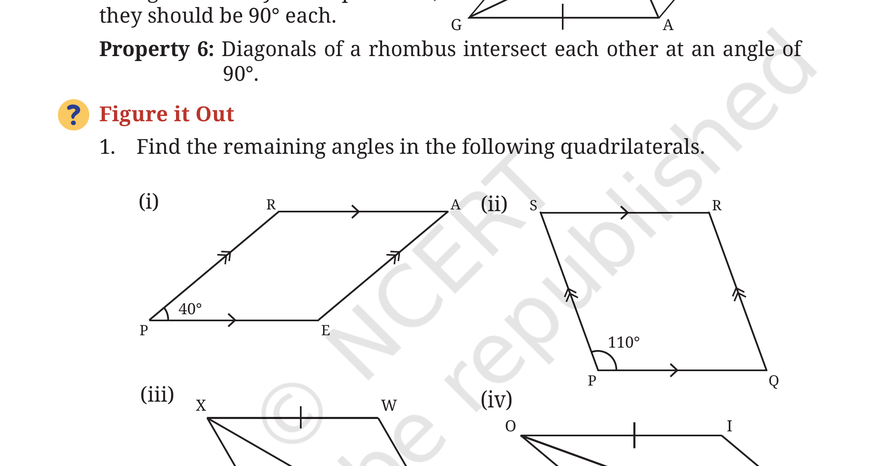
Find the remaining angles in the following quadrilaterals
(i) Parallelogram PARE with ∠𝑃=40∘
(ii) Parallelogram PQRS with ∠𝑃=110∘
(iii) Rhombus UVWX with an angle of 30∘ between the side UV and diagonal XV
(iv) Rhombus OAIE with an angle of 20∘ between the side AE and diagonal OE
Figure it Out (Page 102) — Quadrilaterals for finding remaining angles
Solution
(i) In a parallelogram, opposite angles are equal, so ∠𝐴=∠𝑃=40∘. Adjacent angles sum to 180∘, so ∠𝐸=180∘−40∘=140∘. The last opposite angle is ∠𝑅=∠𝐸=140∘.
(ii) Similarly, opposite angles are equal, so ∠𝑅=∠𝑃=110∘. Adjacent angles sum to 180∘, so ∠𝑆=180∘−110∘=70∘. The last opposite angle is ∠𝑄=∠𝑆=70∘.
(iii) This shape is a rhombus (all four sides are marked equal). The diagonals of a rhombus bisect its corner angles. If the angle between the diagonal and one side is 30∘, the total corner angle at V is 30∘+30∘=60∘. Opposite angles are equal, so ∠𝑋=60∘. Adjacent angles sum to 180∘, so ∠𝑈=180∘−60∘=120∘ and ∠𝑊=120∘.
(iv) This is also a rhombus. The diagonal bisects the corner angle, so if half the angle is 20∘, the full corner angle ∠𝐸 is 20∘+20∘=40∘. Opposite angles are equal, so ∠𝑂=40∘. Adjacent angles sum to 180∘, so ∠𝐴=180∘−40∘=140∘ and ∠𝐼=140∘.
Question 2
Using the diagonal properties, construct a parallelogram whose diagonals are of lengths 7 cm and 5 cm, and intersect at an angle of 140∘.
Solution
Draw a straight line segment measuring 7 cm. This is your first diagonal. Mark its exact midpoint at 3.5 cm. Let's call this midpoint O.
Place a protractor at point O and mark an angle of 140∘. Draw a long straight line passing through O at this angle.
The second diagonal must be 5 cm long. Because diagonals in a parallelogram bisect each other, measure 2.5 cm outwards from O in both directions along the new angled line. Mark these endpoints.
Use a ruler to connect the four outer endpoints. This forms the required parallelogram.
Question 3
Using the diagonal properties, construct a rhombus whose diagonals are of lengths 4 cm and 5 cm.
Solution
Draw a horizontal line segment measuring 5 cm. Mark its exact midpoint at 2.5 cm (point O).
Because the diagonals of a rhombus intersect at exactly 90∘, use a protractor or a set-square to draw a vertical line straight up and down through point O, making a perpendicular cross.
The second diagonal is 4 cm long and must be bisected. Measure 2 cm upwards from O and mark a point, and measure 2 cm downwards from O and mark a point.
Connect the four outer endpoints with a ruler. This forms the required rhombus.
4.5 Playing with Quadrilaterals
Question
Place two rubber bands perpendicular to each other, forming diagonals of equal length. Join the ends. What is the quadrilateral that you get? Justify your answer.
Solution
You get a square.
Justification: The rubber bands represent the diagonals of the shape. Because they are of equal length, bisect each other (implied by forming a standard cross on a geoboard), and are perpendicular (cross at 90°), the resulting shape satisfies all the strict conditions of a square.
Question
Extend one of the diagonals on both sides by 2 cm. What quadrilateral will you get now? Justify your answer.
Solution
You will get a rhombus.
Justification: By extending only one diagonal, the two diagonals are no longer equal in length. However, they still bisect each other and remain perpendicular (crossing at 90°). A quadrilateral whose diagonals bisect each other at 90° is a rhombus.
Question
It's Puzzle Time! (Paper Folding)
How would you fold the quarter paper to get a rhombus?
How would you fold it to get a kite?
How would you fold the quarter paper such that a square is formed?
Solution
When you fold a paper in half and then in half again (a quarter fold), the folded corner acts as the center of the diagonals.
4. Rhombus: Cut a single straight line across the folded corner at a slanted angle (so the distances from the corner to the cut along the two folded edges are different). When unfolded, the diagonals will cross at 90° and bisect, forming a rhombus.
5. Kite: Instead of a single straight cut, make a cut with two different segments meeting at a point, or fold one edge over unevenly so that when opened, the top adjacent sides are shorter than the bottom adjacent sides, forming a kite.
6. Square: Cut a single straight line across the folded corner at an exact 45° angle, ensuring the distance from the corner to the cut is exactly the same along both folded edges. Unfolding it will reveal equal, perpendicular, bisecting diagonals, which makes a square.
Joining Triangles
Question 1
Take two cardboard cutouts of an equilateral triangle of sidelength 8 cm. Can you join them to get a quadrilateral? What type of a quadrilateral is this? Justify your answer.
Solution
Yes, you can join them along one of their 8 cm sides. The resulting quadrilateral is a rhombus.
Justification: Because both triangles are equilateral with 8 cm sides, the newly formed quadrilateral will have four outer sides that are all 8 cm long. A quadrilateral with four equal sides is a rhombus. (Note: It is not a square because its interior angles will be 60° and 120°, not 90°.)
Question 2
Take two cardboard cutouts of an isosceles triangle with sidelengths 8 cm, 8 cm, and 6 cm. What are the different ways they can be joined to get a quadrilateral? What quadrilaterals are these? Justify your answers.
Solution
Way 1 (Joining at the 6 cm base): If you glue the two 6 cm sides together, the outer sides of the quadrilateral will all be 8 cm. This creates a rhombus because all four sides are equal.
Way 2 (Joining at an 8 cm side): If you glue two of the 8 cm sides together, the outer sides will be 8 cm, 8 cm, 6 cm, and 6 cm. If arranged so the two 6 cm sides are adjacent (next to each other) and the two 8 cm sides are adjacent, this creates a kite. (It can also create a parallelogram if arranged so opposite sides are equal).
Question 3
Take two cardboard cutouts of a scalene triangle with sides 6 cm, 9 cm, and 12 cm. What are the different ways they can be joined? Are you able to identify the different quadrilaterals?
Solution
You can join them along the 6 cm, 9 cm, or 12 cm sides.
If you join them perfectly along the 12 cm side by flipping one triangle over, the adjacent top sides will both be 6 cm, and the adjacent bottom sides will both be 9 cm. This specifically forms a kite.
Joining them in other orientations without flipping can form general parallelograms (e.g., opposite sides 6 cm and 9 cm).
4.6 Kite and Trapezium
Kite
Kite ABCD with 𝐴𝐵=𝐵𝐶, 𝐶𝐷=𝐷𝐴, and diagonals meeting at O
Question
Property 1: In the kite ABCD (where 𝐴𝐵=𝐵𝐶 and 𝐶𝐷=𝐷𝐴), show that the diagonal BD (i) bisects angle ABC and angle ADC (ii) bisects the diagonal AC, that is, 𝐴𝑂=𝑂𝐶 and is perpendicular to it. Hint: Is triangle AOB congruent to triangle COB?
Solution
(i) First, let's look at the large triangles Δ𝐴𝐵𝐷 and Δ𝐶𝐵𝐷. We know 𝐴𝐵=𝐶𝐵 (given), 𝐴𝐷=𝐶𝐷 (given), and they share side 𝐵𝐷. By SSS congruence, Δ𝐴𝐵𝐷≅Δ𝐶𝐵𝐷. Therefore, the corresponding angles are equal: angle ABD = angle CBD, and angle ADB = angle CDB. This proves that diagonal BD bisects the corner angles at B and D.
(ii) Now look at the smaller triangles Δ𝐴𝑂𝐵 and Δ𝐶𝑂𝐵. We know 𝐴𝐵=𝐶𝐵 (given), angle ABO = angle CBO (just proven above), and they share side 𝑂𝐵. By Side-Angle-Side (SAS) congruence, Δ𝐴𝑂𝐵≅Δ𝐶𝑂𝐵. Because they are congruent, their corresponding base segments are equal (𝐴𝑂=𝐶𝑂), proving the diagonal is bisected. Additionally, the corresponding angles at the center (angle AOB and angle COB) must be equal. Since they sit on a straight line, they must be 90° each, proving the diagonals intersect perpendicularly.
Trapezium
Question
Construct a trapezium. Measure the base angles (marked in the figure). Can you find the remaining angles without measuring them?
Solution
Yes, you can calculate the remaining angles using the properties of parallel lines. In a trapezium, there is exactly one pair of parallel sides (e.g., 𝑃𝑄∥𝑆𝑅). When a transversal line intersects parallel lines, the interior angles on the same side of the transversal sum to 180∘.
Therefore, ∠𝑆+∠𝑃=180∘ and ∠𝑅+∠𝑄=180∘.
If you measure the base angles ∠𝑆 and ∠𝑅, you can find the remaining top angles by subtracting them from 180∘: ∠𝑃=180∘−∠𝑆 and ∠𝑄=180∘−∠𝑅.
Question
Construct an isosceles trapezium UVWX, with 𝑈𝑉∥𝑋𝑊. Measure ∠𝑈. Can you find the remaining angles without measuring them? Does it appear that the angles opposite to the equal sides—U and V—are also equal?
Solution
Yes, in an isosceles trapezium (where the non-parallel sides are equal, 𝑈𝑋=𝑉𝑊), the base angles are always equal.
Therefore, ∠𝑈=∠𝑉.
Because 𝑋𝑊∥𝑈𝑉, the adjacent angles sum to 180∘ (∠𝑋+∠𝑈=180∘ and ∠𝑊+∠𝑉=180∘).
Since the base angles are equal, the top angles must also be equal (∠𝑋=∠𝑊).
Question
Consider line segments XY and WZ perpendicular to UV. What type of quadrilateral is XWZY? Now, it can be shown that Δ𝑈𝑋𝑌≅Δ𝑉𝑊𝑍 (How?)
Solution
Quadrilateral XWZY: It is a rectangle. Because the segments are perpendicular to the base, ∠𝑋𝑌𝑍=90∘ and ∠𝑊𝑍𝑌=90∘. Since the top and bottom are parallel, the top angles are also 90∘, making it a rectangle.
Triangle Congruence: The triangles are congruent by the Right-Angle Hypotenuse Side (RHS) condition. They both contain a 90∘ angle, their hypotenuses are equal (𝑈𝑋=𝑉𝑊, as it is an isosceles trapezium), and their height sides are equal (𝑋𝑌=𝑊𝑍, as they are opposite sides of a rectangle).
Figure it Out (End of Chapter Exercises)
Question 1
Find all the sides and the angles of the quadrilateral obtained by joining two equilateral triangles with sides 4 cm.
Solution
Joining two 4 cm equilateral triangles forms a rhombus. All four outer sides will measure 4 cm. Two of the opposite angles will be the original triangle angles, 60∘ and 60∘. The other two opposite angles are formed by combining two triangle angles side-by-side, resulting in 60∘+60∘=120∘.
Question 2
Construct a kite whose diagonals are of lengths 6 cm and 8 cm.
Solution
Draw a horizontal line segment of 6 cm to serve as the shorter diagonal. Mark its midpoint at 3 cm.
Draw a perpendicular line straight through this midpoint.
Since a kite's longer diagonal intersects perpendicularly but does not have to be bisected, mark a point 2 cm above the midpoint and a point 6 cm below the midpoint on the perpendicular line (creating an 8 cm diagonal).
Connect the four endpoints to complete the kite.
Question 3
Find the remaining angles in the following trapeziums —
(i) One pair of base angles marked 135∘ and 105∘ (as in the figure).
(ii) An isosceles trapezium with one angle marked 100∘ (as in the figure).
Figure it Out Q3 — Trapeziums with given angles
Solution
(i) Interior angles on the same transversal side sum to 180∘. For the left side: 180∘−135∘=45∘. For the right side: 180∘−105∘=75∘.
(ii) In an isosceles trapezium, the base angles are equal, and the top angles are equal. If one top angle is 100∘, the adjacent base angle is 180∘−100∘=80∘. Therefore, the other base angle is 80∘, and the remaining top angle is 100∘.
Question 4
Draw a Venn diagram showing the set of parallelograms, kites, rhombuses, rectangles, and squares. Then answer:
What is the quadrilateral that is both a kite and a parallelogram?
Can there be a quadrilateral that is both a kite and a rectangle?
Is every kite a rhombus?
Venn diagram of parallelograms, rectangles, rhombuses, squares, and kites
Solution
(i) A rhombus (and a square) is both a kite and a parallelogram.
(ii) Yes, a square fits both definitions: it is a kite (adjacent sides are equal) and a rectangle (all angles are 90∘).
(iii) No, not every kite is a rhombus. A kite only requires adjacent sides to be equal in pairs, whereas a rhombus requires all four sides to be equal. A rhombus is a special kite, but a kite need not be a rhombus.
Question 5
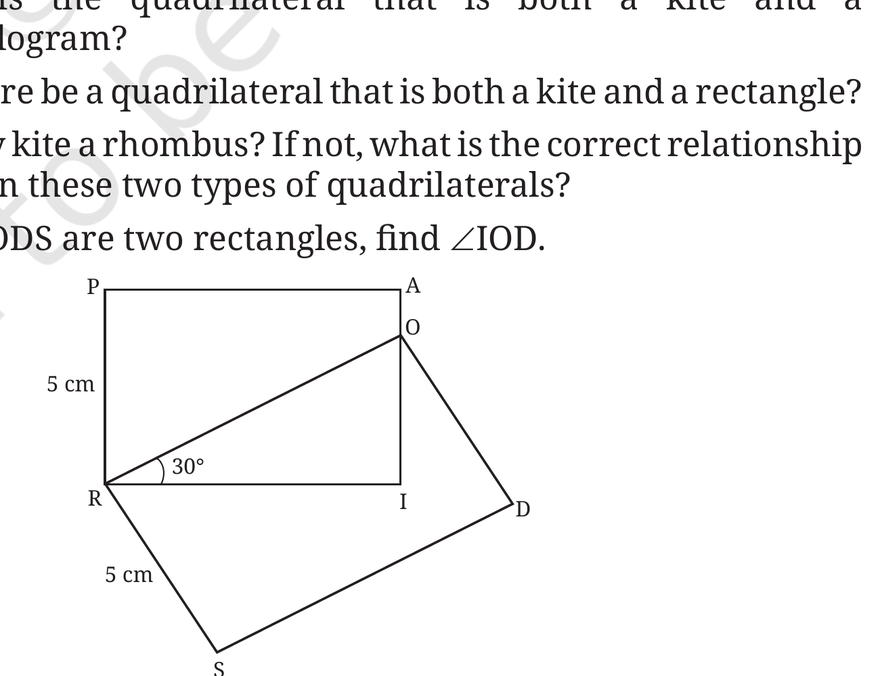
If PAIR and RODS are two rectangles, find ∠𝐼𝑂𝐷. (In the figure, ∠𝑂𝑅𝐼=30∘ and 𝑃𝑅=𝑅𝑆=5 cm.)
If PAIR and RODS are two rectangles, find ∠𝐼𝑂𝐷
Solution
In rectangle PAIR, ∠𝐴𝐼𝑅=90∘. Point 𝑂 lies on 𝐴𝐼, so in Δ𝑂𝑅𝐼 we have ∠𝑂𝐼𝑅=90∘. We are given ∠𝑂𝑅𝐼=30∘.
Therefore, in Δ𝑂𝑅𝐼:
∠𝑅𝑂𝐼=180∘−90∘−30∘=60∘.
RODS is a rectangle, so ∠𝑅𝑂𝐷=90∘. From the figure, rays OR, OI, and OD meet at O with OI lying between OR and OD. Hence
∠𝐼𝑂𝐷=∠𝑅𝑂𝐷−∠𝑅𝑂𝐼=90∘−60∘=30∘.
So ∠𝐼𝑂𝐷=30∘.
Question 6
Construct a square with diagonal 6 cm without using a protractor.
Solution
Draw a line segment measuring 6 cm. Use a compass to construct a perpendicular bisector by drawing intersecting arcs from both endpoints. From the center intersection point, mark 3 cm upwards and 3 cm downwards along the bisector line. Connect the four outer points to form the square.
Question 7
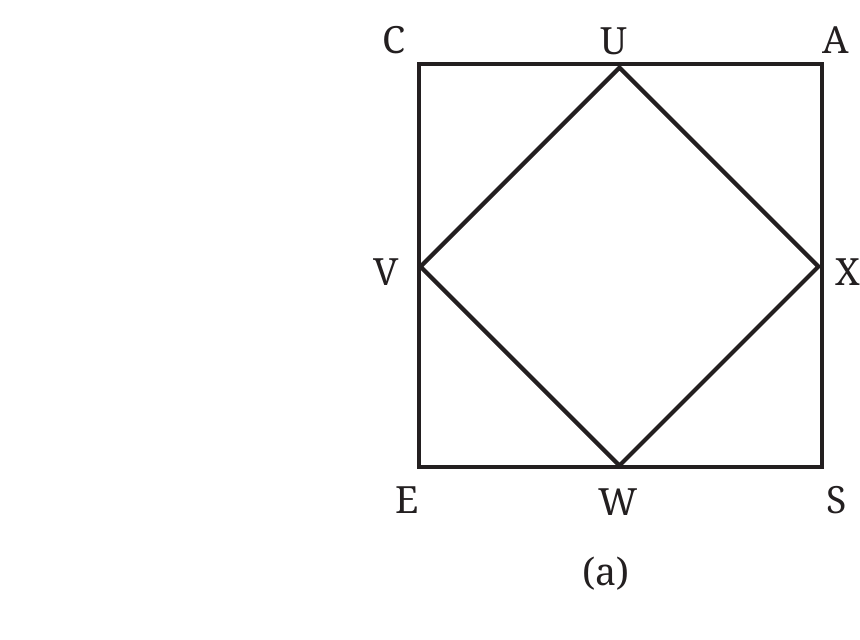
CASE is a square. The points 𝑈, 𝑉, 𝑊 and 𝑋 are the midpoints of the sides of the square. What type of quadrilateral is 𝑈𝑉𝑊𝑋? Find this by geometric reasoning as well as by construction and measurement. Find other ways of constructing a square within a square such that the vertices of the inner square lie on the sides of the outer square, as shown in Figure (b).
CASE is a square; U, V, W, X are midpoints — what type is UVWX?
Solution
UVWX is a square. By geometric reasoning, the four corner triangles cut out from the larger square are congruent right-angled isosceles triangles. Their hypotenuses (which make up the sides of UVWX) are all equal. The acute angles of these corner triangles are 45∘. Because angles on a straight line sum to 180∘, the interior corners of UVWX are 180∘−45∘−45∘=90∘.
If the side of CASE is 𝑥, then each half-side is 𝑥2. By Pythagoras,
𝑈𝑉=√(𝑥2)2+(𝑥2)2=𝑥√2.
All four sides of UVWX equal this length and all four angles are 90∘, so UVWX is a square.
Figure (b): Other inner squares can be formed by choosing four points, one on each side of CASE, at equal distances from a given corner (or by rotating a square about the centre). As long as the four points are placed symmetrically, the quadrilateral they form is again a square.
Question 8
If a quadrilateral has four equal sides and one angle of 90°, will it be a square?
Solution
Yes. Having four equal sides makes it a rhombus, which is a type of parallelogram. In a parallelogram, adjacent angles sum to 180∘ and opposite angles are equal. If one angle is 90∘, all other angles must mathematically be 90∘ as well. A rhombus with all 90∘ angles is a square.
Question 9
What type of a quadrilateral is one in which the opposite sides are equal?
Solution
It is a parallelogram. By drawing a diagonal, you form two triangles that are congruent by the SSS rule (the diagonal is a shared side, and both pairs of opposite sides are equal). This congruence proves that the alternate interior angles are equal, which in turn proves that the opposite sides are parallel.
Question 10
Will the sum of the angles in a quadrilateral such as the following one [a concave shape/dart] also be 360°?
A concave quadrilateral (dart) ABCD
Solution
Yes. By drawing a diagonal line that connects the inward-pointing vertex to the opposite outer vertex, the shape is split into two distinct triangles. Since the interior angles of any triangle sum to 180∘, the total sum for the two triangles forming the quadrilateral is exactly 180∘+180∘=360∘.
Question 11
State whether the following statements are true or false. Justify your answers.
A quadrilateral whose diagonals are equal and bisect each other must be a square.
A quadrilateral having three right angles must be a rectangle.
A quadrilateral whose diagonals bisect each other must be a parallelogram.
A quadrilateral whose diagonals are perpendicular to each other must be a rhombus.
A quadrilateral in which the opposite angles are equal must be a parallelogram.
A quadrilateral in which all the angles are equal is a rectangle.
Isosceles trapeziums are parallelograms.
Solution
(i) False. The diagonals must also intersect at exactly 90∘; without that, it is merely a rectangle.
(ii) True. Because the sum of angles is 360∘, the fourth angle must be 360∘−(3×90∘)=90∘.
(iii) True. This is one of the definitive properties of a parallelogram.
(iv) False. A kite can have perpendicular diagonals without them bisecting each other. To be a rhombus, they must be perpendicular and bisect each other.
(v) True. This ensures that adjacent angles will sum to 180∘, which proves the opposite sides are parallel.
(vi) True. If all four angles are equal, they must each be 360∘/4=90∘, defining a rectangle.
(vii) False. A trapezium strictly has only one pair of parallel sides, whereas a parallelogram must have two pairs of parallel sides.