5.1 Is This a Multiple Of?
Math Talk — Signs Between Consecutive Numbers
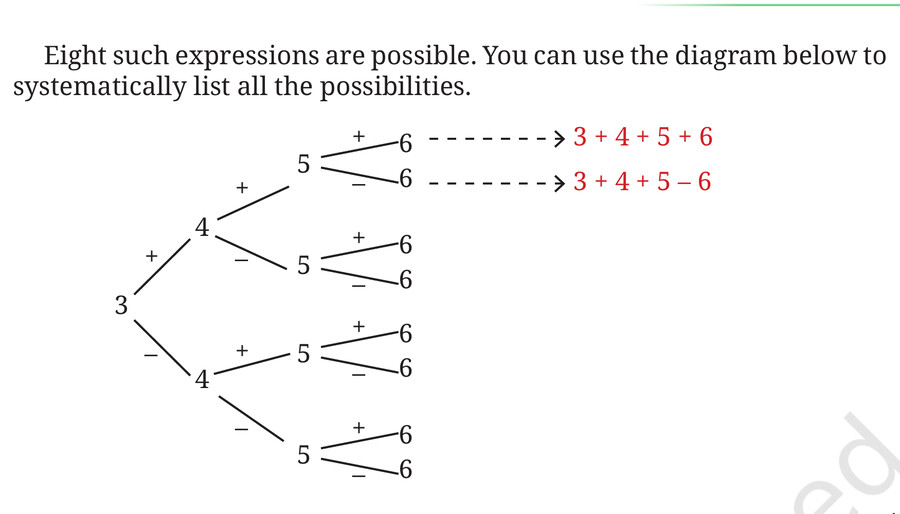
There are 8 different possibilities. You can write them by changing the plus and minus signs systematically:
3 + 4 + 5 + 6 3 + 4 + 5 − 6 3 + 4 − 5 + 6 3 + 4 − 5 − 6 3 − 4 + 5 + 6 3 − 4 + 5 − 6 3 − 4 − 5 + 6 3 − 4 − 5 − 6
Let's calculate the results:
3 + 4 + 5 + 6 = 1 8 3 + 4 + 5 − 6 = 6 3 + 4 − 5 + 6 = 8 3 + 4 − 5 − 6 = − 4 3 − 4 + 5 + 6 = 1 0 3 − 4 + 5 − 6 = − 2 3 − 4 − 5 + 6 = 0 3 − 4 − 5 − 6 = − 1 2
Something very interesting happens here! Every single answer is an even number.
Let's try the numbers 5, 6, 7, and 8:
5 + 6 + 7 + 8 = 2 6 5 + 6 − 7 + 8 = 1 2 5 − 6 − 7 − 8 = − 1 6
We observe the exact same thing again. All the final answers are even numbers.
Let's try 1, 2, 3, and 4.
1 + 2 + 3 + 4 = 1 0 1 + 2 − 3 + 4 = 4 1 − 2 − 3 − 4 = − 8
My findings are consistent. No matter how we arrange the plus and minus signs, the final answer is always an even number.
Yes, this pattern always occurs. When you take 4 consecutive numbers, you will always have exactly two odd numbers and exactly two even numbers. No matter whether you add or subtract them, combining two odd numbers always makes an even number. Combining that with the remaining even numbers will guarantee that the final result is always even.
In general form, if the four consecutive numbers are
Parity is just a math word for whether a number is odd or even. The basic rules of parity are:
- odd + odd = even
- even + even = even
- odd + even = odd
Because four consecutive numbers always contain two even and two odd numbers, combining them with plus or minus will always result in an even number. The two odds cancel each other out to make an even number, and all evens combined together stay even.
Let's change
Our starting expression is:
Our new expression is:
The difference between them is:
When we simplify this, the difference is
We can conclude that changing a sign always changes the total value by an even amount (like
No, it is not limited to 4 numbers. Any set of numbers will keep the same parity if you just switch between adding and subtracting them. This is because switching a sign from plus to minus changes the sum by double that number, which is always an even change.
Breaking Even
An expression will always be even if it has 2 as a factor.
2 𝑎 + 2 𝑏 2 ( 𝑎 + 𝑏 ) 3 𝑔 + 5 ℎ 𝑔 = 1 ℎ = 2 4 𝑚 + 2 𝑛 2 ( 2 𝑚 + 𝑛 ) 2 𝑢 − 4 𝑣 2 ( 𝑢 − 2 𝑣 ) 1 3 𝑘 − 5 𝑘 8 𝑘 2 ( 4 𝑘 ) 6 𝑚 − 3 𝑛 𝑚 = 1 𝑛 = 1 𝑥 2 + 2 𝑥 = 3 9 + 2 = 1 1 𝑏 2 + 1 𝑏 = 2 4 + 1 = 5 4 𝑘 × 3 𝑗 1 2 𝑘 𝑗 2 ( 6 𝑘 𝑗 )
This has been addressed comprehensively in the previous "Breaking Even" answer above by listing out which are always even and providing examples for those that are not.
Here are three examples:
Pairs to Make Fours
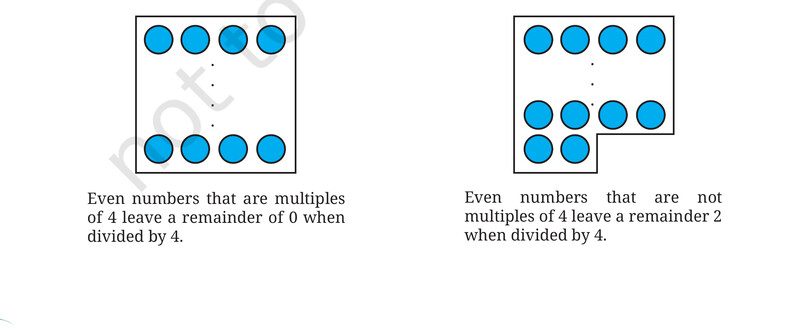
Let's look at some pairs:
2 + 4 = 6 4 + 8 = 1 2 6 + 1 0 = 1 6 2 + 6 = 8
Here is the general rule:
- Adding two numbers that are already multiples of 4 will give you a multiple of 4.
- Adding two even numbers that are not multiples of 4 will also give you a multiple of 4.
- However, adding one multiple of 4 and one non-multiple of 4 will not give you a multiple of 4.
Two even numbers will add up to a multiple of 4 in two situations: when both of the numbers are multiples of 4, or when neither of the numbers are multiples of 4.
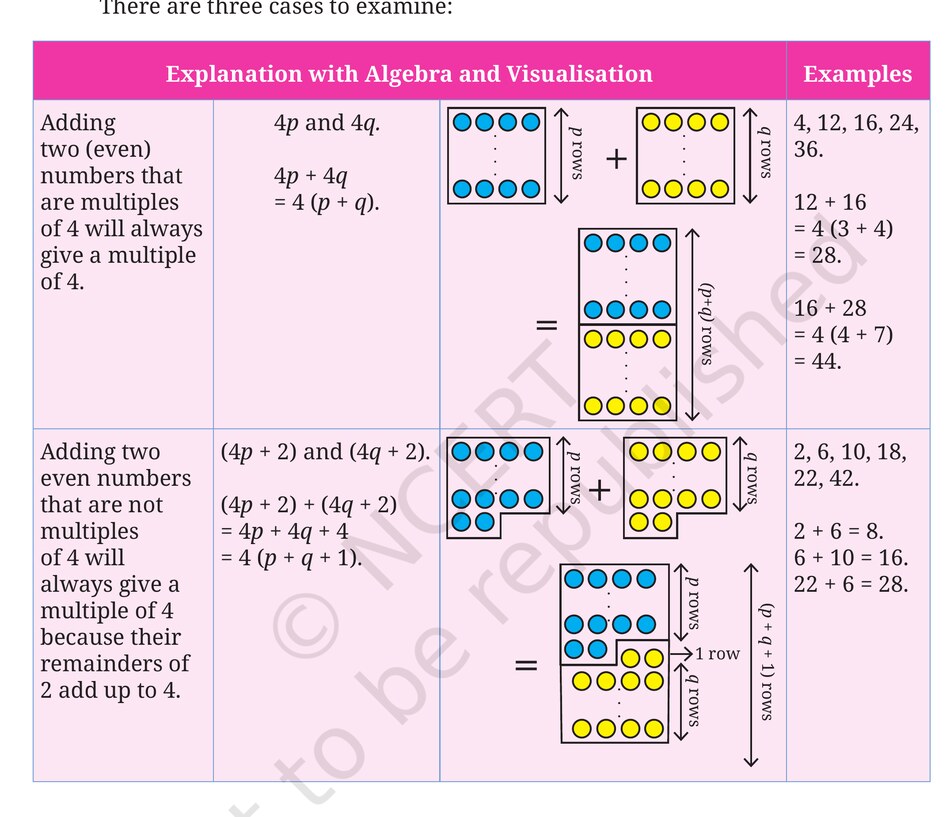
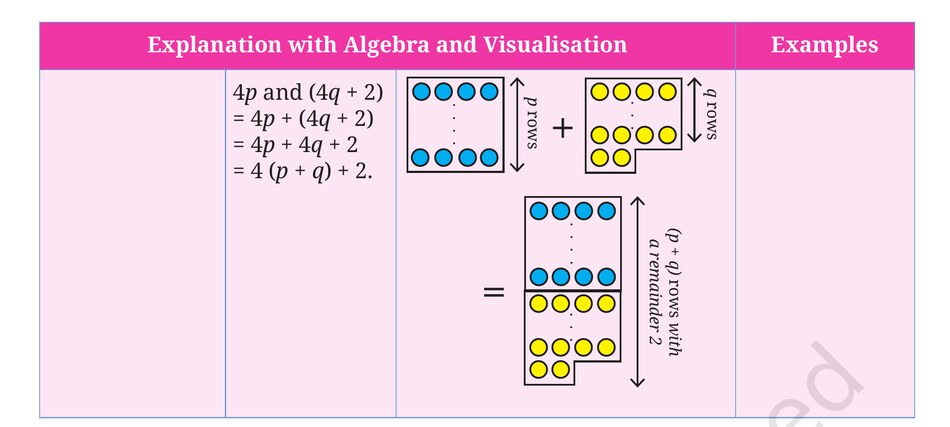
- Explanation: When we add a multiple of 4 (written as
4 𝑝 4 𝑞 + 2 4 𝑝 + ( 4 𝑞 + 2 ) = 4 ( 𝑝 + 𝑞 ) + 2 - Examples:
4 + 6 = 1 0 1 2 + 1 0 = 2 2
Always, Sometimes, or Never
Always True. If two numbers are multiples of 8 (like
Always True. If 8 divides two numbers separately, it divides their difference as well. For example,
Sometimes True. For example, 72 is divisible by 8. 72 can be split into 48 + 24, and both are divisible by 8. But 72 can also be split into 50 + 22, and neither of those is divisible by 8.
Always True. If a number already has 7 as a factor (like 14), then any multiple of it (like
Always True. If a number is a multiple of 12, it naturally includes all the smaller building blocks (factors) of 12, which are 1, 2, 3, 4, and 6.
Sometimes True. For example, 42 is divisible by 7, and it is also divisible by 14 (which is a multiple of 7). However, 42 is not divisible by 28 (which is also a multiple of 7).
Always True. Because 9 and 4 share no common factors, a number divisible by both of them must be divisible by their product (36).
Sometimes True. A number like 12 is divisible by both 6 and 4, but it is not divisible by 24. A number like 48, however, is divisible by 6, 4, and 24.
Never True. A multiple of 6 is always an even number. If you add an odd number to an even number, the answer is always odd, so it can never be a multiple of 6.
What Remains?
One such number is 8. More numbers in this pattern are 13, 18, 23, and 28.
The correct expressions are (iv)
Note:
Yes. Another expression that works is
Figure It Out (Page 122)
The numbers are 7, 8, 9, and 10. You can check this by adding them:
Consecutive numbers come one after the other. If
- The sum of two even numbers is a multiple of 3.
- If a number is not divisible by 18, then it is also not divisible by 9.
- If two numbers are not divisible by 6, then their sum is not divisible by 6.
- The sum of a multiple of 6 and a multiple of 9 is a multiple of 3.
- The sum of a multiple of 6 and a multiple of 3 is a multiple of 9.
- (i) Sometimes true: For example,
2 + 4 = 6 2 + 6 = 8 - (ii) Sometimes true: For example, 27 is not divisible by 18, but it is divisible by 9. Meanwhile, 30 is not divisible by 18 and also not divisible by 9.
- (iii) Sometimes true: For example, 4 and 8 are not divisible by 6. But their sum, 12, is divisible by 6. However, 3 and 4 are not divisible by 6, and their sum, 7, is also not divisible by 6.
- (iv) Always true: Any multiple of 6 can be written as
6 𝑥 9 𝑦 6 𝑥 + 9 𝑦 3 ( 2 𝑥 + 3 𝑦 ) - (v) Sometimes true: For example, a multiple of 6 is 18, and a multiple of 3 is 9. Their sum is
1 8 + 9 = 2 7 1 2 + 9 = 2 1
We need numbers that are exactly 2 more than common multiples of 3 and 4. The Lowest Common Multiple of 3 and 4 is 12. So, the first number is
When I group them in 3's, one stays with me.
Try pairing them up — it simply won't do,
A stubborn odd pebble remains in my view.
Group them by 5, yet one's still around,
But grouping by seven, perfection is found.
More than one hundred would be far too bold,
Can you tell me the number of pebbles I hold?"
The poem tells us that when we divide the number by 3, 2, or 5, the remainder is always 1. This means the number is 1 more than a common multiple of 3, 2, and 5. The Lowest Common Multiple of 3, 2, and 5 is 30. Therefore, the possible numbers are 31, 61, and 91 (since it must be less than 100). The poem also says that grouping by 7 is perfect, meaning the number must be divisible by 7. Out of our options, only 91 is divisible by 7. So, there are 91 pebbles.
Yes, Tathagat's claim is true. We can write these numbers algebraically as
Algebraically:
4 7 7 9 + 6 6 1 4 7 7 9 − 6 6 1
- (i) When adding, we can just add the remainders:
5 + 3 = 8 ( 7 𝑝 + 5 ) + ( 7 𝑞 + 3 ) = 7 𝑝 + 7 𝑞 + 8 = 7 ( 𝑝 + 𝑞 + 1 ) + 1 - (ii) When subtracting, we can subtract the remainders:
5 − 3 = 2 ( 7 𝑝 + 5 ) − ( 7 𝑞 + 3 ) = 7 𝑝 − 7 𝑞 + 2 = 7 ( 𝑝 − 𝑞 ) + 2
For the visual method, students can draw rows of 7 dots, showing 5 extra dots for the first number and 3 extra dots for the second number, then combining or subtracting those extra dots (see textbook page 120).
Notice that in each case, the remainder is exactly 1 less than the divisor (2 is 1 less than 3; 3 is 1 less than 4; 4 is 1 less than 5). This means the number we are looking for is exactly 1 less than a common multiple of 3, 4, and 5. The smallest common multiple (LCM) of 3, 4, and 5 is 60. So, the smallest number is
5.2 Checking Divisibility Quickly
Let's look at how place values work. A number can be written based on its place values (thousands, hundreds, tens, ones).
- For 2 and 5: All place values from tens upwards (10, 100, 1000) are multiples of 10. Since 10 is divisible by both 2 and 5, all those parts of the number are perfectly divisible by 2 and 5. This is why we only need to look at the very last digit (the ones place) to see if the whole number is divisible by 2 or 5.
- For 4: All place values from hundreds upwards (100, 1000, 10000) are multiples of 100. Since 100 is divisible by 4, we don't need to worry about them. We only need to look at the last two digits (the tens and ones places).
- For 8: All place values from thousands upwards (1000, 10000) are perfectly divisible by 8. We only need to check the last three digits (hundreds, tens, and ones places).
A Shortcut for Divisibility by 9
Yes, all of them are divisible by 9.
Yes. When you write out the number, each digit represents a multiple of 9 multiplied by a place value (like
No, 10 is not divisible by 9. The remainder is 1.
The remainder is exactly the same as the number of hundreds. For example, 100 leaves a remainder of 1. 200 leaves a remainder of 2. 300 leaves a remainder of 3.
We can break it down: 427 has 4 hundreds, which gives a remainder of 4. It has 2 tens, which gives a remainder of 2. And it has 7 units remaining. Adding these up gives us
Yes, it works for any size number. Place values are always 1 more than a number that is a solid string of 9s. For example, 100 is
- If a number is divisible by 9, then the sum of its digits is divisible by 9.
- If the sum of the digits of a number is divisible by 9, then the number is divisible by 9.
- If a number is not divisible by 9, then the sum of its digits is not divisible by 9.
- If the sum of the digits of a number is not divisible by 9, then the number is not divisible by 9.
All of these statements are correct. The shortcut rule works perfectly in both directions: a number and the sum of its digits will always have the exact same remainder when divided by 9.
Figure It Out (Page 126)
- 123
- 405
- 8888
- 93547
- 358095
We check this by adding the digits together.
- 123:
1 + 2 + 3 = 6 - 405:
4 + 0 + 5 = 9 - 8888:
8 + 8 + 8 + 8 = 3 2 - 93547:
9 + 3 + 5 + 4 + 7 = 2 8 - 358095:
3 + 5 + 8 + 0 + 9 + 5 = 3 0
Only number (ii) is divisible by 9.
Even digits are 0, 2, 4, 6, and 8. To make a number divisible by 9, the digits must add up to a multiple of 9. Since we are adding even numbers, the total sum will be even, so the sum can't be 9 or 27. The smallest multiple of 9 we can make is 18. The smallest combination of even numbers that adds to 18 is 2, 8, and 8. Arranging these from smallest to largest gives us 288.
The answer is 6003. The sum of the digits (
There are 11 multiples of 9 between 4300 and 4400.
The first is 4302 and the last is 4392:
A Shortcut for Divisibility by 3
Let's look at the powers of 10. 10 divided by 3 leaves a remainder of 1. 100 divided by 3 leaves a remainder of 1. 1000 divided by 3 leaves a remainder of 1. Just like the shortcut for 9, every place value (10, 100, 1000) is exactly 1 more than a multiple of 3 (like 9, 99, 999). Because of this, every digit in a number represents its own remainder when divided by 3. When you add all the digits up, you are adding all the remainders up. If that total sum can be divided by 3, the entire number can be divided by 3.
A Shortcut for Divisibility by 11
Yes. Let's look at the place values.
- The 4 is in the hundreds place, which is 1 more than a multiple of 11.
- The 6 is in the tens place, which is 1 less than a multiple of 11.
- The 2 is in the ones place, which is 1 more than a multiple of 11.
First, we add the "more" parts:
To check if a number is divisible by 11, add the alternating digits. First, add the first, third, fifth, etc., digits together. Then, add the second, fourth, sixth, etc., digits together. Finally, subtract one sum from the other. If the difference is 0 or a multiple of 11 (like 11, 22, 33), the original number is divisible by 11.
It says that the remainder is 0. The number is perfectly divisible by 11.
We will use the rule from the book: Place alternating '+' and '−' signs before every digit, starting from the unit's (rightmost) digit with a '+' sign.
- (i) 158:
+ 8 − 5 + 1 = 4 - (ii) 841:
+ 1 − 4 + 8 = 5 - (iii) 481:
+ 1 − 8 + 4 = − 3 1 1 − 3 = 8 - (iv) 5529:
+ 9 − 2 + 5 − 5 = 7 - (v) 90904:
+ 4 − 0 + 9 − 0 + 9 = 2 2 - (vi) 857076:
+ 6 − 7 + 0 − 7 + 5 − 8 = − 1 1 − 1 1
It is the exact same method, just written in a faster way. Placing alternating '+' and '−' signs starting from the units digit is a quick trick for separating the place values into the ones that are "1 more" than a multiple of 11 and the ones that are "1 less," and then immediately finding the difference.
The quick way to do this is to use all the divisibility shortcuts (for 2, 3, 4, 5, 8, 9, 10, and 11) that we have learned, rather than actually dividing the numbers the long way.
| Number | 2 | 3 | 4 | 5 | 6 | 8 | 9 | 10 | 11 |
|---|---|---|---|---|---|---|---|---|---|
| 128 | Yes | No | Yes | No | No | Yes | No | No | No |
| 990 | Yes | Yes | No | Yes | Yes | No | Yes | Yes | Yes |
| 1586 | Yes | No | No | No | No | No | No | No | No |
| 275 | No | No | No | Yes | No | No | No | No | Yes |
| 6686 | Yes | No | No | No | No | No | No | No | No |
| 639210 | Yes | Yes | No | Yes | Yes | No | No | Yes | Yes |
| 429714 | Yes | Yes | No | No | Yes | No | Yes | No | No |
| 2856 | Yes | Yes | Yes | No | Yes | Yes | No | No | No |
| 3060 | Yes | Yes | Yes | Yes | Yes | No | Yes | Yes | No |
| 406839 | No | Yes | No | No | No | No | No | No | No |
More on Divisibility Shortcuts
Because 6 is made by multiplying 2 and 3, a number is divisible by 6 if it is divisible by both 2 and 3. So, we just check two things: does it end in an even digit (the rule for 2), and do its digits add up to a multiple of 3 (the rule for 3)?
Yes, it works. Let's verify by checking the rules and then dividing:
- 38: Divisible by 2, but not 3 (
3 + 8 = 1 1 3 8 ÷ 6 - 225: Not divisible by 2, but divisible by 3 (
2 + 2 + 5 = 9 2 2 5 ÷ 6 - 186: Divisible by 2, and divisible by 3 (
1 + 8 + 6 = 1 5 1 8 6 ÷ 6 = 3 1 - 64: Divisible by 2, but not 3 (
6 + 4 = 1 0 6 4 ÷ 6
No, checking divisibility by 4 and 6 will not work to find if a number is divisible by 24. For example, the number 12 is divisible by both 4 and 6, but it is not divisible by 24. This happens because 4 and 6 are not "co-prime" — they share a common factor (2).
Prime factorization means breaking a number down into its smallest prime building blocks. The building blocks of 24 are
If we check for 3 and 8 (
But 4 (
Digital Roots
The digital root is the same as the remainder you get when you divide that number by 9. The only exception is when a number is perfectly divisible by 9, its digital root will be 9 (instead of a remainder of 0).
You can find these by finding the first one and then adding 9 to find the rest.
- (i) Digital root 5: 608, 617, 626, 635, 644, 653, 662, 671, 680, 689, 698. (For example,
6 + 0 + 8 = 1 4 1 + 4 = 5 - (ii) Digital root 7: 601, 610, 619, 628, 637, 646, 655, 664, 673, 682, 691.
- (iii) Digital root 3: 606, 615, 624, 633, 642, 651, 660, 669, 678, 687, 696.
Let's take the numbers 10 through 21. Their digital roots are: 1, 2, 3, 4, 5, 6, 7, 8, 9, 1, 2, 3. We can observe that the digital roots always repeat in a cycle from 1 up to 9.
- (i) Multiples of 3: (3, 6, 9, 12, 15, 18, 21…) The digital roots are 3, 6, 9, 3, 6, 9, 3… They repeat in a pattern of 3, 6, 9.
- (ii) Multiples of 4: (4, 8, 12, 16, 20…) The digital roots are 4, 8, 3, 7, 2, 6, 1, 5, 9… This sequence eventually contains all the numbers from 1 to 9.
- (iii) Multiples of 6: (6, 12, 18, 24, 30, 36…) The digital roots are 6, 3, 9, 6, 3, 9… They repeat in a pattern of 6, 3, 9.
Multiples of 6 are 6, 12, 18, and 24. Numbers that are 1 more than these are 7, 13, 19, and 25. Let's find their digital roots:
7 → 7 1 3 → 4 1 9 → 1 1 + 9 = 1 0 1 + 0 = 1 2 5 → 7
I notice that the digital roots follow a repeating pattern of 7, 4, 1. This happens because the original multiples of 6 had digital roots of 6, 3, and 9. When we add 1 to the numbers, their digital roots also go up by 1 (becoming 7, 4, and 10 which turns into 1).
No shared ground with root #1 — how odd!
My digits count, their sum, my root —
All point to one bold number's pursuit —
The largest odd single-digit I proudly claim.
What's my number? What's my name?
The poem gives us clues. The tiniest odd digit is 1. The largest odd single-digit is 9, which means the digital root is 9. Because "my digits count, their sum, my root" all point to 9, the number must be made of exactly nine 1s.
- The number is: 111,111,111.
- The name is: Eleven crore eleven lakh eleven thousand one hundred eleven.
Figure It Out (Page 131)
The digital root will be 6. When you add 10 to a number, you are increasing the sum of its digits by 1 (since the digits of 10 add up to 1). So,
Let's start with the number 10.
- If we keep adding 11, the sequence is: 10, 21, 32, 43, 54, 65, 76, 87, 98, 109, 120…
- The digital roots of these numbers are: 1, 3, 5, 7, 9, 2, 4, 6, 8, 1, 3…
Observation: Because the digital root of 11 is 2 (
We can simplify this expression to pull out multiples of 9:
The part
- the parity of a number and its digital root.
- the digital root of a number and the remainder obtained when the number is divided by 3 or 9.
- (i) There is no consistent pattern between whether a number is odd/even (parity) and its digital root. Even numbers can have odd digital roots, and odd numbers can have even digital roots.
- (ii) For dividing by 3: If the digital root is 3, 6, or 9, the number is perfectly divisible by 3 (remainder 0). If the digital root is 1, 4, or 7, the remainder is 1. If the digital root is 2, 5, or 8, the remainder is 2.
- (ii) For dividing by 9: The digital root is always the exact same as the remainder. The only exception is if the digital root is 9; in that case, the remainder is 0 (it divides perfectly).
5.3 Digits in Disguise
𝐴 1 + 1 𝐵 = 𝐵 0 𝐴 𝐵 + 3 7 = 6 𝐴 𝑂 𝑁 + 𝑂 𝑁 + 𝑂 𝑁 = 𝑃 𝑂 𝑄 𝑅 + 𝑄 𝑅 + 𝑄 𝑅 = 𝑃 𝑅 𝑅
- (i)
𝐴 = 7 𝐵 = 9 1 + 𝐵 𝐵 𝐴 + 1 + 1 = 𝐵 𝐵 = 9 𝐴 + 2 = 9 𝐴 = 7 7 1 + 1 9 = 9 0 - (ii)
𝐴 = 2 𝐵 = 5 𝐴 = 2 𝐴 𝐵 + 3 7 = 6 2 6 2 − 3 7 = 2 5 𝐴 = 2 𝐵 = 5 2 5 + 3 7 = 6 2 - (iii)
𝑂 = 3 𝑁 = 1 𝑃 = 9 3 1 + 3 1 + 3 1 = 9 3 - (iv)
𝑄 = 8 𝑅 = 5 𝑃 = 2 8 5 + 8 5 + 8 5 = 2 5 5
In the problem
Looking at the options, the ones that follow this rule are:
2 4 × 4 = 9 6 𝐺 = 2 𝐻 = 4 𝐾 = 6 1 6 × 6 = 9 6 𝐺 = 1 𝐻 = 6 𝐾 = 6
Both of these are valid solutions.
𝑈 𝑇 × 3 = 𝑃 𝑈 𝑇 𝐴 𝐵 × 5 = 𝐵 𝐶 𝐿 2 𝑁 × 2 = 2 𝑁 𝑃 𝑋 𝑌 × 4 = 𝑍 𝑋 𝑃 𝑃 × 𝑄 𝑄 = 𝑃 𝑅 𝑃 𝐽 𝐾 × 6 = 𝐾 𝐾 𝐾
- (i)
𝑈 = 5 𝑇 = 0 𝑃 = 1 5 0 × 3 = 1 5 0 - (ii)
𝐴 = 1 𝐵 = 9 𝐶 = 5 1 9 × 5 = 9 5 - (iii)
𝐿 = 1 𝑁 = 5 𝑃 = 0 1 2 5 × 2 = 2 5 0 - (iv)
𝑋 = 2 𝑌 = 3 𝑍 = 9 2 3 × 4 = 9 2 - (v)
𝑃 = 2 𝑄 = 1 𝑅 = 4 2 2 × 1 1 = 2 4 2 - (vi)
𝐽 = 7 𝐾 = 4 7 4 × 6 = 4 4 4
Figure It Out (Pages 132–134)
To be a multiple of 9, the digits must add up to a multiple of 9.
Snehal's claim is false. Let's write the first number as
Let's call the two multiples of three
- If we add an odd multiple of 3 (like 3) and an even multiple of 3 (like 6), the sum is 9 (not a multiple of 6).
- If we add two odd multiples of 3 (like
3 + 9 = 1 2 6 + 1 2 = 1 8
- Examine if her conjecture is true for any multiple of 9.
- Are any other digit shuffles possible such that the number formed is still a multiple of 9?
- (i) Yes, her conjecture is always true. Divisibility by 9 depends only on the sum of the digits. Reversing the digits does not change their sum.
- (ii) Yes, any shuffle of the digits will work for the exact same reason. No matter what order you put the digits in, they will always add up to the same multiple of 9.
To be a multiple of 18, the number must be divisible by both 2 and 9.
Because it is divisible by 2, it must end in an even number. So,
Because it is divisible by 9, the sum of the digits (
Let's test the possible values for
- If
𝑏 = 0 1 7 + 𝑎 + 0 = 1 7 + 𝑎 𝑎 = 1 ( 1 , 0 ) - If
𝑏 = 2 1 7 + 𝑎 + 2 = 1 9 + 𝑎 𝑎 = 8 ( 8 , 2 ) - If
𝑏 = 4 1 7 + 𝑎 + 4 = 2 1 + 𝑎 𝑎 = 6 ( 6 , 4 ) - If
𝑏 = 6 1 7 + 𝑎 + 6 = 2 3 + 𝑎 𝑎 = 4 ( 4 , 6 ) - If
𝑏 = 8 1 7 + 𝑎 + 8 = 2 5 + 𝑎 𝑎 = 2 ( 2 , 8 )
All possible pairs
To be divisible by 44, it must be divisible by 4 and 11.
- Rule for 4: The last two digits (
𝑞 8 𝑞 - Rule for 11: The alternating sum must be 0 or a multiple of 11. From the right:
+ 8 − 𝑞 + 7 − 𝑝 + 3 = 1 8 − ( 𝑝 + 𝑞 ) 1 8 − ( 𝑝 + 𝑞 )
Let's test our
- If difference is 11:
1 8 − ( 𝑝 + 𝑞 ) = 1 1 𝑝 + 𝑞 = 7 - If
𝑞 = 0 𝑝 = 7 ( 7 , 0 ) - If
𝑞 = 2 𝑝 = 5 ( 5 , 2 ) - If
𝑞 = 4 𝑝 = 3 ( 3 , 4 ) - If
𝑞 = 6 𝑝 = 1 ( 1 , 6 ) - If
𝑞 = 8 𝑝
- If
- If difference is 0:
1 8 − ( 𝑝 + 𝑞 ) = 0 𝑝 + 𝑞 = 1 8 𝑝 𝑞 𝑞
The possible pairs are
One set of these numbers is 2, 3, and 4. (2 is a multiple of 2; 3 is a multiple of 3; 4 is a multiple of 4). Yes, there are many more such numbers. Because the Lowest Common Multiple of 2, 3, and 4 is 12, this pattern will repeat every 12 numbers. The next set is 14, 15, and 16.
A number is a multiple of 36 if it is divisible by both 4 and 9. Let's start near 45,000 and find numbers where the last two digits are divisible by 4, and the total sum of digits is divisible by 9.
Five such numbers are: 45036, 45072, 45108, 45144, and 45180.
Even numbers are always separated by 2. If the middle number is
In sequence:
For a number to be divisible by 15, it must end in 0 or 5. If it ends in 0, reversing would produce a number starting with 0 (not a true 6-digit number). So it should end in 5. If we reverse the digits, that 5 becomes the first digit, and whatever the first digit was becomes the new last digit. For the reversed number to be divisible by 6, it must end in an even number. So, our original number must start with an even number (like 2). The digits must also add up to a multiple of 3 for both 15 and 6.
One answer is 200025. (It ends in 5, digits add up to 9. When reversed, it is 520002, which ends in an even number and digits still add to 9).
Deepak's conjecture is false. If you have a multiple of 11, it can be written as
- The product of a multiple of 6 and a multiple of 3 is a multiple of 9.
- The sum of three consecutive even numbers will be divisible by 6.
- If
𝑎 𝑏 𝑐 𝑑 𝑒 𝑓 𝑏 𝑎 𝑑 𝑐 𝑒 𝑓 8 ( 7 𝑏 − 3 ) − 4 ( 1 1 𝑏 + 1 )
- (i) Always True. A multiple of 6 has a 3 in its prime factorization. A multiple of 3 also has a 3. Multiplying them together means the product has
3 × 3 - (ii) Always True. Three consecutive even numbers can be written as
𝑛 𝑛 + 2 𝑛 + 4 3 𝑛 + 6 3 ( 𝑛 + 2 ) 𝑛 𝑛 + 2 3 × 2 = 6 - (iii) Always True. For a number to be a multiple of 6, it must end in an even digit (so
𝑓 𝑏 𝑎 𝑑 𝑐 𝑒 𝑓 𝑓 - (iv) Never True. Let's simplify the algebra:
5 6 𝑏 − 2 4 − 4 4 𝑏 − 4 = 1 2 𝑏 − 2 8 1 2 𝑏 1 2 𝑏 − 2 8 = 1 2 ( 𝑏 − 2 ) − 4
When you divide any number by 3, you get a remainder of 0, 1, or 2. Let's look at the remainders of the three numbers we choose. Their sum will be divisible by 3 if the sum of their individual remainders is 0, 3, or 6. For example, if the remainders are 1, 1, and 1, the sum of remainders is 3, so the total sum is divisible by 3.
Possible cases for the remainders:
- All three are 0; all three are 1; or all three are 2 (sums 0, 3, 6).
- The remainders are 0, 1, and 2 in any order (sum 3).
- Two consecutive integers: Always a multiple of 2. One of the numbers will always be even, and multiplying anything by an even number gives an even answer.
- Three consecutive integers: Always a multiple of 6. In any three numbers in a row, at least one will be even (multiple of 2) and exactly one will be a multiple of 3.
2 × 3 = 6 - Four consecutive integers: Always a multiple of 24 (
2 × 3 × 4 - Five consecutive integers: Always a multiple of 120 (
2 × 3 × 4 × 5
𝐸 𝐹 × 𝐸 = 𝐺 𝐺 𝐺 𝑊 𝑂 𝑊 × 5 = 𝑀 𝐸 𝑂 𝑊
- (i)
𝐸 = 3 𝐹 = 7 𝐺 = 1 3 7 × 3 = 1 1 1 - (ii)
𝑊 = 5 𝑂 = 7 𝑀 = 2 𝐸 = 8 5 7 5 × 5 = 2 8 7 5
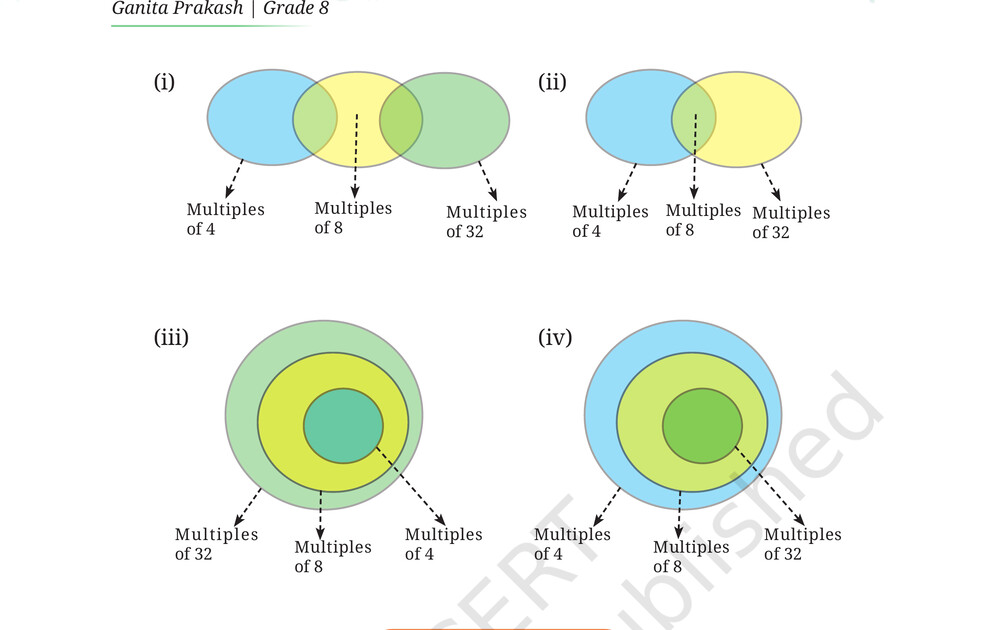
Diagram (iv) is the correct one. Every multiple of 32 is also a multiple of 8, and every multiple of 8 is also a multiple of 4. This means the circles should be nested inside each other, like a bullseye, with 32 in the smallest centre circle, 8 in the middle ring, and 4 on the outside.
Note that (iii) has the nesting inverted (32 outside, 4 inside), which is wrong. (i) and (ii) show overlapping but not nested sets, which does not match the "every multiple of 32 is a multiple of 8 is a multiple of 4" relationship.
It's Puzzle Time! Navakankari
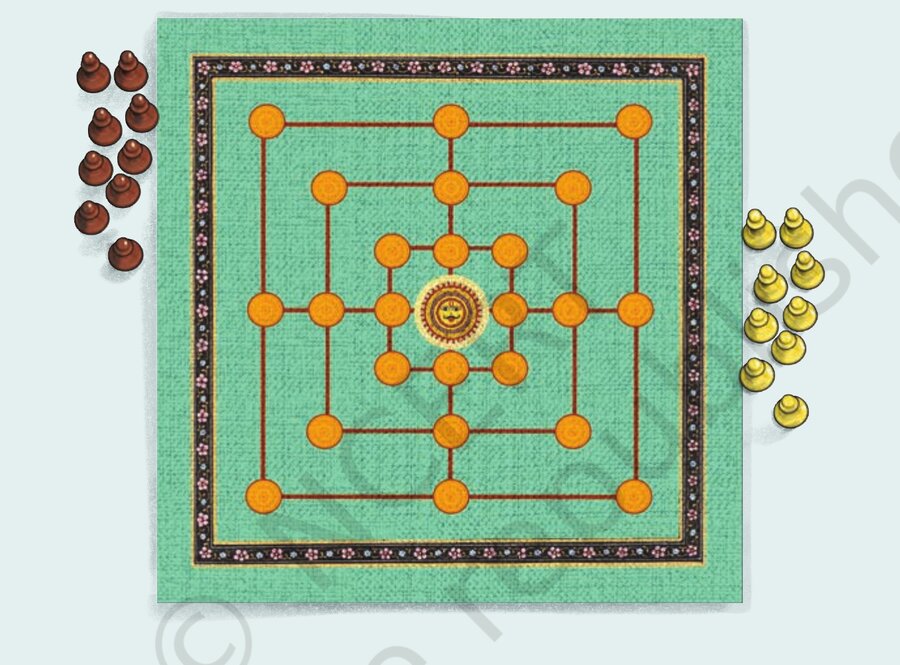
For this activity, you will learn how to play a traditional Indian board game called Navakankari (also known as Nine Men's Morris, Sālu Mane Āṭa, Chār-Pār, or Navkakri).
What you need:
- A Navakankari game board (you can draw the grid shown above on a piece of paper).
- 18 playing pieces in total (9 pieces for you, and 9 pieces of a different colour or shape for your partner).
How to play:
- Phase 1 (Placing): Take turns with your partner placing one piece at a time onto any empty dot (intersection) on the board. You cannot put two pieces on the same dot.
- Phase 2 (Moving): Once all 18 pieces are on the board, take turns sliding one of your pieces along the lines to an empty connected dot.
- The Goal: The aim of the game is to get three of your pieces in a straight line (horizontal or vertical).
- Capturing: Every time you successfully make a line of three, you get to remove one of your opponent's pieces from the board. (Note: You cannot remove a piece that is already part of a line of three).
- Winning: You win the game if your opponent is reduced to only 2 pieces, or if they are completely blocked and cannot make a move.