1.1 INTRODUCTION
This section provides historical background on the evolution of coordinate systems in ancient Bharat (such as grid-planned cities in the Sindhu-Sarasvatī Civilisation, Baudhāyana's geometry, and Āryabhaṭa's celestial sines) and their formalisation by René Descartes in Europe. There are no problem exercises in this introductory section.
1.2 SETTLING IN
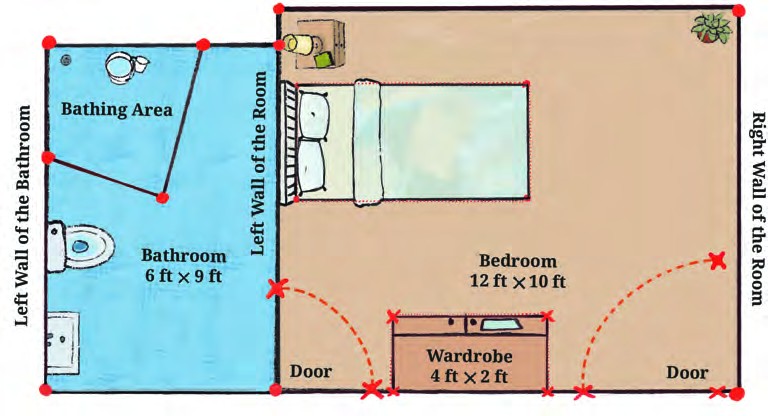
In-Text Question (from text discussing Fig. 1.1)
- Reasoning: A floor plan like Fig. 1.1 is a two-dimensional (2-D) top-down view. It only measures horizontal lengths and widths along the flat floor. Windows are built vertically up on the walls, elevated above the floor level.
- Conclusion: Because windows exist in the third dimension (height above the floor), their positions cannot be shown directly on a flat 2-D floor map.
1.3 THE 2-D CARTESIAN COORDINATE SYSTEM
EXERCISE SET 1.1
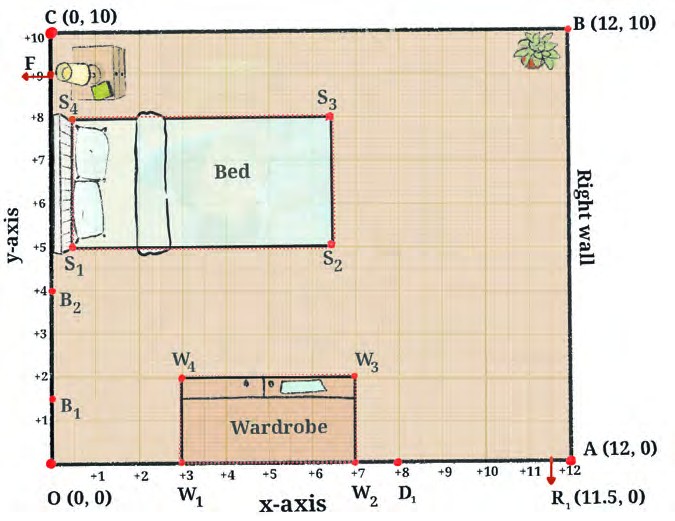
Question 1 (i)
- Distance from the left wall (y-axis): In Fig. 1.3, the door starts at point
𝐷 1 𝑥 = 8 - Distance from the x-axis: Both endpoints of the door,
𝐷 1 𝑅 1 𝑦 = 0
Question 1 (ii)
- Reasoning: Point
𝐷 1 𝑂 ( 0 , 0 ) - Conclusion: The x-coordinate is 8 and the y-coordinate is 0. Its coordinates are
( 8 , 0 )
Question 1 (iii)
- Width of the door: The door spans along the x-axis from
𝐷 1 ( 8 , 0 ) 𝑅 1 ( 1 1 . 5 , 0 )
- Comfortable width: Yes, 3.5 feet (which is 42 inches) is very comfortable and spacious for a residential bedroom door.
- Wheelchair accessibility: Yes, a person in a wheelchair will be able to enter easily. Standard wheelchairs are around 2 to 2.5 feet (24 to 30 inches) wide. A 3.5-foot doorway provides plenty of extra clearance on both sides.
Question 1 (iv)
- Width of bathroom door: Both endpoints lie on the vertical y-axis. We subtract their y-coordinates to find the width:
- Comparison: The room door is 3.5 feet wide, while the bathroom door is only 2.5 feet wide. Therefore, the bathroom door is narrower than the room door.
Think and Reflect (Page 5)
Question 1
- Home doors: In typical homes, standard bedroom doors are usually 2.5 feet to 3 feet (30 to 36 inches) wide. Bathroom doors are often slightly narrower, around 2 feet to 2.5 feet (24 to 30 inches).
- School doors: Classroom and main entrance doors in schools are much wider to allow crowds of students to pass safely, typically ranging between 3 feet and 3.5 feet (36 to 42 inches) wide. (Note: Individual measurements at your home or school may vary slightly).
Question 2
- Reasoning: Modern building accessibility standards require doorways to have a clear opening of at least 32 inches (about 2.7 feet), though 36 inches (3 feet) is ideal for wheelchair users to maneuver comfortably without scraping their hands or wheels.
- Conclusion: If your school doors are around 3 feet wide or more with level thresholds (no high steps), then yes, they are suitable for wheelchair access. Students should use a measuring tape at school to verify their classroom doors!
In-Text Activity / Task (Page 7)
- Marking S and Q: In Fig. 1.4, point
𝑄 ( − 5 , 3 ) 𝑆 ( 3 , − 5 ) - Selecting point P in Quadrant I: In Quadrant I, both coordinates must be positive (
+ , + 𝑥 = 4 𝑦 = 2 𝑃 ( 4 , 2 ) - Selecting point R in Quadrant III: In Quadrant III, both coordinates must be negative (
− , − 𝑥 = − 3 𝑦 = − 4 𝑅 ( − 3 , − 4 )
Think and Reflect (Page 7)
Question 1
- Reasoning: The x-coordinate measures horizontal distance to the left or right of the vertical y-axis. If a point lies directly on the y-axis, it has not moved left or right at all.
- Conclusion: The x-coordinate of any point on the y-axis is always
0 ( 0 , 𝑦 )
Question 2
- Reasoning: Yes! The y-coordinate measures vertical distance above or below the horizontal x-axis. If a point lies directly on the horizontal x-axis, it has not moved up or down at all.
- Conclusion: The y-coordinate of any point on the x-axis is always
0 ( 𝑥 , 0 )
Question 3
- When they coincide: They coincide if and only if
𝑥 = 𝑦 𝑥 = 4 𝑦 = 4 𝑃 𝑄 ( 4 , 4 ) - When they do not coincide: If
𝑥 ≠ 𝑦 𝑥 = 2 𝑦 = 5 𝑃 ( 2 , 5 ) 𝑄 ( 5 , 2 )
Question 4
- Conclusion: Yes, this claim is completely true.
- Reasoning: In Cartesian coordinate geometry,
( 𝑥 , 𝑦 )
EXERCISE SET 1.2 (Using Fig. 1.5)
Question 1 (i)
- Reasoning: In a rectangle, opposite sides must be equal in length and parallel to the coordinate axes.
- The top side connects
( 8 , 9 ) ( 1 1 , 9 ) 1 1 − 8 = 3 - The right side connects
( 1 1 , 9 ) ( 1 1 , 7 ) 9 − 7 = 2 - To form the bottom-left corner, the fourth foot must align vertically with
𝑥 = 8 𝑦 = 7 - Conclusion: The fourth foot of the table will be at the point
( 8 , 7 )
Question 1 (ii)
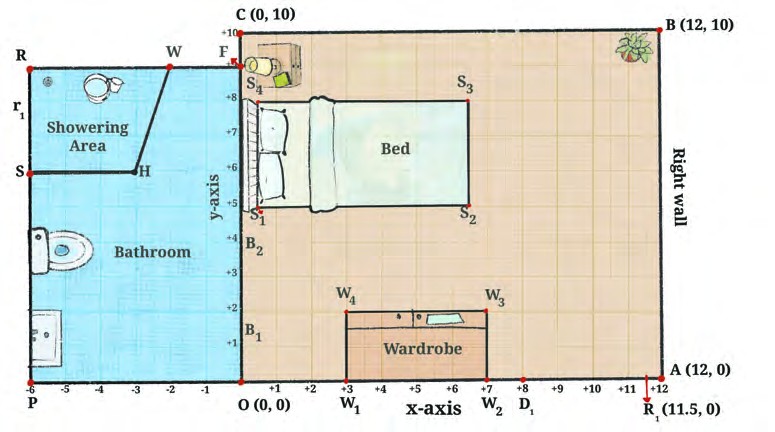
- Reasoning: Let us examine the room layout in Fig. 1.5:
- The bed occupies the space from
𝑥 = 0 𝑥 = 7 𝑦 = 5 𝑦 = 8 - The room door is located at the bottom wall from
𝑥 = 8 𝑥 = 1 1 . 5 𝑦 = 0 - The wardrobe is placed against the bottom wall from
𝑥 = 3 𝑥 = 7 𝑦 = 0 𝑦 = 2 - Conclusion: Yes, this is a very good spot! Placing the table between
𝑥 = 8 1 1 𝑦 = 7 9 𝐵 ( 1 2 , 1 0 )
Question 1 (iii)
- Width (horizontal span): Difference in x-coordinates between
( 8 , 9 ) ( 1 1 , 9 )
- Length / Depth (vertical span): Difference in y-coordinates between
( 1 1 , 9 ) ( 1 1 , 7 )
- Height: No, you cannot make out the height of the table. A Cartesian floor plan is a 2-D map showing only horizontal x and y floor measurements. Height extends vertically out of the page in the third dimension (z-axis), which cannot be read from Fig. 1.5.
Question 2
- Will it hit the wardrobe? No, it will not hit the wardrobe.
- Proof: In Fig. 1.5, the bathroom door is located between
𝐵 1 ( 0 , 1 . 5 ) 𝐵 2 ( 0 , 4 ) 4 − 1 . 5 = 2 . 5 𝐵 1 ( 0 , 1 . 5 ) 𝑥 = 2 . 5 𝑊 4 ( 3 , 2 ) 𝑥 = 3 2 . 5 < 3 0 . 5 - Suggestions if the door is made wider: If the door is widened to 3 feet or more, swinging it open from hinge
𝐵 1 𝑊 4 ( 3 , 2 )
- Move the door hinges to point
𝐵 2 ( 0 , 4 ) - Change the door design so that it opens inwards into the bathroom rather than outwards into the bedroom.
- Shift the wardrobe further to the right along the bottom wall (e.g., starting at
𝑥 = 3 . 5 4
Question 3 (i)
- Let us read the coordinates from Fig. 1.5, keeping in mind that the bathroom lies to the left of the y-axis (negative x-values) and above the x-axis (positive y-values):
- Corner O (Origin, bottom-right of bathroom):
( 0 , 0 ) - Corner F (Top-right of bathroom on y-axis):
( 0 , 1 0 ) - Corner R (Top-left of bathroom): Located at
𝑥 = − 6 𝑦 = 1 0 ( − 6 , 1 0 ) - Corner P (Bottom-left of bathroom on x-axis): Located at
𝑥 = − 6 𝑦 = 0 ( − 6 , 0 )
Question 3 (ii)
- Coordinates of the four corners:
- Corner S: Lies on the left wall along line PR (
𝑥 = − 6 𝑦 = 6 𝑆 = ( − 6 , 6 ) - Corner H: Moving horizontally right from S along
𝑦 = 6 𝑥 = − 2 𝐻 = ( − 2 , 6 ) - Corner W: Lies on the top bathroom wall (
𝑦 = 1 0 𝑥 = − 1 𝑊 = ( − 1 , 1 0 ) - Corner R: The top-left corner of the bathroom,
𝑅 = ( − 6 , 1 0 ) - Shape of SHWR: Notice that side SH (along
𝑦 = 6 𝑦 = 1 0 𝑥 = − 6
Question 3 (iii)
- Washbasin (
3 f t × 2 f t 𝑃 ( − 6 , 0 ) 𝑥 = − 6 𝑥 = − 4 𝑦 = 0 𝑦 = 3
- Toilet (
2 f t × 3 f t 𝑥 = − 6 𝑥 = − 4 𝑦 = 3 𝑦 = 6
(Note: As long as your chosen corners form a
Question 4 (i)
- Reasoning: Let us check the horizontal distance from
𝑃 ( − 6 , 0 ) 𝐴 ( 1 2 , 0 )
This matches the stated 18 ft length exactly! Since Reiaan's bedroom and bathroom lie above the x-axis (
- Coordinates of the dining room corners: Since the width is 15 ft downwards, the y-coordinates will extend from
𝑦 = 0 𝑦 = − 1 5 - Top-left corner (at point P):
( − 6 , 0 ) - Top-right corner (at point A):
( 1 2 , 0 ) - Bottom-right corner:
( 1 2 , − 1 5 ) - Bottom-left corner:
( − 6 , − 1 5 ) - Sketch instructions for students: On your graph paper, draw a large rectangle below the x-axis connecting the four coordinate points listed above.
Question 4 (ii)
- Step 1: Find the exact centre of the dining room.
- The x-coordinates range from
− 6 1 2
- The y-coordinates range from
0 − 1 5
- Thus, the centre of the dining room is at the point
( 3 , − 7 . 5 ) - Step 2: Place the
5 f t × 3 f t ( 3 , − 7 . 5 ) - Let us orient the 5 ft length horizontally (parallel to the x-axis) and the 3 ft width vertically (parallel to the y-axis).
- Half of the 5 ft length is
2 . 5 2 . 5 𝑥 = 3
- Half of the 3 ft width is
1 . 5 1 . 5 𝑦 = − 7 . 5
- Conclusion: The coordinates of the four feet of the dining table are:
(Note: If you orient the table vertically so that length is 5 ft along the y-direction and width is 3 ft along the x-direction, the corners will be at
1.4 DISTANCE BETWEEN TWO POINTS IN THE 2-D PLANE
Worked Example (Pages 9–10, Using Fig. 1.6 and Fig. 1.7)
To find the distance between any two slanted points in the Cartesian plane, we create a right-angled triangle using horizontal and vertical grid lines, and then apply the Baudhāyana-Pythagoras Theorem (
- Step 1: Calculate the length of side AD.
- In Fig. 1.7, draw a horizontal line left from point
𝐷 ( 7 , 1 ) 𝐴 ( 3 , 4 ) 𝐶 ( 3 , 1 ) - Find the horizontal distance along the x-axis (
𝐶 𝐷
- Find the vertical distance along the y-axis (
𝐴 𝐶
- Now, apply the Baudhāyana-Pythagoras Theorem to right-angled triangle
𝐴 𝐶 𝐷
- Step 2: Calculate the length of side DM.
- Find the horizontal shift between
𝐷 ( 7 , 1 ) 𝑀 ( 9 , 6 )
- Find the vertical shift along the y-axis:
- Apply the theorem:
- Step 3: Calculate the length of side MA.
- Find the horizontal shift between
𝑀 ( 9 , 6 ) 𝐴 ( 3 , 4 )
- Find the vertical shift along the y-axis:
- Apply the theorem:
Think and Reflect (Page 9)
Question 1
- Distance along the x-axis (horizontal): We subtract the x-coordinates:
7 − 3 = 𝟒 u n i t s - Distance along the y-axis (vertical): We subtract the y-coordinates:
4 − 1 = 𝟑 u n i t s
Question 2
- Yes! Because horizontal and vertical axes are strictly perpendicular (
9 0 ∘ 4 3
Worked Example (Page 11, Using Fig. 1.9)
- Rule for reflection in the y-axis: When a point
( 𝑥 , 𝑦 ) ( − 𝑥 )
- Finding the reflected coordinates:
𝐴 ( 3 , 4 ) → 𝐀 ′ ( − 𝟑 , 𝟒 ) 𝐷 ( 7 , 1 ) → 𝐃 ′ ( − 𝟕 , 𝟏 ) 𝑀 ( 9 , 6 ) → 𝐌 ′ ( − 𝟗 , 𝟔 )
- Calculating side length
𝐷 ′ 𝑀 ′ - Use the distance formula
√ ( 𝑥 2 − 𝑥 1 ) 2 + ( 𝑦 2 − 𝑦 1 ) 2 𝐷 ′ ( − 7 , 1 ) 𝑀 ′ ( − 9 , 6 )
- Calculating side length
𝑀 ′ 𝐴 ′ - Use the distance formula between
𝑀 ′ ( − 9 , 6 ) 𝐴 ′ ( − 3 , 4 )
Think and Reflect (Page 11)
Question 1
- What remained the same:
- The y-coordinates of all vertices remained identical.
- The side lengths of the triangle (
𝐴 ′ 𝐷 ′ = 5 𝐷 ′ 𝑀 ′ = √ 2 9 𝑀 ′ 𝐴 ′ = √ 4 0 - The shape, size, and total area of the triangle remained exactly the same.
- What changed:
- The signs of the x-coordinates were reversed (positive numbers became negative).
- The orientation (handedness) of the triangle flipped horizontally, just like looking at a drawing in a mirror.
Question 2
- Geometric properties (Side lengths, shape, area): Yes, these observations would be exactly the same! A reflection in the x-axis is also a rigid geometric transformation, meaning it preserves all distances and side lengths completely.
- Coordinate changes: The coordinate behavior would swap! When reflecting across the horizontal x-axis, the x-coordinates remain the same, while the y-coordinates change sign (
( 𝑥 , 𝑦 ) → ( 𝑥 , − 𝑦 )
END-OF-CHAPTER EXERCISES
Question 1
- The point where the horizontal x-axis and vertical y-axis intersect is called the origin.
- Both its x-coordinate and y-coordinate are
0 ( 0 , 0 )
Question 2
- Predicting coordinates: Any line parallel to the vertical y-axis is a vertical straight line. Every single point on a vertical line shares the exact same horizontal position (x-coordinate). Since point W lies on this line and has an x-coordinate of
− 5 − 5 ( − 5 , 𝑦 ) 𝑦 - Quadrants: Because the x-coordinate is strictly negative (
− 5 - Quadrant II (if its y-coordinate is positive, e.g.,
( − 5 , 3 ) - Quadrant III (if its y-coordinate is negative, e.g.,
( − 5 , − 4 )
(Note: If
Question 3
(i) Two sides of RAMP that are perpendicular to each other. (ii) One side of RAMP that is parallel to one of the axes. (iii) Two points that are mirror images of each other in one axis. Which axis will this be? Now plot the points and verify your predictions.
Let us analyze the coordinates before plotting:
- Notice that
𝐴 ( 0 , − 2 ) 𝑀 ( − 5 , − 2 ) − 2 𝐴 𝑀 - Notice that
𝑀 ( − 5 , − 2 ) 𝑃 ( − 5 , 2 ) − 5 𝑀 𝑃
Now let us answer the specific questions:
- (i) Two perpendicular sides: Sides
𝐴 𝑀 𝑀 𝑃 9 0 ∘ 𝑀 ( − 5 , − 2 ) - (ii) Side parallel to an axis: Side
𝐴 𝑀 𝑀 𝑃 - (iii) Mirror images: Points
𝑀 ( − 5 , − 2 ) 𝑃 ( − 5 , 2 ) − 5 − 2 + 2
- Verification by plotting: On your graph paper:
- Plot
𝑅 ( 3 , 0 ) - Plot
𝐴 ( 0 , − 2 ) - Plot
𝑀 ( − 5 , − 2 ) - Plot
𝑃 ( − 5 , 2 ) - Connect
𝑅 → 𝐴 → 𝑀 → 𝑃 → 𝑅
Question 4
Since you may choose the locations of points I and N to form a right angle, let us construct a simple, clear right-angled triangle that makes calculating side lengths easy!
- Step 1: Choose vertices I and N.
- Let vertex
𝑍 ( 5 , − 6 ) - Let us pick point
𝐼 𝐼 ( 0 , − 6 ) - Let us pick point
𝑁 𝑁 ( 0 , 0 )
- Step 2: Check the right angle.
- Side
𝑍 𝐼 ( 5 , − 6 ) ( 0 , − 6 ) 𝑍 𝐼 - Side
𝐼 𝑁 ( 0 , − 6 ) ( 0 , 0 ) 0 𝐼 𝑁 - Because horizontal and vertical lines meet at
9 0 ∘ ∠ 𝑍 𝐼 𝑁 = 9 0 ∘ 𝐼 𝑍 𝑁
- Step 3: Calculate the lengths of the three sides.
- Length of side
𝑍 𝐼
- Length of side
𝐼 𝑁
- Length of hypotenuse
𝑍 𝑁
Question 5
- What the system would look like: Without negative numbers, our coordinate axes would only start from zero and extend in the positive directions (rightward along the x-axis and upward along the y-axis). We would only have Quadrant I (the top-right quarter of the grid).
- Would it locate all points? No, absolutely not! Without negative numbers, we would be completely unable to locate any points to the left of the y-axis (Quadrants II and III) or below the x-axis (Quadrants III and IV). Three-quarters of the entire 2-D plane would be impossible to describe! This highlights why Brahmagupta's formal introduction of zero and negative numbers in the 7th century CE was essential for creating the full four-quadrant Cartesian plane.
*Question 6
- Method to check without plotting (Distance Method): Three points lie on the same straight line (they are collinear) if the sum of the distances between the two shorter line segments equals the distance of the longest line segment between the two outer points. If
D i s t a n c e 𝑀 𝐴 + D i s t a n c e 𝐴 𝐺 = D i s t a n c e 𝑀 𝐺
- Step-by-Step Calculation:
- Find distance
𝑀 𝐴 𝑀 ( − 3 , − 4 ) 𝐴 ( 0 , 0 )
- Find distance
𝐴 𝐺 𝐴 ( 0 , 0 ) 𝐺 ( 6 , 8 )
- Find distance
𝑀 𝐺 𝑀 ( − 3 , − 4 ) 𝐺 ( 6 , 8 )
- Conclusion: Check the sum:
Since
*Question 7
Let us calculate the three pairwise distances between
- Distance RB:
- Distance BC:
- Distance RC:
- Conclusion: Let us check if the two shorter distances add up to the longest distance:
Since
*Question 8
(i) A right-angled isosceles triangle. (ii) An isosceles triangle with one vertex in Quadrant III and the other in Quadrant IV.
An isosceles triangle is a triangle that has two sides of equal length. A right-angled triangle has one
- (i) Right-angled isosceles triangle:
- Let Vertex 1 be the origin
𝑂 ( 0 , 0 ) - To make a right angle at the origin with two equal sides, simply pick two equal distances along the positive coordinate axes!
- Let Vertex 2 be
𝑃 ( 4 , 0 ) 𝑂 𝑃 = 4 - Let Vertex 3 be
𝑄 ( 0 , 4 ) 𝑂 𝑄 = 4 - Proof: Since the x and y axes are perpendicular,
∠ 𝑃 𝑂 𝑄 = 9 0 ∘ 𝑂 𝑃 = 𝑂 𝑄 = 4 Δ 𝑃 𝑂 𝑄
- (ii) Isosceles triangle with vertices in Quadrants III and IV:
- Let Vertex 1 be the origin
𝑂 ( 0 , 0 ) - To ensure the other two vertices are equal distances from the origin, choose two points that are mirror images of each other across the vertical y-axis!
- In Quadrant III (where both coordinates are negative), choose Vertex 2:
𝑉 1 ( − 3 , − 4 ) - In Quadrant IV (where x is positive and y is negative), choose its mirror image for Vertex 3:
𝑉 2 ( 3 , − 4 ) - Proof: Let us calculate the distances from the origin
𝑂 ( 0 , 0 )
Since side
*Question 9
A point
Let us test each row in the table:
| Coordinates of S | Coordinates of M | Coordinates of T | Is M the midpoint of ST? (Yes / No) | Reason for your answer |
|---|---|---|---|---|
| Yes | The averages of the coordinates are | |||
| Yes | The averages of the coordinates are | |||
| No | The average of the y-coordinates is | |||
| No | The average of the x-coordinates is |
*Question 10
- Connection (The Midpoint Formula): As discovered in Question 9, when
𝑀 ( 𝑥 𝑀 , 𝑦 𝑀 ) 𝑆 𝑇 𝑆 ( 𝑥 𝑆 , 𝑦 𝑆 ) 𝑇 ( 𝑥 𝑇 , 𝑦 𝑇 )
- Finding coordinates of B(x, y): We are given endpoint
𝐴 ( 3 , − 4 ) 𝑀 ( − 7 , 1 ) - For the x-coordinate:
Multiply both sides by 2:
Subtract 3 from both sides:
- For the y-coordinate:
Multiply both sides by 2:
Add 4 to both sides:
- Conclusion: The coordinates of point B are
( − 1 7 , 6 )
*Question 11
- How to find P and Q using midpoint concepts:
"Points of trisection" means that points P and Q divide the line segment AB into three segments of equal length (
- Since
𝐴 𝑃 = 𝑃 𝑄 - Since
𝑃 𝑄 = 𝑄 𝐵
This means that each point of trisection represents taking exactly one-third (
- Find the total change in x (
𝑥 𝐵 − 𝑥 𝐴 𝑦 𝐵 − 𝑦 𝐴 - Divide these total changes by 3 to find the size of one trisection step.
- Add one step to A's coordinates to find P (which is
1 3 - Add two steps to A's coordinates to find Q (which is
2 3
- Step-by-Step Calculation for
𝐴 ( 4 , 7 ) 𝐵 ( 1 6 , − 2 ) - Step 1: Find total changes from A to B:
- Step 2: Divide by 3 to find the size of one step:
- Step 3: Find coordinates of P (closer to A, 1 step from A):
Therefore,
- Step 4: Find coordinates of Q (closer to B, 2 steps from A):
Therefore,
*Question 12 (i)
- Reasoning: By geometric definition, a circle is the set of all points in a plane that are at a constant fixed distance (called the radius) from a center point. To prove that points A, B, and C lie on circle K centered at the origin
𝑂 ( 0 , 0 ) √ 𝑥 2 + 𝑦 2 - Step-by-Step Calculation:
- Distance from origin to A(1, -8):
- Distance from origin to B(-4, 7):
- Distance from origin to C(-7, -4):
- Conclusion: Since
𝑂 𝐴 = 𝑂 𝐵 = 𝑂 𝐶 = √ 6 5 𝑂 ( 0 , 0 ) √ 6 5 u n i t s 8 . 0 6
*Question 12 (ii)
- Rule: To determine where a point lies relative to circle K (which has radius
𝑅 = √ 6 5 𝑑 𝑂 ( 0 , 0 ) - If
𝑑 < √ 6 5 - If
𝑑 = √ 6 5 - If
𝑑 > √ 6 5
- Check Point D(-5, 6):
Since
- Check Point E(0, 9):
Since
*Question 13
Let the coordinates of the three vertices of triangle ABC be
- Let
𝐹 ( 0 , 3 ) 𝐴 𝐵 - Let
𝐷 ( 5 , 1 ) 𝐵 𝐶 - Let
𝐸 ( 6 , 5 ) 𝐶 𝐴
(Note: Whichever midpoint is assigned to which side, the resulting set of three vertex coordinates will be identical).
Using the midpoint formula (
- From F:
𝑥 1 + 𝑥 2 2 = 0 ⟹ 𝑥 1 + 𝑥 2 = 0 - From D:
𝑥 2 + 𝑥 3 2 = 5 ⟹ 𝑥 2 + 𝑥 3 = 1 0 - From E:
𝑥 3 + 𝑥 1 2 = 6 ⟹ 𝑥 3 + 𝑥 1 = 1 2
- Step 1: Solve for the x-coordinates (
𝑥 1 , 𝑥 2 , 𝑥 3 - Add all three equations together:
- Divide by 2 to find the sum of all three x-coordinates:
- Now substitute each pair into Equation S:
- Since
𝑥 2 + 𝑥 3 = 1 0 𝑥 1 + 1 0 = 1 1 ⟹ 𝐱 𝟏 = 𝟏 - Since
𝑥 3 + 𝑥 1 = 1 2 𝑥 2 + 1 2 = 1 1 ⟹ 𝐱 𝟐 = − 𝟏 - Since
𝑥 1 + 𝑥 2 = 0 0 + 𝑥 3 = 1 1 ⟹ 𝐱 𝟑 = 𝟏 𝟏
- Step 2: Solve for the y-coordinates (
𝑦 1 , 𝑦 2 , 𝑦 3
Set up equations for the y-coordinates from the midpoints:
- From F:
𝑦 1 + 𝑦 2 2 = 3 ⟹ 𝑦 1 + 𝑦 2 = 6 - From D:
𝑦 2 + 𝑦 3 2 = 1 ⟹ 𝑦 2 + 𝑦 3 = 2 - From E:
𝑦 3 + 𝑦 1 2 = 5 ⟹ 𝑦 3 + 𝑦 1 = 1 0
- Add all three equations together:
- Divide by 2:
- Substitute each pair into Equation T:
- Since
𝑦 2 + 𝑦 3 = 2 𝑦 1 + 2 = 9 ⟹ 𝐲 𝟏 = 𝟕 - Since
𝑦 3 + 𝑦 1 = 1 0 𝑦 2 + 1 0 = 9 ⟹ 𝐲 𝟐 = − 𝟏 - Since
𝑦 1 + 𝑦 2 = 6 6 + 𝑦 3 = 9 ⟹ 𝐲 𝟑 = 𝟑
- Conclusion: The coordinates of the three vertices of triangle ABC are:
(Geometric Shortcut for students: To find any vertex of a triangle from its midpoints, simply add the coordinates of the two midpoints adjacent to that vertex and subtract the opposite midpoint! For example:
Question 14 (i)
- Instructions for drawing the model in your notebook:
- Draw the Main Roads: In the middle of your graph sheet, draw two thick perpendicular lines intersecting at the center. Label the vertical line as the North-South (N-S) Main Road (this acts as the y-axis) and the horizontal line as the East-West (E-W) Main Road (this acts as the x-axis). Their intersection is the city centre
( 0 , 0 ) - Scale: Because
1 c m = 2 0 0 m - Draw the Streets: Draw 10 thin vertical lines parallel to the N-S Main Road, spaced exactly 1 cm apart from each other. Draw 10 thin horizontal lines parallel to the E-W Main Road, also spaced exactly 1 cm apart. This creates a neat grid representing the city blocks!
Question 14 (ii)
(a) how many street intersections can be referred to as
- Understanding the convention: The ordered pair
( 𝑥 , 𝑦 ) - First number (
𝑥 - Second number (
𝑦 - (a) How many street intersections can be referred to as
( 4 , 3 ) - The coordinate
( 4 , 3 ) 1 ( 4 , 3 ) - (b) How many street intersections can be referred to as
( 3 , 4 ) - Similarly,
( 3 , 4 ) 1 ( 3 , 4 )
(Note: This reinforces that
Question 15
(i) whether any part of either circle lies outside the screen. (ii) whether the two circles intersect each other.
Because the origin
- (i) Does any part of either circle lie outside the screen?
- Check Circle A: Center
𝐴 ( 1 0 0 , 1 5 0 ) 𝑟 𝐴 = 8 0 - Leftmost edge reaches:
𝑥 = 1 0 0 − 8 0 = 𝟐 𝟎 2 0 ≥ 0 - Rightmost edge reaches:
𝑥 = 1 0 0 + 8 0 = 𝟏 𝟖 𝟎 1 8 0 ≤ 8 0 0 - Bottommost edge reaches:
𝑦 = 1 5 0 − 8 0 = 𝟕 𝟎 7 0 ≥ 0 - Topmost edge reaches:
𝑦 = 1 5 0 + 8 0 = 𝟐 𝟑 𝟎 2 3 0 ≤ 6 0 0 - Circle A is entirely inside the screen.
- Check Circle B: Center
𝐵 ( 2 5 0 , 2 3 0 ) 𝑟 𝐵 = 1 0 0 - Leftmost edge reaches:
𝑥 = 2 5 0 − 1 0 0 = 𝟏 𝟓 𝟎 ≥ 0 - Rightmost edge reaches:
𝑥 = 2 5 0 + 1 0 0 = 𝟑 𝟓 𝟎 ≤ 8 0 0 - Bottommost edge reaches:
𝑦 = 2 3 0 − 1 0 0 = 𝟏 𝟑 𝟎 ≥ 0 - Topmost edge reaches:
𝑦 = 2 3 0 + 1 0 0 = 𝟑 𝟑 𝟎 ≤ 6 0 0 - Circle B is entirely inside the screen.
- Conclusion for (i): No, neither circle has any part lying outside the computer screen.
- (ii) Do the two circles intersect each other?
- Rule: Two circles intersect if the distance between their centers (
𝐴 𝐵 𝑟 𝐴 + 𝑟 𝐵 - Step 1: Calculate the sum of the radii:
- Step 2: Calculate the exact distance between center A(100, 150) and center B(250, 230):
Since
- Step 3: Compare distance to radius sum:
The distance between the centers is
- Conclusion for (ii): Yes, the two circles intersect each other (overlapping by 10 pixels).
Question 16
To prove geometrically that a four-sided polygon (quadrilateral) is a square, we must prove two things:
- All four outer sides are equal in length.
- The two diagonals are equal in length (which confirms that all corner angles are
9 0 ∘
- Step 1: Calculate the lengths of all four outer sides using the distance formula
√ ( 𝑥 2 − 𝑥 1 ) 2 + ( 𝑦 2 − 𝑦 1 ) 2 - Side AB: between
𝐴 ( 2 , 1 ) 𝐵 ( − 1 , 2 )
- Side BC: between
𝐵 ( − 1 , 2 ) 𝐶 ( − 2 , − 1 )
- Side CD: between
𝐶 ( − 2 , − 1 ) 𝐷 ( 1 , − 2 )
- Side DA: between
𝐷 ( 1 , − 2 ) 𝐴 ( 2 , 1 )
- Result: Since
𝐴 𝐵 = 𝐵 𝐶 = 𝐶 𝐷 = 𝐷 𝐴 = √ 1 0
- Step 2: Calculate the lengths of the two interior diagonals AC and BD:
- Diagonal AC: between opposite corners
𝐴 ( 2 , 1 ) 𝐶 ( − 2 , − 1 )
- Diagonal BD: between opposite corners
𝐵 ( − 1 , 2 ) 𝐷 ( 1 , − 2 )
- Result: Since diagonal
𝐴 𝐶 = d i a g o n a l 𝐵 𝐷 = √ 2 0
- Is ABCD a square? Explain why.
Yes, ABCD is a square. Because all four sides are equal in length (
- What is the area of this square?
The area of any square is found by squaring its side length:
CHAPTER SUMMARY
- Cartesian Plane: A 2-D system using two perpendicular number lines—the horizontal x-axis and vertical y-axis—that intersect at the origin
( 0 , 0 ) - Quadrants: The axes divide the plane into four quadrants:
- Quadrant I:
( + , + ) - Quadrant II:
( − , + ) - Quadrant III:
( − , − ) - Quadrant IV:
( + , − ) - Coordinates: Written as an ordered pair
( 𝑥 , 𝑦 ) 𝑥 𝑦 ( 𝑥 , 0 ) ( 0 , 𝑦 ) - Distance Formula: By the Baudhāyana-Pythagoras Theorem, the distance between any two points
( 𝑥 1 , 𝑦 1 ) ( 𝑥 2 , 𝑦 2 )