2.1 INTRODUCTION

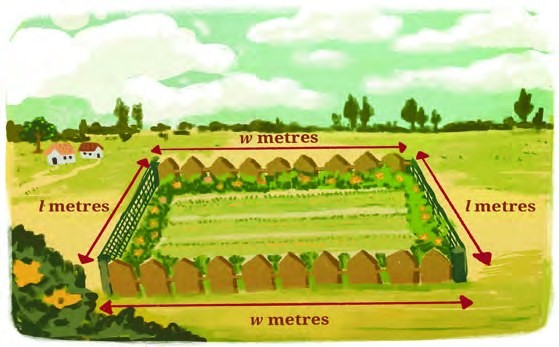
Think and Reflect (after Example 2)
Context from the textbook — Example 2: total cost of fencing and sowing a rectangular garden of length
The algebraic expression from Example 2 is
- Terms: A term is each part of the expression that is added or subtracted. Here there are three terms:
2 0 0 𝑙 , 1 6 0 𝑤 , 5 0 𝑙 𝑤 . - Variables: The letter-numbers that stand for unknown quantities are
𝑙 𝑤 - Coefficients: The numerical factor multiplying each variable part is its coefficient:
- Coefficient of
𝑙 2 0 0 2 0 0 𝑙 - Coefficient of
𝑤 1 6 0 1 6 0 𝑤 - Coefficient of the product
𝑙 𝑤 5 0 5 0 𝑙 𝑤
- Coefficient of
Compare Example 2 (
- Product term: Example 2 has a product term
5 0 𝑙 𝑤 𝑙 × 𝑤 𝑥 𝑦 4 𝑥 5 𝑦 𝑥 𝑦 - Constant term: Example 2 has no constant term (no standalone number without a variable). Example 1 has a constant term
3 - Variables used: Example 2 uses
𝑙 𝑤 𝑥 𝑦
Think and Reflect (after Example 3)
Context from the textbook — Example 3: a wire of length
The algebraic expression from Example 3 (area of the rectangle) is
(which is the same as
- Terms: There are two terms:
1 0 𝑥 a n d − 𝑥 2 . - Variables: Only one variable is used:
𝑥 - Coefficients:
- The term
1 0 𝑥 1 0 ⋅ 𝑥 1 𝑥 1 0 - The term
− 𝑥 2 ( − 1 ) ⋅ 𝑥 2 𝑥 2 − 1
- The term
- Constant term: There is no constant term (no standalone number without
𝑥
Compare Example 1 (
| Feature | Example 1: |
Example 3: |
|---|---|---|
| Similarity | Both are algebraic expressions with numerical coefficients and variables | |
| Number of variables | Two variables: | One variable: |
| Highest power (degree) | Highest power is | Highest power is |
| Constant term | Has constant term | No constant term |
| Product of different variables | No product term like | No product of two different variables (only powers of the same |
So: both are algebraic expressions, but Example 3 is a one-variable quadratic polynomial, while Example 1 is a two-variable linear expression with a constant term.
EXERCISE SET 2.1
The degree of a polynomial is the highest exponent (power) of the variable in the expression.
- (i) Degree is
2 2 𝑥 2 − 5 𝑥 + 3 𝑥 2 - (ii) Degree is
3 𝑦 3 + 2 𝑦 − 1 𝑦 3 - (iii) Degree is
0 − 9 − 9 𝑥 0 0 0 - (iv) Degree is
1 4 𝑧 − 3 𝑧 1 4 𝑧 1 − 3 1
(Note: Answers may vary; any polynomial with the correct highest exponent is correct.)
- Degree 1 (Linear Polynomial):
3 𝑥 + 5 - Degree 2 (Quadratic Polynomial):
𝑥 2 − 4 𝑥 + 7 - Degree 3 (Cubic Polynomial):
2 𝑦 3 + 6 𝑦 2 − 𝑦 − 8
- Look at the term containing
𝑥 2 + 6 𝑥 2 𝑥 2 6 - Look at the term containing
𝑥 3 − 3 𝑥 3 𝑥 3 − 3
The polynomial does not contain a term with the variable
The constant term is the number that stands alone without any variable multiplying it. In this polynomial, that term is
2.2 LINEAR POLYNOMIALS
Think and Reflect (after Example 4)
The formula for the perimeter of a square with side length
- For
𝑥 = 1 c m 𝑃 = 4 × 1 = 𝟒 c m - For
𝑥 = 1 . 5 c m 𝑃 = 4 × 1 . 5 = 𝟔 c m - For
𝑥 = 2 c m 𝑃 = 4 × 2 = 𝟖 c m - For
𝑥 = 2 . 5 c m 𝑃 = 4 × 2 . 5 = 𝟏 𝟎 c m - For
𝑥 = 3 c m 𝑃 = 4 × 3 = 𝟏 𝟐 c m
Every time the side length increases by
Think and Reflect (after Example 5)
From Example 5, the linear polynomial representing the total cost for playing
The player played
Think and Reflect (after Fig. 2.3 / Input-Output Process)
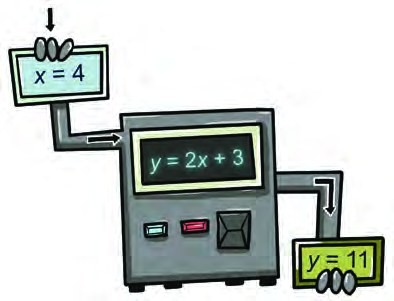
- Input-Output Interpretation: Yes. In an input-output machine, the side length
𝑥 1 0 1 0 𝑥 − 𝑥 2 c m 2 - Value when
𝑥 = 6 c m 6
EXERCISE SET 2.2
- (i) For
𝑥 = 0 0 𝑥 5 ( 0 ) − 3 = 0 − 3 = − 𝟑 - (ii) For
𝑥 = − 1 − 1 𝑥 5 ( − 1 ) − 3 = − 5 − 3 = − 𝟖 - (iii) For
𝑥 = 2 2 𝑥 5 ( 2 ) − 3 = 1 0 − 3 = 𝟕
- (i) For
𝑠 = 0 0 𝑠 7 ( 0 ) 2 − 4 ( 0 ) + 6 = 0 − 0 + 6 = 𝟔 - (ii) For
𝑠 = − 3 − 3 𝑠
- (iii) For
𝑠 = 4 4 𝑠
- Let Salil's present age be
𝑥 - Then, his mother's present age is
3 𝑥 - After
5
- Salil's age will be
( 𝑥 + 5 ) - His mother's age will be
( 3 𝑥 + 5 )
- Set the sum of their future ages equal to
7 0
- Calculate their present ages:
- Salil's age
= 𝑥 = 𝟏 𝟓 y e a r s - Mother's age
= 3 𝑥 = 3 × 1 5 = 𝟒 𝟓 y e a r s
- Since the ratio is
2 : 5 2 𝑥 5 𝑥 - Set up an equation using their difference:
- Find the actual integers by multiplying by
𝑥
- Smaller integer
= 2 𝑥 = 2 × 2 1 = 𝟒 𝟐 - Larger integer
= 5 𝑥 = 5 × 2 1 = 𝟏 𝟎 𝟓
- Let the number of ₹5 coins Ruby has be
𝑥 - Then, the number of ₹2 coins she has is
3 𝑥 - Calculate the total monetary value of the coins:
- Value from ₹5 coins
= 5 × 𝑥 = 5 𝑥 - Value from ₹2 coins
= 2 × ( 3 𝑥 ) = 6 𝑥
- Set the total monetary value equal to ₹88:
- Find the coin counts:
- Number of ₹5 coins
= 𝑥 = 𝟖 c o i n s - Number of ₹2 coins
= 3 𝑥 = 3 × 8 = 𝟐 𝟒 c o i n s
- Let the length of the shorter piece be
𝑥 - Then, the length of the longer piece is
4 𝑥 - The sum of the lengths of both pieces equals the total length of the fence:
- Calculate the two lengths:
- Shorter piece
= 𝑥 = 𝟔 𝟎 f e e t - Longer piece
= 4 𝑥 = 4 × 6 0 = 𝟐 𝟒 𝟎 f e e t
- Let the width of the rectangle be
𝑤 c m - The length
𝑙 𝑙 = 2 𝑤 + 3 - The formula for the perimeter of a rectangle is
𝑃 = 2 ( 𝑙 + 𝑤 ) 2 4
- Calculate the dimensions:
- Width
= 𝑤 = 𝟑 c m - Length
= 𝑙 = 2 ( 3 ) + 3 = 6 + 3 = 𝟗 c m
2.3 EXPLORING LINEAR PATTERNS
Think and Reflect (after Fig. 2.4 - Growing Pattern of Square Tiles)
- Looking at Fig. 2.4 in the book: Stage 1 has
1 3 5 7 - Notice that at each stage,
2 - Next three stages (Stages 5, 6, and 7):
- Stage 5:
7 + 2 = 𝟗 t i l e s - Stage 6:
9 + 2 = 𝟏 𝟏 t i l e s - Stage 7:
1 1 + 2 = 𝟏 𝟑 t i l e s - Sequence up to Stage 7:
𝟏 , 𝟑 , 𝟓 , 𝟕 , 𝟗 , 𝟏 𝟏 , 𝟏 𝟑
Think and Reflect (after deriving 2 𝑛 − 1
- Tiles in the 15th stage (
𝑛 = 1 5
- Tiles in the 26th stage (
𝑛 = 2 6
- Which stage contains 21 tiles? Set the formula equal to
2 1 𝑛
- Which stage contains 47 tiles? Set the formula equal to
4 7 𝑛
Think and Reflect (after Example 7)
From Example 7, Bela starts with ₹100 and spends ₹5 daily. The linear polynomial for the amount left after
- Amount left on the 15th day (
𝑛 = 1 5
- Days to spend the entire amount: Set the amount left to
0 𝑛
Think and Reflect (after Example 8)
From Example 8, the auto-rickshaw fare formula for a distance of
A travel distance of
EXERCISE SET 2.3
- Understanding the sequence:
- At the start (Month 0): She has ₹500.
- At the end of Month 1:
5 0 0 + 1 5 0 = ₹ 6 5 0 - At the end of Month 2:
6 5 0 + 1 5 0 = ₹ 𝟖 𝟎 𝟎 - At the end of Month 3:
8 0 0 + 1 5 0 = ₹ 𝟗 𝟓 𝟎 - At the end of Month 4:
9 5 0 + 1 5 0 = ₹ 𝟏 , 𝟏 𝟎 𝟎 - Linear Expression: Since she adds ₹150 every month to her initial ₹500 balance, the amount of money at the end of the
𝑛
- Calculating members remaining hour by hour:
- After 1 hour (
𝑛 = 1 1 2 0 − 9 ( 1 ) = 𝟏 𝟏 𝟏 m e m b e r s - After 2 hours (
𝑛 = 2 1 2 0 − 9 ( 2 ) = 𝟏 𝟎 𝟐 m e m b e r s - After 3 hours (
𝑛 = 3 1 2 0 − 9 ( 3 ) = 𝟗 𝟑 m e m b e r s - After 4 hours (
𝑛 = 4 1 2 0 − 9 ( 4 ) = 𝟖 𝟒 m e m b e r s - Linear Expression: Because 9 members leave each hour, the number of members remaining at the end of the
𝑛
The area of a rectangle is calculated as
- (i) For breadth
= 1 2 c m A r e a = 1 3 × 1 2 = 𝟏 𝟓 𝟔 c m 𝟐 - (ii) For breadth
= 1 0 c m A r e a = 1 3 × 1 0 = 𝟏 𝟑 𝟎 c m 𝟐 - (iii) For breadth
= 8 c m A r e a = 1 3 × 8 = 𝟏 𝟎 𝟒 c m 𝟐 - Linear Pattern: Notice that every time the breadth decreases by
2 c m 2 6 c m 2 1 5 6 → 1 3 0 → 1 0 4 𝑏
The volume of a rectangular box is
- (i) For height
= 5 c m V o l u m e = 7 7 × 5 = 𝟑 𝟖 𝟓 c m 𝟑 - (ii) For height
= 9 c m V o l u m e = 7 7 × 9 = 𝟔 𝟗 𝟑 c m 𝟑 - (iii) For height
= 1 3 c m V o l u m e = 7 7 × 1 3 = 𝟏 , 𝟎 𝟎 𝟏 c m 𝟑 - Linear Pattern: Notice that as the height increases in equal intervals of
4 c m 5 → 9 → 1 3 3 0 8 c m 3 3 8 5 → 6 9 3 → 1 0 0 1 ℎ
- Pages left after 15 days:
In
- Linear Pattern: Since the number of unread pages decreases by a constant
2 0 𝑛
2.4 LINEAR GROWTH AND LINEAR DECAY
Think and Reflect (after Example 9)
From Example 9, the journey cost function is
- Cost for travelling
1 5 k m 𝑑 = 1 5
- Distance when the cost is ₹700: Set
𝐶 ( 𝑑 ) = 7 0 0 𝑑
Think and Reflect (after Example 10)
From Example 10, the water tank height function is
- Height at the end of 5 months (
𝑡 = 5
EXERCISE SET 2.4
- (i) Height after 7 months (
𝑡 = 7
- (ii) Table of values (for
𝑡 = 0 1 0
| Month, | 0 | 1 | 2 | 3 | 4 | 5 | 6 | 7 | 8 | 9 | 10 |
|---|---|---|---|---|---|---|---|---|---|---|---|
| Height, | 1.75 | 2.25 | 2.75 | 3.25 | 3.75 | 4.25 | 4.75 | 5.25 | 5.75 | 6.25 | 6.75 |
- (iii) Expression and Explanation:
- Expression:
𝐡 ( 𝐭 ) = 𝟏 . 𝟕 𝟓 + 𝟎 . 𝟓 𝐭 - Explanation: This equation models linear growth because as the independent variable (time
𝑡 1 ℎ + 0 . 5 f t
- (i) Value after 3 years (
𝑡 = 3
- (ii) Table of values (for
𝑡 = 0 8
| Year, | 0 | 1 | 2 | 3 | 4 | 5 | 6 | 7 | 8 |
|---|---|---|---|---|---|---|---|---|---|
| Value, | 10000 | 9200 | 8400 | 7600 | 6800 | 6000 | 5200 | 4400 | 3600 |
- (iii) Expression and Explanation:
- Expression:
𝐯 ( 𝐭 ) = 𝟏 𝟎 𝟎 𝟎 𝟎 − 𝟖 𝟎 𝟎 𝐭 - Explanation: This equation models linear decay because as time (
𝑡 1 𝑣 − ₹ 8 0 0
- (i) Population after 6 years (
𝑡 = 6
- (ii) Table of values (for
𝑡 = 0 1 0
| Year, | 0 | 1 | 2 | 3 | 4 | 5 | 6 | 7 | 8 | 9 | 10 |
|---|---|---|---|---|---|---|---|---|---|---|---|
| Population, | 750 | 800 | 850 | 900 | 950 | 1000 | 1050 | 1100 | 1150 | 1200 | 1250 |
- (iii) Expression and Explanation:
- Expression:
𝐏 ( 𝐭 ) = 𝟕 𝟓 𝟎 + 𝟓 𝟎 𝐭 - Explanation: This equation models linear growth because the population size (
𝑃 + 5 0 p e o p l e 1
- (i) Equation and Explanation:
- Equation:
𝐛 ( 𝐱 ) = 𝟔 𝟎 𝟎 − 𝟏 𝟓 𝐱 - Explanation: This models linear decay because the account balance decreases by a steady, unchanging amount (
− ₹ 1 5 𝑥
- (ii) When the balance runs out (
𝑏 ( 𝑥 ) = 0
The prepaid balance will be completely gone after
- (iii) Table of values (for
𝑥 = 1 1 0
| Day, | 1 | 2 | 3 | 4 | 5 | 6 | 7 | 8 | 9 | 10 |
|---|---|---|---|---|---|---|---|---|---|---|
| Balance, | 585 | 570 | 555 | 540 | 525 | 510 | 495 | 480 | 465 | 450 |
2.5 LINEAR RELATIONSHIPS
Think and Reflect (after Example 11)
In the telecom data equation
2 0 1 G B 𝑎 1 5 0 𝑥 = 0 𝑏
EXERCISE SET 2.5
- Use the given data points
( 𝑥 , 𝑦 )
- For
𝑥 = 1 0 𝑦 = 4 0 0 ⟹ 𝟒 𝟎 𝟎 = 𝟏 𝟎 𝐚 + 𝐛 - For
𝑥 = 1 4 𝑦 = 5 0 0 ⟹ 𝟓 𝟎 𝟎 = 𝟏 𝟒 𝐚 + 𝐛
- Subtract Equation 1 from Equation 2 to eliminate
𝑏
- Substitute
𝑎 = 2 5 𝑏
- Conclusion:
𝐚 = 𝟐 𝟓 𝐛 = 𝟏 𝟓 𝟎 𝑦 = 2 5 𝑥 + 1 5 0
- Form two equations from the given information:
- For
𝑥 = 1 0 𝑦 = 8 0 0 ⟹ 𝟖 𝟎 𝟎 = 𝟏 𝟎 𝐚 + 𝐛 - For
𝑥 = 1 5 𝑦 = 1 1 0 0 ⟹ 𝟏 𝟏 𝟎 𝟎 = 𝟏 𝟓 𝐚 + 𝐛
- Subtract Equation 1 from Equation 2:
- Substitute
𝑎 = 6 0
- Conclusion:
𝐚 = 𝟔 𝟎 𝐛 = 𝟐 𝟎 𝟎 𝑦 = 6 0 𝑥 + 2 0 0
- Let
𝑦 = ∘ C 𝑥 = ∘ F 𝑦 = 𝑎 𝑥 + 𝑏 - Substitute the melting point of ice (
0 ∘ C = 3 2 ∘ F
(Equation 1)
- Substitute the boiling point of water (
1 0 0 ∘ C = 2 1 2 ∘ F
(Equation 2)
- Substitute
𝑏 = − 3 2 𝑎
- Now, calculate
𝑏
- Conclusion:
𝐚 = 𝟓 𝟗 𝐛 = − 𝟏 𝟔 𝟎 𝟗
2.6 VISUALISING LINEAR RELATIONSHIPS
Think and Reflect (after Fig. 2.5 / Line 𝑦 = 2 𝑥 + 1
| 5 | 2 | 1 | 7 | 9 | 12 | 20 | |
|---|---|---|---|---|---|---|---|
| 3 | 15 |
Use the equation of the line,
- For
𝑥 = 5 𝑦 = 2 ( 5 ) + 1 = 1 0 + 1 = 𝟏 𝟏 - For
𝑥 = 2 𝑦 = 2 ( 2 ) + 1 = 4 + 1 = 𝟓 - For
𝑥 = 1 𝑦 = 2 ( 1 ) + 1 = 𝟑 - For
𝑥 = 7 𝑦 = 2 ( 7 ) + 1 = 𝟏 𝟓 - For
𝑥 = 9 𝑦 = 2 ( 9 ) + 1 = 1 8 + 1 = 𝟏 𝟗 - For
𝑥 = 1 2 𝑦 = 2 ( 1 2 ) + 1 = 2 4 + 1 = 𝟐 𝟓 - For
𝑥 = 2 0 𝑦 = 2 ( 2 0 ) + 1 = 4 0 + 1 = 𝟒 𝟏
| 5 | 2 | 1 | 7 | 9 | 12 | 20 | |
|---|---|---|---|---|---|---|---|
| 11 | 5 | 3 | 15 | 19 | 25 | 41 |
Think and Reflect (after Fig. 2.9)
Looking at Fig. 2.9 (which plots
- Passes through origin: Regardless of the positive value of
𝑎 𝑦 = 𝑎 𝑥 ( 0 , 0 ) - When
𝑎 > 1 𝑦 = 2 𝑥 𝑦 = 𝑥 𝑦 𝑎 - When
0 < 𝑎 < 1 𝑦 = 1 2 𝑥 𝑦 = 𝑥 𝑥 𝑎
Think and Reflect (after Fig. 2.11)
- Similarity (
𝑦 𝑏 = + 1 𝑦 ( 0 , 1 ) - Difference (Direction/Slope):
- The graph of
𝑦 = 3 𝑥 + 1 𝑎 = + 3 - The graph of
𝑦 = − 3 𝑥 + 1 𝑎 = − 3 - Geometric Relation: The two straight lines are mirror reflections of each other across the vertical
𝑦 ( 0 , 1 )
Think and Reflect (after Fig. 2.13)
Looking at Fig. 2.13 (which plots
- When the slope
𝑎 𝑎 = 2 - When you vary the value of
𝑏 - A larger positive
𝑏 + 5 𝑦 ( 0 , 5 ) - A negative
𝑏 − 1 𝑦 ( 0 , − 1 )
EXERCISE SET 2.6
(To draw any linear graph on graph paper, pick two simple
- (i) Reflection on
𝑦 = 3 𝑥 − 1 𝑦 = 3 𝑥 𝑦 = 3 𝑥 + 1 - Role of
𝑎 𝑎 = 3 - Role of
𝑏 𝑏 − 1 , 0 , + 1 𝑦 ( 0 , − 1 ) ( 0 , 0 ) ( 0 , 1 ) 𝑏
- (ii) Reflection on
𝑦 = 4 𝑥 𝑦 = 2 𝑥 𝑦 = 𝑥 - Role of
𝑏 𝑏 = 0 ( 0 , 0 ) - Role of
𝑎 𝑎 1 → 2 → 4 𝑥 𝑦
- (iii) Reflection on
𝑦 = − 6 𝑥 𝑦 = − 3 𝑥 𝑦 = − 𝑥 - Role of
𝑏 𝑏 = 0 ( 0 , 0 ) - Role of
𝑎 𝑎 − 1 , − 3 , − 6 − 1 − 6
- (iv) Reflection on
𝑦 = 5 𝑥 𝑦 = − 5 𝑥 - Role of
𝑏 ( 0 , 0 ) 𝑏 = 0 - Role of
𝑎 5 + 5 − 5 𝑦
- (v) Reflection on
𝑦 = − 2 𝑥 − 3 𝑦 = − 2 𝑥 𝑦 = 2 𝑥 + 3 - Comparing the first two (
𝑦 = − 2 𝑥 − 3 𝑦 = − 2 𝑥 𝑎 = − 2 𝑦 ( 0 , − 3 ) ( 0 , 0 ) - Comparing with the third (
𝑦 = 2 𝑥 + 3 𝑎 = + 2 𝑦 ( 0 , 3 )
END-OF-CHAPTER EXERCISES
(Note: Many answers are possible as long as the highest exponent of
- (i) Substitute
𝑥 = 1
- (ii) Substitute
𝑡 = 𝑎
Replace every
- Let the unknown number be
𝑥 - Write the word problem as a linear equation:
- Subtract
2 3 2 3 1 2 2 × 4 3 × 4 = 8 1 2
- Reduce
− 1 5 1 2 3
- Multiply both sides by the reciprocal
2 5 𝑥
The required number is
- Let the smaller positive number be
𝑥 - Then, the larger positive number is
5 𝑥 - After adding
2 1
- Smaller new number
= ( 𝑥 + 2 1 ) - Larger new number
= ( 5 𝑥 + 2 1 )
- Since
𝑥 ( 5 𝑥 + 2 1 ) ( 𝑥 + 2 1 )
- Expand and solve for
𝑥
- Find both original numbers:
- Smaller number
= 𝑥 = 𝟕 - Larger number
= 5 𝑥 = 5 × 7 = 𝟑 𝟓
- (i) Amount after 6 months:
- (ii) Amount after 2 years (24 months):
- Linear Pattern Expression:
Let
- Let the tens digit of the original number be
𝑡 𝑢 - The value of the original two-digit number is
( 1 0 𝑡 + 𝑢 ) - When the digits are interchanged, the new number's value is
( 1 0 𝑢 + 𝑡 ) - The sum of the original number and the interchanged number is
1 4 3
(Equation 1)
- We are given that the digits differ by
3
- Case 1: The tens digit is larger (
𝑡 − 𝑢 = 3
Add this equation to Equation 1:
Since
- Case 2: The units digit is larger (
𝑢 − 𝑡 = 3 ⟹ − 𝑡 + 𝑢 = 3
Add this equation to Equation 1:
Since
- Conclusion: Both two-digit numbers satisfying the conditions are
5 8 8 5
To find the slope (
- (i)
𝑦 = − 3 𝑥 + 4 - Already in standard form.
- Slope (
𝑎 − 𝟑 𝑦 𝑏 𝟒 - Cuts
𝑦 ( 𝟎 , 𝟒 )
- (ii)
2 𝑦 = 4 𝑥 + 7 - Divide all terms by
2 𝑦 = 2 𝑥 + 7 2 𝑦 = 2 𝑥 + 3 . 5 - Slope (
𝑎 𝟐 𝑦 𝑏 𝟕 𝟐 3 . 5 - Cuts
𝑦 ( 𝟎 , 𝟕 𝟐 ) ( 0 , 3 . 5 )
- (iii)
5 𝑦 = 6 𝑥 − 1 0 - Divide all terms by
5 𝑦 = 6 5 𝑥 − 2 𝑦 = 1 . 2 𝑥 − 2 - Slope (
𝑎 𝟔 𝟓 1 . 2 𝑦 𝑏 − 𝟐 - Cuts
𝑦 ( 𝟎 , − 𝟐 )
- (iv)
3 𝑦 = 6 𝑥 − 1 1 - Divide all terms by
3 𝑦 = 2 𝑥 − 1 1 3 - Slope (
𝑎 𝟐 𝑦 𝑏 − 𝟏 𝟏 𝟑 ≈ − 3 . 6 7 - Cuts
𝑦 ( 𝟎 , − 𝟏 𝟏 𝟑 )
- Are any of the lines parallel?
Yes. Two lines are parallel if their slopes (
(To draw these on graph paper: use the
- (i) Given
𝑥 = 3 1 3 K 𝑦
The temperature is
- (ii) Given
𝑦 = 1 5 8 ∘ F 𝑥
Subtract
Multiply both sides by the reciprocal
The temperature is
- Linear Equation:
We are given that
- Work done when distance
𝑑 = 2 u n i t s
- Verification by Graphing:
- Table of points to plot:
- For
𝑑 = 0 𝑤 = 3 ( 0 ) = 0 ⟹ ( 𝟎 , 𝟎 ) - For
𝑑 = 1 𝑤 = 3 ( 1 ) = 3 ⟹ ( 𝟏 , 𝟑 ) - For
𝑑 = 2 𝑤 = 3 ( 2 ) = 6 ⟹ ( 𝟐 , 𝟔 )
- Drawing the Graph: On a graph paper, label the horizontal axis as Distance (
𝑑 𝑤 ( 0 , 0 ) ( 1 , 3 ) ( 2 , 6 ) - Visual Verification: Locate
𝑑 = 2 6
- (i) Find the polynomial
𝑝 ( 𝑥 )
Let the general linear polynomial be
- Since it passes through
( 1 , 5 ) 𝑥 = 1 𝑝 ( 1 ) = 5
(Equation 1)
- Since it passes through
( 3 , 1 1 ) 𝑥 = 3 𝑝 ( 3 ) = 1 1
(Equation 2)
- Subtract Equation 1 from Equation 2:
- Substitute
𝑎 = 3
- Polynomial:
𝐩 ( 𝐱 ) = 𝟑 𝐱 + 𝟐
- (ii) Coordinates where graph cuts the axes:
- Cutting the
𝑦 𝑥 = 0
- Cutting the
𝑥 𝑦 = 𝑝 ( 𝑥 ) = 0
(or
- (iii) Graph and Verification:
- Plot the known points
( 0 , 2 ) ( 1 , 5 ) ( 3 , 1 1 ) - Look at where the line crosses the axes: it clearly intersects the vertical
𝑦 + 2 𝑥 − 2 3
- From condition (i):
So, we know
- From condition (iii):
We are told this sum equals
- Constant terms:
5 + 𝑑 = 4 ⟹ 𝐝 = − 𝟏 𝑥 𝑎 + 𝑐 = 6 ⟹ 𝐜 = 𝟔 − 𝐚
So, we know
- From condition (ii):
First, find the difference polynomial
We are told this polynomial cuts the
- Find
𝑐
Since
𝐩 ( 𝐱 ) = 𝟐 𝐱 + 𝟓 𝐪 ( 𝐱 ) = 𝟒 𝐱 − 𝟏
| Stage | 1 | 2 | 3 | 4 | 5 | |
|---|---|---|---|---|---|---|
| Number of matchsticks |
(iii) Find a rule to determine the number of matchsticks required for the
(iv) How many matchsticks will be required for the 15th stage of the pattern?
(v) Can 200 matchsticks form a stage in this pattern? Justify your answer.
- Understanding the matchstick count:
- Stage 1 (1 standalone hexagon) requires
6 - Stage 2 (2 attached hexagons sharing 1 side) requires
6 + 5 = 𝟏 𝟏 m a t c h s t i c k s - Stage 3 (3 attached hexagons sharing 2 sides) requires
1 1 + 5 = 𝟏 𝟔 m a t c h s t i c k s - Notice that every new attached hexagon requires
5
- (i) Next two stages (Stage 4 and Stage 5):
- Stage 4: Draw a horizontal chain of
4
- Stage 5: Draw a horizontal chain of
5
- (ii) Completed Table:
| Stage | 1 | 2 | 3 | 4 | 5 | |
|---|---|---|---|---|---|---|
| Number of matchsticks | 6 | 11 | 16 | 21 | 26 |
- (iii) Rule for the
𝑛
Since the count increases by
- (iv) Matchsticks for the 15th stage (
𝑛 = 1 5
- (v) Can 200 matchsticks form a stage?
Set our rule equal to
Justification: No, 200 matchsticks cannot form a stage. The stage number
- Find polynomial
𝑝 ( 𝑥 ) ( 2 , 3 ) ( 6 , 1 1 )
- For
( 2 , 3 ) 𝟐 𝐚 + 𝐛 = 𝟑 - For
( 6 , 1 1 ) 𝟔 𝐚 + 𝐛 = 𝟏 𝟏 - Subtract Equation 1 from Equation 2:
- Substitute
𝑎 = 2
- Thus,
𝐩 ( 𝐱 ) = 𝟐 𝐱 − 𝟏
- Find polynomial
𝑞 ( 𝑥 )
- Since
𝑞 ( 𝑥 ) 𝑝 ( 𝑥 ) 𝑐 = 𝑎 = 2 𝑞 ( 𝑥 ) = 2 𝑥 + 𝑑 - We are given that
𝑞 ( 𝑥 ) ( 4 , − 1 ) 𝑥 = 4 𝑞 ( 4 ) = − 1
- Thus,
𝐪 ( 𝐱 ) = 𝟐 𝐱 − 𝟗
- Find coordinates where they meet the
𝑥 𝑦 = 0
- For
𝑝 ( 𝑥 ) 2 𝑥 − 1 = 0 ⟹ 2 𝑥 = 1 ⟹ 𝑥 = 1 2
The line
- For
𝑞 ( 𝑥 ) 2 𝑥 − 9 = 0 ⟹ 2 𝑥 = 9 ⟹ 𝑥 = 9 2
The line
Let us factor out the common algebraic factor
Now, notice what happens if we calculate the value of the function when
Because the result is
- Common
𝑥 𝑥 ( − 1 , 0 ) - Equal Slope and
𝑦 𝑦 = 𝑎 𝑥 + 𝑎 𝑎 𝑦 𝑎 𝑦