3.1 THE DAWN OF MATHEMATICS: THE HUMAN NEED TO COUNT
EXERCISE SET 3.1

We can solve this problem step-by-step using ratios or the unitary method.
- Step 1: Understand the exchange rate given in the problem. The merchant gets
1 5 2 - Step 2: Find out how many batches of
2 1 2
- Step 3: Since each batch earns him
1 5 1 5
Therefore, the merchant will leave the market with
- What they have in common: All of these numbers (
1 1 , 1 3 , 1 7 , 1 9 1 0 2 0 1 1 - The next three numbers in the pattern: To continue this sequence of consecutive prime numbers after
1 9 2 0 , 2 1 , 2 2 2 3 1 2 3 2 4 , 2 5 , 2 6 , 2 7 , 2 8 2 9 1 2 9 3 0 2 , 3 , 5 , 3 1 1 3 1
Therefore, the next three numbers that fit this pattern are
No, the set of Natural Numbers (
- What closure means: A set of numbers is "closed" under an operation (like subtraction) if performing that operation on any two numbers from the set always gives you an answer that is also a member of that same set.
- Why it fails for Natural Numbers: When you subtract a smaller natural number from a larger one, the answer is a natural number (e.g.,
1 0 − 3 = 7 - Examples to justify this:
- Example 1: Let us pick the natural numbers
4 9 9 4
The result,
- Example 2: Let us pick the natural numbers
5 5
The result is zero (
- How many you can count on one hand: Exclude the thumb (since the thumb acts as the pointer to touch the joints). You have
4 4 3
By touching the thumb to each joint sequentially, you can count up to
- Relation to ancient base-12 systems: Today, we use a base-10 (decimal) system because humans have
1 0 1 2 6 4 3 2 4 1 2
3.3 INTEGERS: EXPANDING THE HORIZON
Think and Reflect (Page 46)
To understand why multiplying two negative numbers gives a positive answer, we can use Brahmagupta's ancient concepts of Fortunes (positive numbers) and Debts (negative numbers):
- Let us say you owe ₹3 to a friend. In mathematical terms, your financial state is a debt of ₹3, which we write as
− 3 - Now, imagine a generous benefactor comes along and decides to cancel (take away)
4 - In mathematics, "taking away" or removing something is represented by a negative sign (
− 4 − 4 - When those debts are removed, you no longer have to pay out that money from your pocket. By having a ₹3 debt taken away
4 ₹ 3 × 4 = ₹ 1 2
Therefore, removing (
EXERCISE SET 3.2
- Step 1: Identify the starting temperature at noon, which is
+ 4 ∘ C - Step 2: A "drop" in temperature means we must subtract from the starting value. The temperature drops by
1 5 ∘ C - Step 3: Write the mathematical equation using integers:
- Step 4: To subtract a larger number (
1 5 4 1 5 − 4 = 1 1
Therefore, the midnight temperature in Ladakh is
Using Brahmagupta's terminology, we represent financial gains (profits/fortunes) as positive integers and financial liabilities (loans/losses/debts) as negative integers:
- Initial loan (debt) =
− 8 5 0 - Profit next day (fortune) =
+ 1 2 0 0 - Loss following week (debt) =
− 4 5 0
- Step 1: Write the sequence as an integer equation:
- Step 2: Calculate step-by-step from left to right:
- First, combine the initial debt with the profit:
(At this point, the trader has paid off the loan and has ₹350 left in his pocket).
- Next, incorporate the loss of ₹450:
Therefore, the trader's final financial standing is
Let us solve each part step-by-step using Brahmagupta's arithmetic rules established in 628 CE:
- (i)
( − 1 2 ) × 5 - Rule: Brahmagupta stated that the product of a debt and a fortune is a debt (a negative number multiplied by a positive number gives a negative result).
- Calculation: Multiply the numbers without signs first (
1 2 × 5 = 6 0
- (ii)
( − 8 ) × ( − 7 ) - Rule: Brahmagupta stated that the product of two debts is a fortune (a negative number multiplied by a negative number gives a positive result).
- Calculation:
8 × 7 = 5 6
- (iii)
0 − ( − 1 4 ) - Rule: Subtracting a debt (a negative number) is equivalent to adding a fortune (a positive number).
- Calculation: The two consecutive minus signs turn into a plus sign:
- (iv)
( − 2 0 ) ÷ 4 - Rule: Just like multiplication, dividing a debt by a positive number distributes that debt into equal parts, so the answer remains a debt (negative divided by positive is negative).
- Calculation: Divide
2 0 4 5
Imagine you have a wallet containing a ₹10 currency note, but you also owe your local tea vendor ₹5 for tea you drank yesterday.
- In mathematical terms, your current net worth is your cash minus your debt:
- Now, imagine the tea vendor is feeling generous and says, "Don't worry about paying me back; I am cancelling your ₹5 debt!"
- What just happened? The vendor subtracted your debt of ₹5. In our integer ledger, a debt of ₹5 is written as
− 5 − ( − 5 ) - Because you no longer have to hand over ₹5 from your wallet to pay the vendor, you get to keep your entire ₹10 currency note! In addition, compared to your old net worth of ₹5, your financial standing has jumped up by ₹5. Cancelling the debt had the exact same positive effect on your wealth as if someone had handed you an extra ₹5 note!
Therefore, taking away a debt is mathematically identical to receiving cash:
3.4 FILLING THE SPACES: FRACTIONS AND RATIONAL NUMBERS
Think and Reflect (Page 47)
A rational number is defined as any number that can be written in the form
To understand why division by zero destroys mathematical logic, let us look at what division truly means:
- When we say
1 2 3 = 4 4 × 3 = 1 2 - Now, imagine we allowed
𝑞 0 5 0 5 0 𝑥 𝑥 × 0 = 5 𝑥 × 0 = 0 5 - What if we tried to evaluate
0 0 0 0 = 𝑥 𝑥 × 0 = 0 𝑥 1 , 5 0 , − 9 9 ,
To prevent these impossible and contradictory situations, mathematics strictly forbids dividing by zero. Therefore,
Think and Reflect (Page 49)
To make different denominators equal before adding or subtracting, we follow a simple two-step process:
- Step 1: Find the LCM (Least Common Multiple): Look at the different denominators and find their LCM. The LCM is the smallest positive number that can be divided cleanly by both denominators. This LCM will become our new, shared common denominator.
- Step 2: Create Equivalent Fractions: For each fraction, ask: "By what integer do I need to multiply this denominator to turn it into the LCM?" Once you find that integer, multiply both the numerator and the denominator of the fraction by that exact same integer. This changes the appearance of the fractions so their bottom numbers match, without changing their mathematical value!
Example: To add
- The LCM of denominators
4 3 1 2 - Convert the first fraction: Multiply top and bottom by
3 → 1 × 3 4 × 3 = 3 1 2 - Convert the second fraction: Multiply top and bottom by
4 → 2 × 4 3 × 4 = 8 1 2 - Now that denominators are equal, simply add the numerators:
3 1 2 + 8 1 2 = 1 1 1 2
The Distributive Law states that for any three rational numbers
Let us verify this law by picking three simple rational numbers: Let
- Step 1: Calculate the Left-Hand Side (LHS)
→ 𝑝 ( 𝑞 + 𝑟 ) - First, solve inside the parentheses by finding a common denominator for
1 3 1 4 1 2
- Now, multiply this sum by
𝑝
- Step 2: Calculate the Right-Hand Side (RHS)
→ 𝑝 𝑞 + 𝑝 𝑟 - First, multiply
𝑝 × 𝑞
- Next, multiply
𝑝 × 𝑟
- Now, add these two individual products together by finding a common denominator for
1 6 1 8 2 4
Since the
EXERCISE SET 3.3
We will use Brahmagupta's Equality Rule from the chapter: two rational numbers
- (i)
2 3 4 6 - Here,
𝑎 = 2 , 𝑏 = 3 , 𝑐 = 4 , 𝑑 = 6 - Cross-multiply:
𝑎 × 𝑑 = 2 × 6 = 1 2 - Cross-multiply:
𝑏 × 𝑐 = 3 × 4 = 1 2 - Since
1 2 = 1 2 2 3 = 4 6
- (ii)
5 4 1 0 8 - Here,
𝑎 = 5 , 𝑏 = 4 , 𝑐 = 1 0 , 𝑑 = 8 - Cross-multiply:
5 × 8 = 4 0 - Cross-multiply:
4 × 1 0 = 4 0 - Since
4 0 = 4 0 5 4 = 1 0 8
- (iii)
− 3 5 − 6 1 0 - Keep the negative sign with the numerators:
𝑎 = − 3 , 𝑏 = 5 , 𝑐 = − 6 , 𝑑 = 1 0 - Cross-multiply:
( − 3 ) × 1 0 = − 3 0 - Cross-multiply:
5 × ( − 6 ) = − 3 0 - Since
− 3 0 = − 3 0 − 3 5 = − 6 1 0
- (iv)
9 3 3 - Any integer can be written as a fraction over
1 3 3 1 9 3 3 1 - Cross-multiply:
9 × 1 = 9 - Cross-multiply:
3 × 3 = 9 - Since
9 = 9 9 3 = 3
- (i)
2 5 + 3 1 0 - The denominators are
5 1 0 1 0 - Convert
2 5 1 0 2
- Now add the numerators while keeping the common denominator:
- (ii)
7 1 2 + 5 8 - The denominators are
1 2 8 2 4 1 2 × 2 = 2 4 8 × 3 = 2 4 - Convert both fractions to have a denominator of
2 4
- Add the numerators:
- (iii)
− 4 7 + 3 1 4 - The denominators are
7 1 4 1 4 - Convert
− 4 7 2
- Now add the numerators using integer addition rules:
- (i)
5 6 − 1 4 - Denominators are
6 4 1 2 - Convert equivalent fractions:
- Subtract the numerators:
- (ii)
1 1 8 − 3 4 - Denominators are
8 4 8 - Convert the second fraction:
- Subtract:
- (iii)
− 7 9 − ( − 2 3 ) - Remember that subtracting a negative fraction is the same as adding a positive fraction:
- The LCM of denominators
9 3 9 2 3
- Now combine the numerators:
To multiply rational numbers, multiply the numerators together to get the new numerator, and multiply the denominators together to get the new denominator (
- (i)
2 3 × 3 1 0 - Multiply across:
- Reduce to lowest terms by dividing both top and bottom by their greatest common factor (
6
(Alternative method: You can cross-cancel the common factor of
- (ii)
7 1 1 × 5 8 - Multiply across:
(Since
- (iii)
− 4 7 × 5 1 4 - Multiply across (remembering that a negative times a positive gives a negative product):
- Both numbers are even, so reduce by dividing top and bottom by
2
To divide by a fraction, we flip the second fraction upside down (this is called taking the reciprocal) and change the division sign to multiplication (
- (i)
2 3 ÷ 3 1 0 - Flip
3 1 0 1 0 3
- (ii)
7 1 1 ÷ 5 8 - Flip
5 8 8 5
- (iii)
− 4 7 ÷ 5 1 4 - Flip
5 1 4 1 4 5
- Both
5 6 3 5 7
(Alternative method: Cross-cancel
This question asks us to prove that the equation is true by calculating the Left-Hand Side (LHS) and the Right-Hand Side (RHS) separately to see if they match. This is a practical test of the Distributive Property!
- Step 1: Calculate the Left-Hand Side (LHS)
- First, add the fractions inside the brackets. Convert
1 2 2 4
- Now multiply this result by
8 3
- Reduce
4 0 1 2 4
- Step 2: Calculate the Right-Hand Side (RHS)
- Solve the first multiplication block:
- Solve the second multiplication block:
- Now add the two blocks together:
- Reduce
2 0 6 2
Since
The distributive property states that
- Step 1: Distribute
7 9
- Step 2: Simplify each multiplication block separately:
- First block: Notice that the
7 7
- Second block: Multiply across:
Divide top and bottom by
- Step 3: Subtract the simplified terms:
- To subtract, we need a common denominator (LCM of
3 1 2 1 2 2 3 4
- Now perform the final subtraction:
Therefore, the simplified answer is
Let us use basic algebra and the distributive property to simplify this equation and find
- Step 1: Apply the distributive property on the left side of the equation:
- Step 2: Simplify the multiplication on the left side:
- Notice how the
5 5 6 × 3 5
- Put this simplified fraction back into our equation:
- Step 3: Analyze the result:
Look at both sides of the equation. The Left-Hand Side (
- Conclusion:
Because the variable
Think and Reflect (Page 51)
Try and locate
To locate
- Step 1: Understand the fraction's value: Since there is a negative sign, we will be moving to the left of the zero origin (
0 7 4
This tells us the number is located beyond
- Step 2: Prepare the number line: Draw a number line with an origin labeled
0 − 1 , − 2 , − 3 - Step 3: Divide the intervals: Look at the denominator, which is
4 0 − 1 − 1 − 2 4 3 - Step 4: Count and mark the point: Starting from the origin
0 7 - Step
4 − 4 4 − 1 - Step
3 − 7 4
This point lies exactly on the third tick mark between
Think and Reflect (Page 52)
There are two distinct mathematical facts we need to explain here: why the answer is rational, and why it is always trapped between the two original numbers.
- Part 1: Why is the average always a rational number?
- We know that rational numbers are closed under addition. This means if you take any two rational numbers
𝑎 𝑏 ( 𝑎 + 𝑏 ) - We also know that rational numbers are closed under division (as long as you do not divide by zero). Since we are dividing the rational sum
( 𝑎 + 𝑏 ) 2 𝑎 + 𝑏 2
- Part 2: Why does the average always lie strictly between
𝑎 𝑏 - Let us assume that
𝑎 𝑏 𝑎 < 𝑏 - Proof that the average is greater than
𝑎
Take the inequality
Now, divide both sides by
This proves the average is strictly greater than
- Proof that the average is less than
𝑏
Take our starting inequality
Divide both sides by
This proves the average is strictly less than
By combining both proven inequalities, we get the complete chain:
This proves that the average
EXERCISE SET 3.4
To plot different fractions accurately on the same number line without guessing their positions, we must first convert them so they all share a common denominator.
- Step 1: Convert all numbers to improper fractions with a common denominator:
- Our numbers are
2 3 − 5 4 1 1 2 3 2 - Look at the denominators:
3 , 4 , 2 1 2 1 2 2 3 × 4 4 = 𝟖 𝟏 𝟐 − 5 4 × 3 3 = − 𝟏 𝟓 𝟏 𝟐 3 2 × 6 6 = 𝟏 𝟖 𝟏 𝟐 1 6 1 2
- Step 2: Prepare the number line:
- Draw a long horizontal line and mark an origin labeled
0 - Mark integer boundaries to the right (
+ 1 , + 2 − 1 , − 2 - Because our common denominator is
1 2 1 2 1 1 1 1 2
- Step 3: Locate and mark each point:
- For
2 3 8 1 2 0 8 2 3 - For
− 5 4 − 1 5 1 2 0 1 2 − 1 3 − 1 1 5 − 5 4 - For
1 1 2 1 8 1 2 0 1 2 + 1 6 + 1 + 1 + 2 1 1 2
- Step 1: Ensure denominators match:
We want numbers between
Right now, looking at the numerators
- Step 2: Magnify the gap by expanding the fractions:
To create plenty of integer steps between the numerators, let us multiply both top and bottom of our fractions by a large number, say
Because we multiplied top and bottom by the same amount, their mathematical values remain completely unchanged.
- Step 3: Pick three intermediate numerators:
Now we simply look at the integer numerators between
- Step 4: Simplify to lowest terms (optional but good practice):
− 1 5 4 0 5 → − 𝟑 𝟖 − 1 4 4 0 2 → − 𝟕 𝟐 𝟎 − 1 3 4 0 → − 𝟏 𝟑 𝟒 𝟎
Therefore, three distinct rational numbers lying strictly between
- Step 1: Find a common denominator:
The denominators are
- Step 2: Convert the first fraction:
Multiply the numerator and denominator of
- Step 3: Add the numerators:
Now combine the fractions:
- Step 4: Reduce to lowest terms:
Divide both top and bottom by their common factor of
Therefore, the simplified value is
To find out how many kurtas can be made, we need to divide the total length of silk available by the length of silk required for a single kurta.
- Step 1: Convert both mixed fractions into improper fractions:
- Total silk:
1 5 3 4 = ( 1 5 × 4 ) + 3 4 = 𝟔 𝟑 𝟒 m e t r e s - Silk per kurta:
2 1 4 = ( 2 × 4 ) + 1 4 = 𝟗 𝟒 m e t r e s
- Step 2: Perform the fraction division:
Remember our rule for fraction division: flip the second fraction upside down (reciprocal) and multiply:
- Step 3: Simplify and multiply:
Notice that the
Now simply divide
Therefore, the tailor can make exactly
- Step 1: Understand decimal places:
At first glance,
- Step 2: Pick intermediate decimal numbers:
Now it is easy to see the gap! We can pick any numbers ending in
- Step 3: Why are these rational?
Every terminating decimal can be written as a fraction over a power of
Therefore, three rational numbers between
Yes! Aside from the Averaging Method (
- How the Mediant Method works:
If you have two rational numbers written as positive fractions
In normal fraction addition, adding straight across is a famous mistake. However, if your goal is solely to find an intermediate number lying trapped between two fractions, this "mistake" is actually a guaranteed mathematical theorem! The mediant
- Example to prove how well it works:
Let us find a rational number between
- Using Farey Addition: Add top numbers (
1 + 2 = 3 3 + 3 = 6 - The resulting mediant is
3 6 = 1 2 - Since
1 3 ≈ 0 . 3 3 3 2 3 ≈ 0 . 6 6 7 1 2 ( 0 . 5 )
3.5 IRRATIONAL NUMBERS
Think and Reflect (Page 53)
No,
Think and Reflect (Page 55)
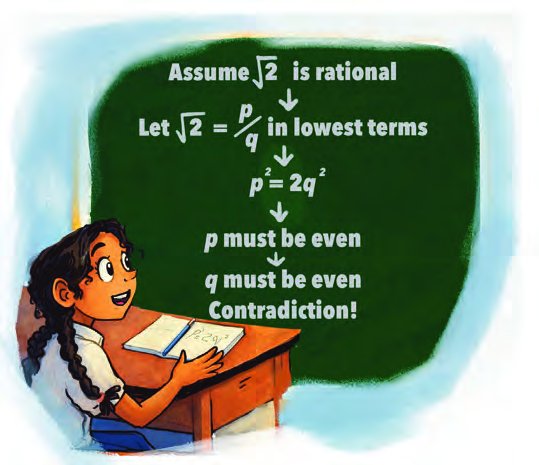
We will prove that
- Step 1: The Assumption (The Contradiction setup)
Assume the exact opposite of what we want to prove. Assume
(Important: "Simplest terms" means
- Step 2: Square both sides of the equation
- Step 3: Rearrange to clear the denominator
Multiply both sides by
- Step 4: Make a deduction about
𝑝
Since
- Step 5: Substitute
𝑝 = 3 𝑘
Now, divide both sides of the equation by
- Step 6: Make a deduction about
𝑞
Now we see that
- Step 7: The Fatal Contradiction!
In Step
- Will this same approach work for
√ 5 √ 7 √ 1 0
Yes! This exact proof by contradiction works seamlessly for
Think and Reflect (Page 55)
We obtain line segments of precise irrational lengths using geometric construction based on the Baudhāyana-Pythagoras Theorem.
While you cannot measure an irrational length like
- The Baudhāyana-Pythagoras Theorem states that in any right-angled triangle, the square of the hypotenuse (
𝑐 𝑎 𝑏
- If we deliberately draw a right-angled triangle where the two perpendicular legs have clean, integer lengths of
1 𝑎 = 1 , 𝑏 = 1
- By simply connecting the two ends of our integer legs, the resulting diagonal hypotenuse line is magically forced to have an exact, perfect length of
√ 2
Think and Reflect (Page 56)
Let us see how to construct
Part 1: Constructing Length √ 3
To get
- Step 1: On your number line, locate the point labeled
𝑃 √ 2 0 𝑂 𝑃 = √ 2 - Step 2: Use your ruler and compass to construct a vertical line segment exactly
1 𝑃 𝐷 - Step 3: Connect the origin
𝑂 𝐷 𝑂 𝐷
- Step 4: Place your compass needle at origin
𝑂 𝐷 √ 3 √ 3
Part 2: Constructing Length √ 5
Instead of laboriously building
- Notice that
5 5 = 4 + 1 = 2 2 + 1 2 - Step 1: On your number line, measure a base line segment from origin
𝑂 2 2 - Step 2: At point
2 1 𝐸 - Step 3: Connect origin
𝑂 𝐸 𝑂 𝐸
- Step 4: Swing an arc with your compass from origin
𝑂 𝑂 𝐸 √ 5
Part 3: Generalizing for any length √ 𝑛
To construct a line segment of length
- Assume you have already constructed a segment of length
√ 𝑛 − 1 - Draw a perpendicular line segment of length
1 - When you join the origin to the top of that perpendicular leg, the hypotenuse will always equal
√ 𝑛
(Note: Whenever
3.6 REAL NUMBERS: DECIMALS AND CYCLIC PATTERNS
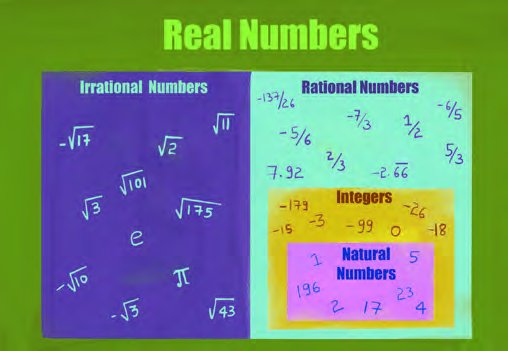
Section 3.6.1 Rational Decimals: Terminating and Repeating
Example 2 (Page 57)
A rational number written in its simplest form (
In mathematical notation, the denominator must take the form:
Why does this work for
Think and Reflect (Page 57)
Let us perform long division for both fractions to observe how their decimal digits behave:
- Part 1: Decimal expansion of
1 0 3 - Divide
1 0 3 1 0 ÷ 3 = 3 1 - Add a decimal point and bring down a zero (
1 0 3 3 1 - Because the remainder
1 3
- Part 2: Decimal expansion of
1 1 1 2 - Divide
1 1 . 0 1 2 1 1 0 ÷ 1 2 = 9 1 2 × 9 = 1 0 8 2 - Bring down a zero (
2 0 1 2 2 0 ÷ 1 2 = 1 1 2 × 1 = 1 2 8 - Bring down a zero (
8 0 1 2 8 0 ÷ 1 2 = 6 1 2 × 6 = 7 2 8 - Bring down a zero (
8 0 8 6
- What do we observe about the repetition?
We observe two distinct styles of repeating patterns:
- For
1 0 3 = 3 . ―― 3 - For
1 1 1 2 = 0 . 9 1 ―― 6 9 1 6
Think and Reflect (Page 58)
The secret lies in our standard base-10 (decimal) number system.
- When a decimal terminates (stops), such as
0 . 3 7 5 0 . 1 5
Any terminating decimal is simply a fraction whose denominator is an exact power of
- Now, let us look at the prime building blocks of the number
1 0
Because
- Therefore, if a fraction's simplified denominator
𝑞 2 5 2 5 1 0 - What happens if any other prime number is present? If the denominator contains a prime factor like
3 , 7 , 1 1 1 0 1 0 3 , 7 , 1 1 1 0
Worked Examples 4 to 9 (Pages 58–60): Full Step-by-Step Solutions
Here are the complete, step-by-step conversions for all six worked examples in the chapter, written out clearly using algebraic rules without shortcut omissions.
Example 4: Convert
This is a Terminating Decimal (it ends after two decimal places).
- Step 1: Write the decimal as a fraction over a power of
1 0 3 5 1 0 2 = 1 0 0
- Step 2: Reduce the fraction to its lowest terms by finding the greatest common factor between
3 5 1 0 0 5 5
Therefore,
This is a Pure Repeating Decimal where one digit (
- Step 1: Let our variable
𝑥
- Step 2: Count the number of repeating digits. Here, exactly
1 1 0 1 = 1 0
- Step 3: Subtract Equation 1 from Equation 2. Notice how the infinite tail of decimal
6
- Step 4: Solve for
𝑥 9
- Step 5: Reduce
6 9 3
Therefore,
This is a Pure Repeating Decimal where a block of two digits (
- Step 1: Let
𝑥
- Step 2: Since
2 1 0 2 = 1 0 0
- Step 3: Subtract Equation 1 from Equation 2 to eliminate the infinite decimal tail:
- Step 4: Solve for
𝑥
- Step 5: Reduce to lowest terms by dividing top and bottom by
9
Therefore,
This is a General (Mixed) Repeating Decimal (
- Step 1: Let
𝑥
- Step 2: First, we must shift the decimal point to place the repeating block immediately after the decimal point. Since there is
1 1 1 0 1 = 1 0
- Step 3: Next, we need a second equation where one full repeating cycle is shifted to the left of the decimal point. Since the repeating block is
1 6 1 0 𝑥 1 0 0
- Step 4: Subtract Equation 2 from Equation 3. Notice that both equations now have the exact same infinite tail (
0 . 6 6 6 6 . . .
- Step 5: Solve for
𝑥
- Step 6: Reduce to lowest terms by dividing top and bottom by
1 5
Therefore,
This is a General Repeating Decimal (
- Step 1: Let
𝑥
- Step 2: Shift the
2 3 5 1 0 2 = 1 0 0
- Step 3: Shift one cycle of the
1 7 1 0 1 0 0 0 × 𝑥
- Step 4: Subtract Equation 2 from Equation 3 to eliminate the infinite repeating tail:
- Step 5: Solve for
𝑥
- Step 6: Reduce to lowest terms by dividing top and bottom by
2
Therefore,
This is a General Repeating Decimal (
- Step 1: Let
𝑥
- Step 2: Shift the
2 4 5 1 0 2 = 1 0 0
- Step 3: Shift one full cycle of the
2 3 7 1 0 2 = 1 0 0 1 0 0 0 0 × 𝑥
- Step 4: Subtract Equation 2 from Equation 3 to eliminate the infinite repeating decimal tail:
- Step 5: Solve for
𝑥
- Step 6: Reduce to lowest terms by dividing top and bottom by their common factor of
4
Therefore,
EXERCISE SET 3.5
Part 1: Prediction using Prime Factorization
A rational number in lowest terms terminates if and only if the prime factorization of its denominator contains ONLY powers of
- For
7 2 0 2 0 2 0 = 2 × 2 × 5 = 2 2 × 5 2 5 - For
4 1 5 1 5 1 5 = 3 × 5 3 2 5 - For
1 3 2 5 0 2 5 0 2 5 0 = 2 × 5 × 5 × 5 = 2 × 5 3 2 5
Part 2: Verification by Explicit Long Division
Let us perform actual long division to check our predictions:
- Check
7 2 0 - Divide
7 . 0 0 2 0 2 0 7 0 2 0 × 3 = 6 0 1 0 - Bring down a zero to make
1 0 0 2 0 1 0 0 2 0 × 5 = 1 0 0 0
- Check
4 1 5 - Divide
4 . 0 0 0 1 5 1 5 4 0 1 5 × 2 = 3 0 1 0 - Bring down zero (
1 0 0 1 5 1 0 0 1 5 × 6 = 9 0 1 0 - Bring down zero (
1 0 0 1 5 1 0 0 9 0 1 0 1 0
- Check
1 3 2 5 0 - Divide
1 3 . 0 0 0 2 5 0 2 5 0 1 3 1 3 0 0 . 0 - Look at
1 3 0 0 2 5 0 1 3 0 0 2 5 0 × 5 = 1 2 5 0 5 0 - Bring down zero (
5 0 0 2 5 0 5 0 0 2 5 0 × 2 = 5 0 0 0
Step 1: Perform Long Division for 1 1 3
Let us divide
1 0 ÷ 1 3 = 0 1 0 1 0 0 ÷ 1 3 = 𝟕 1 3 × 7 = 9 1 9 9 0 ÷ 1 3 = 𝟔 1 3 × 6 = 7 8 1 2 1 2 0 ÷ 1 3 = 𝟗 1 3 × 9 = 1 1 7 3 3 0 ÷ 1 3 = 𝟐 1 3 × 2 = 2 6 4 4 0 ÷ 1 3 = 𝟑 1 3 × 3 = 3 9 1 - Notice that our remainder is now
1
The repeating block of digits is 076923 (a 6-digit block).
Step 2: Evaluate 2 1 3
Let us divide
Step 3: Compute other multiples and state what we notice
Let us look at the decimal blocks for the first few multiples of
1 1 3 = 0 . ――――― 𝟎 𝟕 𝟔 𝟗 𝟐 𝟑 2 1 3 = 0 . ――――― 𝟏 𝟓 𝟑 𝟖 𝟒 𝟔 3 1 3 = 0 . ――――― 𝟐 𝟑 𝟎 𝟕 𝟔 𝟗 4 1 3 = 0 . ――――― 𝟑 𝟎 𝟕 𝟔 𝟗 𝟐 5 1 3 = 0 . ――――― 𝟑 𝟖 𝟒 𝟔 𝟏 𝟓 6 1 3 = 0 . ――――― 𝟒 𝟔 𝟏 𝟓 𝟑 𝟖
We discover a fascinating internal pattern! The multiples of
- Family 1 (The 076923 circle): The fractions
1 1 3 , 3 1 3 , 4 1 3 , 9 1 3 , 1 0 1 3 , 1 2 1 3 3 1 3 = 0 . ――――― 2 3 0 7 6 9 0 7 6 9 2 3 2 - Family 2 (The 153846 circle): The remaining fractions
2 1 3 , 5 1 3 , 6 1 3 , 7 1 3 , 8 1 3 , 1 1 1 3
Find the explicit fractions in case they are rational.
Let us classify each number using the golden rule of decimals: Rational numbers always terminate or repeat a fixed block; Irrational numbers never terminate and never repeat a fixed block.
- (i)
√ 8 1 - Since
8 1 9 × 9 = 8 1 √ 8 1 = 9 - Classification: Rational Number.
- Explicit fraction:
𝟗 𝟏
- (ii)
√ 1 2 1 2 √ 4 × 3 = 2 √ 3 √ 3 2 - Classification: Irrational Number (Cannot be written as an explicit fraction).
- (iii)
0 . 3 3 3 3 3 . . . - This is a non-terminating decimal, but notice that the single digit
3 0 . ―― 3 - Classification: Rational Number.
- Explicit fraction: Let
𝑥 = 0 . ―― 3 ⟹ 1 0 𝑥 = 3 . ―― 3 ⟹ 9 𝑥 = 3 ⟹ 𝑥 = 𝟏 𝟑
- (iv)
0 . 1 2 3 4 5 1 2 3 4 5 1 2 3 4 5 . . . - Notice that the 5-digit block 12345 repeats continuously (
0 . ―――― 1 2 3 4 5 - Classification: Rational Number.
- Explicit fraction: Let
𝑥 = 0 . ―――― 1 2 3 4 5 1 0 5 1 0 0 0 0 0 𝑥 = 1 2 3 4 5 . ―――― 1 2 3 4 5 9 9 9 9 9 𝑥 = 1 2 3 4 5 ⟹ 𝑥 = 1 2 3 4 5 9 9 9 9 9 3 𝟒 𝟏 𝟏 𝟓 𝟑 𝟑 𝟑 𝟑 𝟑
- (v)
1 . 0 1 0 0 1 0 0 0 1 0 0 0 0 1 . . . - Look at the pattern: we have one zero between
1 - Classification: Irrational Number (Cannot be written as a fraction).
- (vi)
2 3 . 5 6 0 1 8 5 6 1 2 2 3 9 8 7 4 7 9 0 1 2 0 - While this looks like a long and chaotic string of digits, notice that there are no "dots" (
. . . 2 1 - Classification: Rational Number.
- Explicit fraction: Write the entire number without the decimal point over
1 0 2 1 1
Let us follow the standard algebraic conversion steps for repeating decimals to reveal this surprising mathematical truth:
- Step 1: Set the variable
𝑥
- Step 2: Since exactly
1 9 1 0 1 = 1 0
- Step 3: Subtract Equation 1 from Equation 2. Look at the right side: the infinite tails of
9
- Step 4: Solve for
𝑥 9
- Conclusion:
Since we started by defining
A prime number
Whenever a prime number has this maximum repeating length, that repeating block of digits is guaranteed to be a cyclic number! Just like
𝑛 = 1 7
If you multiply this 16-digit block by any number from
𝑛 = 1 9
𝑛 = 2 3
- Other cyclic-generating prime numbers (
𝑛
Following
3.7 CONCLUSION: THE NEVER-ENDING JOURNEY
Think and Reflect (Page 64)
This puzzle highlights the final conceptual frontier of numbers discussed in the chapter!
- As Brahmagupta's laws prove, multiplying two positive numbers gives a positive result (
1 × 1 = 1 ( − 1 ) × ( − 1 ) = + 1 𝑥 2 ≥ 0 − 1 - To solve this dilemma and answer equations like
𝑥 2 = − 1 𝑖
- When you combine Real numbers with Imaginary numbers (e.g.,
3 + 4 𝑖
END-OF-CHAPTER EXERCISES
- (i)
3 5 0 - Set up long division: divide
3 . 0 0 5 0 5 0 3 3 0 0 . 0 - Look at
3 0 0 5 0 3 0 0 5 0 × 6 = 3 0 0 0
This is a Terminating Decimal.
- (ii)
2 9 - Set up long division: divide
2 . 0 0 0 9 9 2 0 9 × 2 = 1 8 2 - Bring down zero to make
2 0 9 2 0 1 8 2 - Because the remainder
2 2
This is a Non-terminating and Repeating Decimal.
We will prove this using Proof by Contradiction, following the same logical structure used for
- Step 1: The Assumption
Assume that
- Step 2: Square both sides and clear denominator
- Step 3: Deduce divisibility for
𝑝
Since
- Step 4: Substitute and deduce divisibility for
𝑞
Substitute
Divide both sides by
Now we see that
- Step 5: The Contradiction
We have deduced that
Let us convert each decimal into its simplest fractional form
- (i)
1 2 . 6
Divide top and bottom by
- (ii)
0 . 0 1 2 0
Drop the trailing zero (
Divide top and bottom by
- (iii)
3 . 0 ――― 5 2 - Let
𝑥 = 3 . 0 ――― 5 2 - Shift
1 0 1 0 1 0 𝑥 = 3 0 . ――― 5 2 - Shift
2 5 2 1 0 0 0 1 0 0 0 𝑥 = 3 0 5 2 . ――― 5 2 - Subtract:
1 0 0 0 𝑥 − 1 0 𝑥 = 3 0 5 2 − 3 0 ⟹ 9 9 0 𝑥 = 3 0 2 2 𝑥 = 3 0 2 2 9 9 0 2 𝟏 𝟓 𝟏 𝟏 𝟒 𝟗 𝟓
- (iv)
1 . 2 3 5
Divide top and bottom by
- (v)
0 . ――― 2 3 - Let
𝑥 = 0 . ――― 2 3 - Multiply by
1 0 0 1 0 0 𝑥 = 2 3 . ――― 2 3 - Subtract:
1 0 0 𝑥 − 𝑥 = 2 3 ⟹ 9 9 𝑥 = 2 3 - Fraction:
𝟐 𝟑 𝟗 𝟗
- (vi)
2 . 0 ―― 5 - Let
𝑥 = 2 . 0 ―― 5 - Shift
1 0 1 0 𝑥 = 2 0 . ―― 5 - Shift
1 5 1 0 0 𝑥 = 2 0 5 . ―― 5 - Subtract:
1 0 0 𝑥 − 1 0 𝑥 = 2 0 5 − 2 0 ⟹ 9 0 𝑥 = 1 8 5 𝑥 = 1 8 5 9 0 5 𝟑 𝟕 𝟏 𝟖
- (vii)
2 . 1 2 5
Divide top and bottom by
- (viii)
3 . 1 2 5
Divide top and bottom by
- (ix)
2 . 1 6 2 5
Divide top and bottom by
Because these decimals involve thousandths and infinite repetition, we locate them on the number line using Successive Magnification (zoom in step by step).
- (i) Locating
0 . 5 3 2 - Step 1 (Tenths): The first decimal digit is
5 0 . 5 3 2 0 . 5 0 . 6 - Step 2 (Hundredths): Magnify
[ 0 . 5 , 0 . 6 ] 1 0 3 0 . 5 3 0 . 5 4 - Step 3 (Thousandths): Magnify
[ 0 . 5 3 , 0 . 5 4 ] 1 0 2 0 . 5 3 0 0 . 5 3 2
- (ii) Locating
1 . 1 ―― 5 1 . 1 5 5 5 … - Step 1 (Whole & Tenths): The number lies between
1 2 1 . 1 1 . 2 - Step 2 (Hundredths): Magnify
[ 1 . 1 , 1 . 2 ] 1 0 5 1 . 1 5 1 . 1 6 - Step 3 (Thousandths & beyond): Magnify
[ 1 . 1 5 , 1 . 1 6 ] 5 1 . 1 5 5 5 … 1 . 1 5 5 1 . 1 5 6
To easily find
- Here we want
𝑛 = 6 6 + 1 = 𝟕 - Step 1: Convert both integers to equivalent fractions with denominator
7
- Step 2: List the integer numerators between
2 1 2 8
These are six distinct rational numbers lying strictly between
We want
- Step 1: Expand both fractions:
- Step 2: List five consecutive numerators between
1 2 1 8
- Step 3: Simplify to lowest terms where possible:
- Step 1: Find a common denominator:
The LCM of denominators
- Step 2: Check the integer gap:
Look at the numerators
- Step 3: Write and simplify five numbers:
Let us solve this linear fraction equation step-by-step:
- Step 1: Combine the fractions on the Left-Hand Side (LHS):
Find a common denominator for
Add the numerators:
- Step 2: Clear the denominators:
Since both sides of the equation are divided by the exact same denominator (
- Step 3: Solve for
𝑥
Divide both sides by
Therefore, the rational number
We can determine the exact algebraic sign of the product
- Step 1: Start with the given algebraic equation:
- Step 2: Subtract
1 𝑏 𝑎
- Step 3: Since we are given that
𝑏 𝑏 ≠ 0 𝑏
- Conclusion and Justification:
Without plugging in a single numerical value for
Let us break this conceptual proof down into two clear parts:
Part 1: Proving it can be written as 𝑝 1 0 4 𝑝
- If a decimal terminates at exactly the 4th decimal place, it looks like:
- Because we are explicitly told that the last non-zero digit occurs at the 4th place, we know for a fact that
𝑑 4 ≠ 0 - When we convert any 4-decimal place number into a fraction, we remove the decimal point and place the entire integer over
1 0 4 1 0 0 0 0
Here,
- Why is
𝑝 1 0 0 𝑝 𝑑 4 𝑑 4 ≠ 0 𝑝
Part 2: Is the lowest-form denominator necessarily divisible by 2 4 5 4
Yes, it is absolutely necessary that the lowest-form denominator is divisible by either
- Look at our prime-factored denominator:
- To reduce
𝑝 2 4 × 5 4 𝑝 𝑞 𝑝 2 4 × 5 4 - Because we proved in Part 1 that
𝑝 1 0 2 × 5 𝑝 - If
𝑝 2 5 2 4 5 4 - If
𝑝 5 5 4 2 4 - If
𝑝 5 2 4 5 4
Therefore, when reduced to lowest terms, the final denominator
- Step 1: Simplify to lowest terms:
Check if
- Step 2: Check prime factorization of the denominator:
The denominator is
Because the only prime factor present is
- Step 3: Find the number of decimal places without dividing:
To terminate, we need to turn the denominator into an exact power of
Because the denominator is
The decimal expansion will have exactly 3 decimal places.
Explanation:
- The number of decimal places in a terminating fraction equals the number of tens (
1 0 𝑛 - Our denominator is currently:
- To create powers of
1 0 2 × 5 2 5 2 2 3 5 5 1 - To complete the pairs without changing the fraction's value, we must multiply both the top and bottom by
5 2 2 5
- Because the smallest power of
1 0 1 0 3 1 0 0 0 1 0 0 0 1 0 0 0 3
Let us solve this multi-part problem step-by-step:
Part 1: Express 𝑎 𝑏 𝑚 𝑘 2 − 𝑘 1 > 6
- Right now,
𝑎 = 7 1 2 𝑏 = 5 6 1 2
Here, the difference between numerators is
- To make the gap larger than
6 3
- Let us check our values: our shared denominator is
𝑚 = 3 6 𝑘 1 = 2 1 𝑘 2 = 3 0
Since
Part 2: Write five distinct rational numbers between 𝑎 𝑏 𝑚 = 3 6
Now we simply pick five consecutive integer numerators lying between
Part 3: Why is the condition 𝑘 2 − 𝑘 1 > 𝑛 + 1 ≥ 𝑛 + 1 𝑛
- Imagine you want to fit exactly
𝑛 𝑘 1 𝑘 2 - The intermediate integers after
𝑘 1
- For this final,
𝑛 𝑘 1 + 𝑛 𝑘 2 𝑘 2
- Rearranging this inequality by subtracting
𝑘 1
Because
We can prove this elegantly using a famous algebraic identity:
- Step 1: State the identity for the square of a trinomial:
- Step 2: Substitute our given zero values into the identity:
We are given that
- Step 3: Analyze the properties of squared rational numbers:
In the set of rational numbers (and all real numbers), any number multiplied by itself is always positive or zero. A square number can never be negative!
- Step 4: The Logical Conclusion:
How can you add three positive or non-negative numbers together (
Thus, we have proven that
(Note: This is the formal algebraic proof for the same concept we explored in Think and Reflect on page 52).
Let us assume without loss of generality that
- Part 1: Prove that
𝑎 + 𝑏 2 > 𝑎 - Start with our true statement:
- Add the number
𝑎
- Divide both sides by the positive number
2
This proves the average sits above the lower boundary
- Part 2: Prove that
𝑎 + 𝑏 2 < 𝑏 - Start again with our true statement:
- This time, add the number
𝑏
- Divide both sides by
2
This proves the average sits below the upper boundary
- Final Conclusion:
By combining the two proven inequalities, we get the complete statement:
This rigorously proves that the average
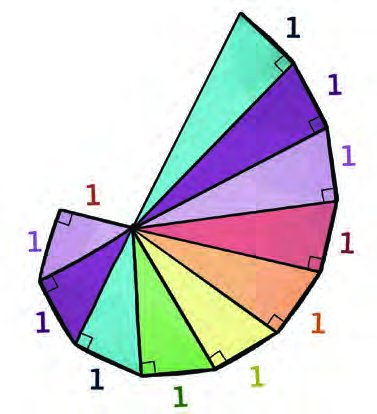
The Square Root Spiral (also known as the Spiral of Theodorus) is constructed by taking a right-angled triangle, and then using its hypotenuse as the base leg for a brand new right triangle, adding a perpendicular leg of
Let us use the Baudhāyana-Pythagoras Theorem (
- Triangle 1 (Innermost): Both base leg and perpendicular height are
1
- Triangle 2: The base leg is now
√ 2 1
- Triangle 3: The base leg is
√ 3 1
- Triangle 4: The base leg is
√ 4 2 1
- Triangle 5: The base leg is
√ 5 1
- Triangle 6: The base leg is
√ 6 1
- Triangle 7: The base leg is
√ 7 1
- Triangle 8: The base leg is
√ 8 1
- Triangle 9: The base leg is
√ 9 3 1
- Triangle 10: The base leg is
√ 1 0 1
- Triangle 11 (Outermost in Fig. 3.14): The base leg is
√ 1 1 1
Summary of Hypotenuse Lengths: The lengths form a beautiful, perfect sequence of square roots of consecutive natural numbers: