Sections 6.1 to 6.5 (Perimeter of Shapes and Circles)
This chapter develops perimeter of circles and circular arcs (including athletics-track staggers), then moves on to area of parallelograms, triangles (including Heron’s formula), cyclic quadrilaterals (Brahmagupta), and sectors and segments of circles.
Section 6.1: Think and Reflect (Fig. 6.1)
In Fig. 6.1, you see athletes assembled at the start of a
- What could be the reason for this?
- Do you think the stagger gives anyone (those in the outer lanes or in the inner lanes) an unfair advantage? Why or why not?
- On what basis can the organisers work out the length of the stagger between lanes?
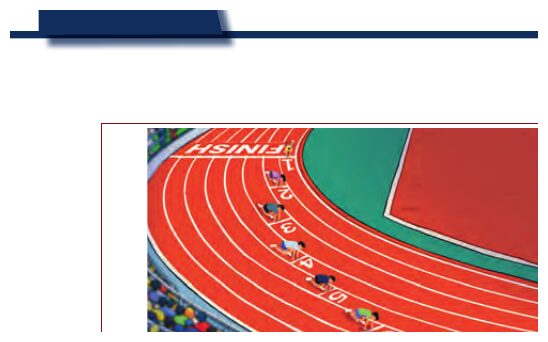
- Reason for different starting lines: An athletics track consists of two straight sections and two curved semicircular turns. As you move from the inner lanes to the outer lanes, the radius of the semicircular curves increases. This means an outer lane is physically longer than an inner lane around the curve. To ensure that every athlete runs the exact same total distance (400 meters), athletes in outer lanes must start further ahead.
- Fairness: No, the stagger does not give anyone an unfair advantage. It simply compensates for the extra distance on the outer curves, making the total running distance identical for every lane.
- Basis for calculation: Organizers calculate the stagger by finding the difference between the perimeters (circumferences) of the curved sections of adjacent lanes. If a lane has a width of
𝑤 𝑤 2 𝜋 𝑤
Section 6.1: Think and Reflect (Page 118)
In my school, the playground is too small to have a 400 m track, so the school constructed a 200 m track instead. Does this mean that we need a smaller stagger for the race tracks in my school (i.e., smaller than the stagger used in the Olympics), for the same
No, you do not need a smaller stagger per lap; in fact, for a
- The stagger for completing one full set of turns (
3 6 0 ∘ 𝑟 1 𝑟 2 2 𝜋 ( 𝑟 2 − 𝑟 1 ) ( 𝑟 2 − 𝑟 1 ) - On a standard 400 m track, a
4 × 1 0 0 m - On a 200 m track, a 400 m race requires athletes to run two full laps (two full circles of turns).
- Since the runners go around the curves twice as many times on a 200 m track, the outer lane runners experience the curve penalty twice. Therefore, if they stay in their lanes for the entire race, the total stagger required is double that of a 400 m track.
Section 6.1: Think and Reflect (Page 119)
Here we see a circle with radius
- Perimeter of the circle: The perimeter (called the circumference) of a circle with radius
𝑟 2 𝜋 𝑟 u n i t s - How we find out: We find it by discovering that the ratio of a circle's circumference (
𝐶 𝐷 = 2 𝑟 3 . 1 4 1 6 𝜋 𝐶 = 𝜋 𝐷 = 2 𝜋 𝑟 - Connection to the athletics track: The two curved portions of an athletics track form two semicircles that fit together to make one complete circle. To calculate how much longer an outer lane is compared to an inner lane (the stagger), we must use the circle perimeter formula
2 𝜋 𝑟
Section 6.2: Home Measurement Activity (Page 120)
Take a cotton reel with thin thread around it. Measure the diameter
- Experimental Result: When you perform this experiment, wrapping the thread 20 times reduces measurement errors. The total length
𝐿 2 0 𝐶 2 0 𝐷 𝐶 𝐷 𝜋 3 . 1 4 1 5 9 - Estimation using pure geometry: You can estimate the ratio without physical measurements by drawing a circle and inscribing (drawing inside) and circumscribing (drawing outside) regular polygons with straight sides, such as hexagons. Because straight line segments can be calculated using the Baudhāyana-Pythagoras theorem, we can calculate the exact perimeters of the inner and outer polygons. The circle's circumference must lie trapped between the smaller inner polygon's perimeter and the larger outer polygon's perimeter.
Section 6.2: In-Text Questions (Pages 121–122)
Question 1: Can you see why Fig. 6.6 shows that
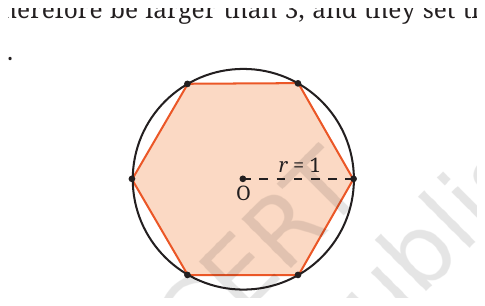
In Fig. 6.6, a regular hexagon is inscribed inside a circle of radius
Question 2: Can you see why Fig. 6.7 tells us that
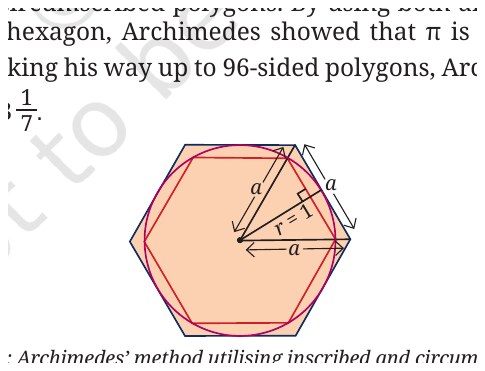
- Inner Hexagon (Lower Bound): As shown above, a regular hexagon inscribed in a circle of radius
𝑟 = 1 1 6 𝜋 > 6 2 = 3 - Outer Hexagon (Upper Bound): For a regular hexagon circumscribed outside a circle of radius
𝑟 = 1 9 0 ∘ ℎ = 1 𝑎
By the Baudhāyana-Pythagoras theorem on half of this triangle:
The perimeter of this outer hexagon is
- Conclusion: Since the circle lies between the inner and outer hexagons, its circumference
𝐶 6 4 √ 3 𝐷 = 2 𝜋 6 2 4 √ 3 2 3 < 𝜋 < 2 √ 3 2 √ 3 ≈ 3 . 4 6
Section 6.4: A Closer Look at a 400 m Athletics Track — Think and Reflect (Page 127)
- What is the difference in radius between the first and second lanes?
- Use Fig. 6.11 to find the stagger needed by the runner in the second lane.
- Will an equal stagger be needed between the third and second lanes?
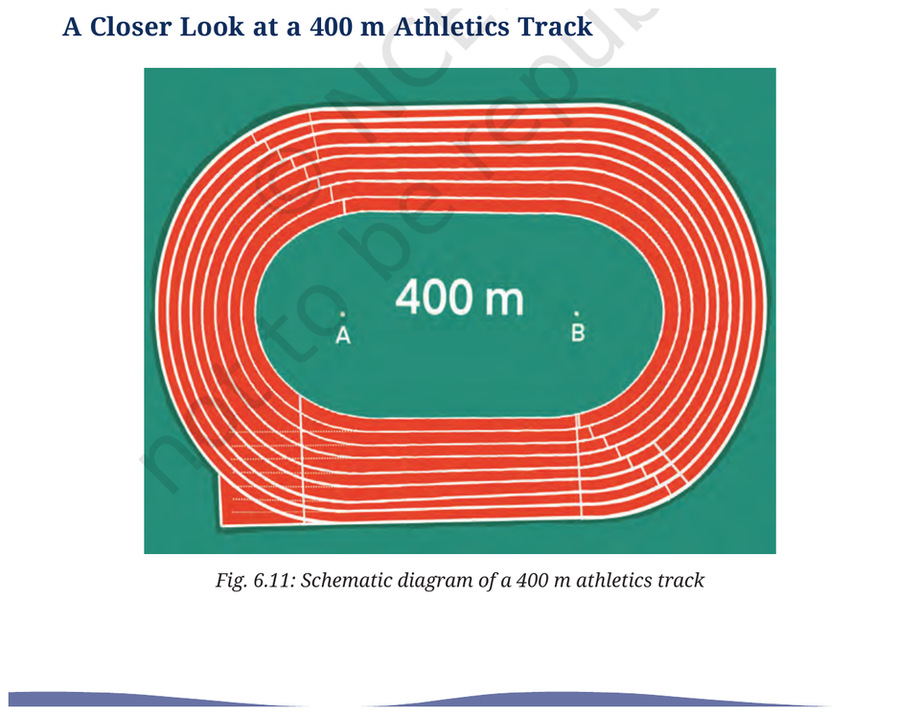
- Difference in radius: The width of each lane is given as
1 . 2 2 m 1 . 2 2 m - Stagger for second lane: A runner in lane 1 runs at radius
𝑟 1 = 3 6 . 5 + 0 . 3 = 3 6 . 8 m 𝑟 2 = 3 6 . 8 + 1 . 2 2 = 3 8 . 0 2 m
- Equal stagger for third lane: Yes, an equal stagger of
7 . 6 7 m 1 . 2 2 m
Section 6.5: Worked Examples (Redone Step-by-Step)
Two circles of equal radius are located such that each circle passes through the centre of the other circle (Fig. 6.12). Given that the radius of each circle is
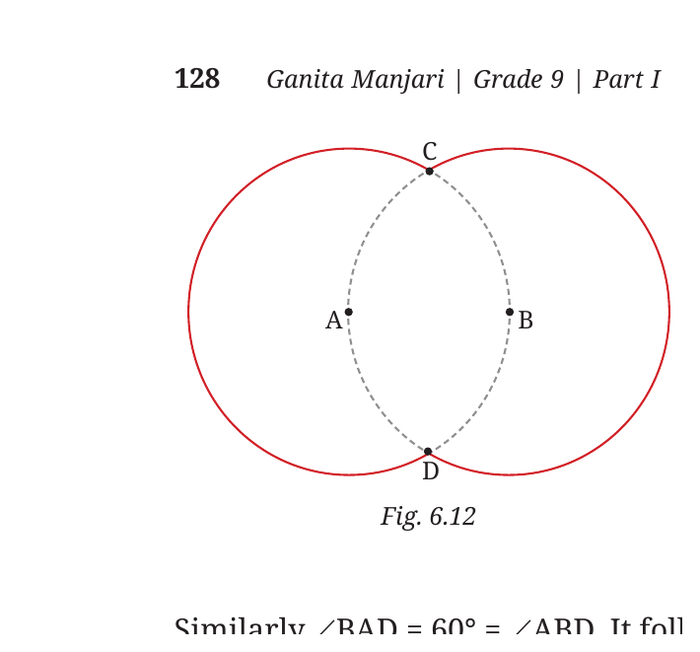
- Identify the geometric triangle: Let the centers of the two circles be
𝐴 𝐵 𝐶 𝐷 △ 𝐴 𝐵 𝐶 - Find side lengths: Since point
𝐵 𝐴 𝐴 𝐵 = 𝑟 𝐶 𝐴 𝐴 𝐶 = 𝑟 𝐶 𝐵 𝐵 𝐶 = 𝑟 - Determine central angles: Because
𝐴 𝐵 = 𝐴 𝐶 = 𝐵 𝐶 = 𝑟 △ 𝐴 𝐵 𝐶 ∠ 𝐶 𝐴 𝐵 = 6 0 ∘ △ 𝐴 𝐵 𝐷 ∠ 𝐵 𝐴 𝐷 = 6 0 ∘ - Find the angle of the inner dotted arc: The total angle subtended by the inner dotted arc
𝐶 𝐷 𝐴 ∠ 𝐶 𝐴 𝐷 = 6 0 ∘ + 6 0 ∘ = 1 2 0 ∘ - Find the angle of the outer red arc: A full circle has
3 6 0 ∘ 𝐴
In terms of fractions, this outer arc is
- Calculate total perimeter: The combined shape consists of two such outer arcs (one from each circle).
In Fig. 6.13, we see points
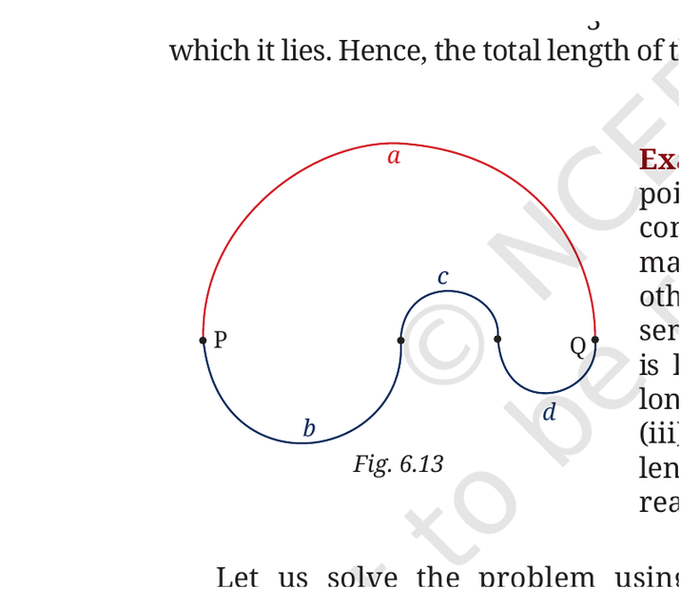
- Define radii: Let the radius of semicircle
𝑎 𝑟 𝑎 𝑏 , 𝑐 , 𝑑 𝑟 𝑏 , 𝑟 𝑐 , 𝑟 𝑑 - Express lengths of semicircular arcs: The length of any semicircle of radius
𝑟 𝜋 𝑟
- Length of Path 1 (semicircle
𝑎 = 𝜋 𝑟 𝑎 - Length of Path 2 (semicircles
𝑏 + 𝑐 + 𝑑 = 𝜋 𝑟 𝑏 + 𝜋 𝑟 𝑐 + 𝜋 𝑟 𝑑 = 𝜋 ( 𝑟 𝑏 + 𝑟 𝑐 + 𝑟 𝑑 )
- Relate the diameters along the straight line: All semicircles lie along the same straight baseline connecting
𝑃 𝑄 2 𝑟 𝑎
- Compare path lengths: Substituting
𝑟 𝑎
- Conclusion: Therefore, (iii) The two paths have equal length.
Section 6.5: Exercise Set 6.1 (Pages 129–130)
The perimeter of a circle is
We use the circumference formula
Multiply both sides by
Calculate, correct to 3 significant figures, the circumference of a circle with: (i) radius
- (i) Radius
𝑟 = 7 c m
- (ii) Radius
𝑟 = 1 0 c m
- (iii) Radius
𝑟 = 1 2 c m
Calculate the length of the arc of a circle if: (i) the radius is
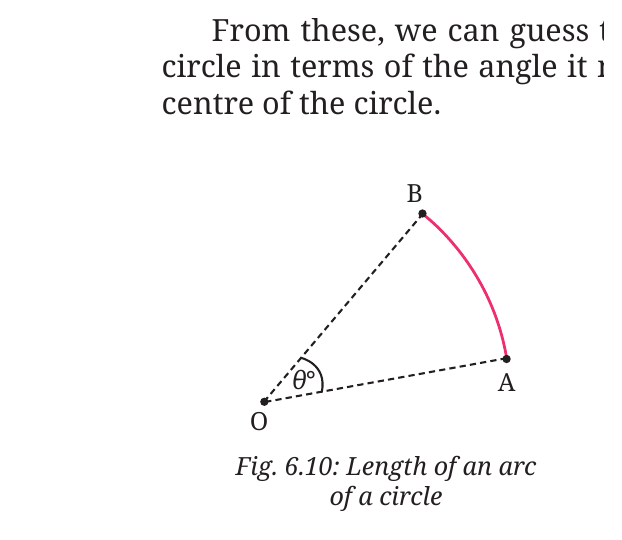
The formula for arc length is
- (i)
𝑟 = 3 . 5 c m 𝜃 = 6 0 ∘
- (ii)
𝑟 = 6 . 3 m 𝜃 = 1 2 0 ∘
Find the perimeter of a sector (i.e., the curved portion as well as the two straight portions) of a circle of radius
- Find curved arc length (
𝑙
- Add the two straight radius edges:
Find the perimeters of the following shapes (taking the arcs to be quarter or half or three-quarters of a circle, as appropriate) (Fig. 6.14i to 6.14ix):
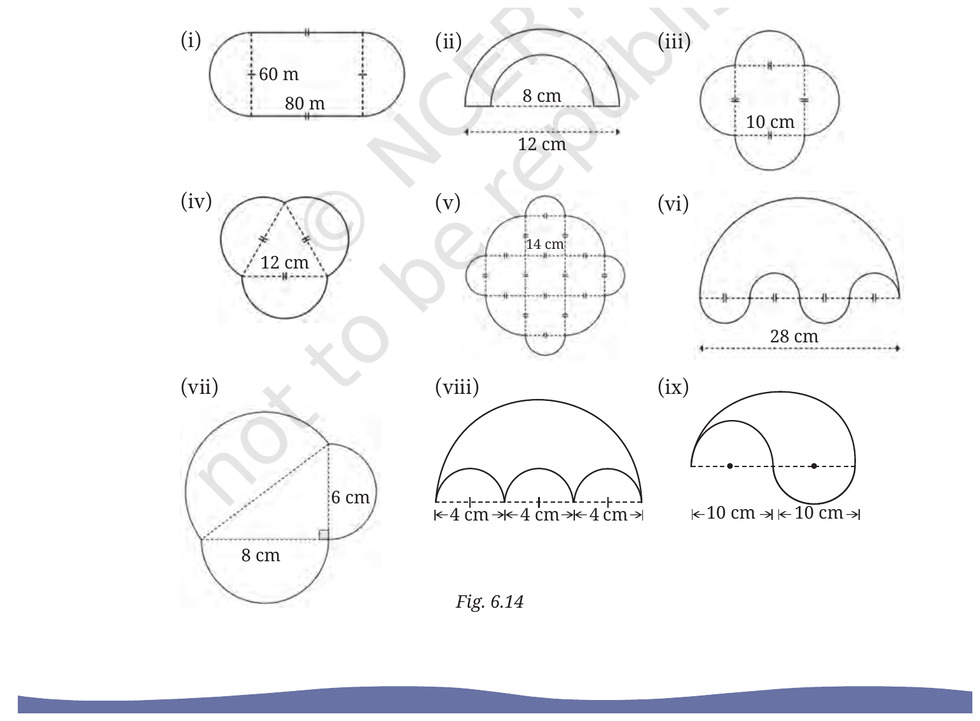
- (i) Stadium: rectangular length
8 0 m 6 0 m P e r i m e t e r = 2 × 8 0 + 𝜋 × 6 0 = 1 6 0 + 1 3 2 0 7 = 𝟐 𝟒 𝟒 𝟎 𝟕 m ≈ 𝟑 𝟒 𝟖 . 𝟓 𝟕 m - (ii) Semicircle on diameter
1 2 c m 𝑟 = 6 c m 8 c m 1 2 c m 𝑟 = 6 P e r i m e t e r = 𝜋 𝑟 + 2 𝑟 = 6 𝜋 + 1 2 = 𝟐 𝟏 𝟔 𝟕 c m ≈ 𝟑 𝟎 . 𝟖 𝟔 c m - (iii) Square side
1 0 c m P e r i m e t e r = 4 × ( 𝜋 × 5 ) = 2 0 𝜋 = 𝟒 𝟒 𝟎 𝟕 c m ≈ 𝟔 𝟐 . 𝟖 𝟔 c m - (iv) Three semicircles on the sides of an equilateral triangle of side
1 2 c m P e r i m e t e r = 3 × ( 𝜋 × 6 ) = 1 8 𝜋 = 𝟑 𝟗 𝟔 𝟕 c m ≈ 𝟓 𝟔 . 𝟓 𝟕 c m - (v) Square side
1 4 c m P e r i m e t e r = 4 × ( 𝜋 × 7 ) = 2 8 𝜋 = 𝟖 𝟖 c m - (vi) Large semicircle diameter
2 8 c m 1 4 c m P e r i m e t e r = 𝜋 × 1 4 + 2 × ( 𝜋 × 7 ) = 2 8 𝜋 = 𝟖 𝟖 c m - (vii) Circle diameter
8 c m 6 c m P e r i m e t e r = 2 𝜋 × 4 + 𝜋 × 3 = 1 1 𝜋 = 𝟐 𝟒 𝟐 𝟕 c m ≈ 𝟑 𝟒 . 𝟓 𝟕 c m - (viii) Large semicircle diameter
1 2 c m 4 c m P e r i m e t e r = 𝜋 × 6 + 3 × ( 𝜋 × 2 ) = 1 2 𝜋 = 𝟐 𝟔 𝟒 𝟕 c m ≈ 𝟑 𝟕 . 𝟕 𝟏 c m - (ix) S-curve / double lobe with two
1 0 c m 1 0 5 O u t e r + d i v i d e r = 2 × ( 2 𝜋 × 1 0 ) / 2 + 2 × ( 2 𝜋 × 5 ) / 2 = 2 0 𝜋 + 1 0 𝜋 = 3 0 𝜋 = 𝟔 𝟔 𝟎 𝟕 c m ≈ 𝟗 𝟒 . 𝟐 𝟗 c m
If the diameter of a car tyre is
- (i) Distance for one revolution: This equals the circumference of the tyre:
- (ii) Number of revolutions in
1 0 k m 1 0 k m
Find the total perimeter of all the petals in each of the given flowers: (i) Fig. 6.15A: Square of side
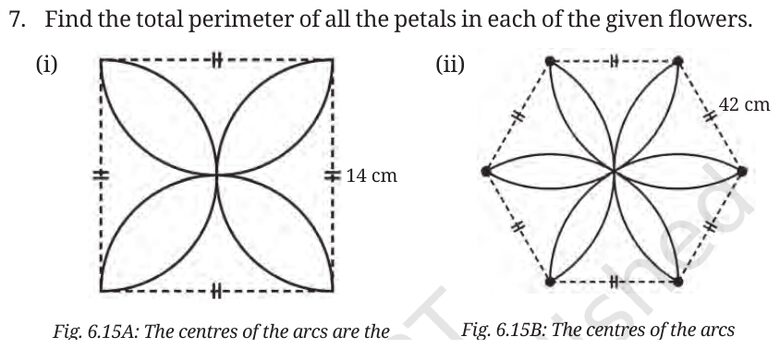
- (i) Square flower (Fig. 6.15A):
- Since the arc centers are at the midpoints of the square's sides (
1 4 c m 𝑟 = 1 4 2 = 7 c m - Each corner of the square forms a
9 0 ∘ 9 0 ∘ 3 6 0 ∘ = 1 4 - There are 4 petals, and each petal is bounded by 2 such quarter-circle arcs, making a total of
4 × 2 = 8 - Eight quarter circles equal 2 complete circles of radius
7 c m
- (ii) Hexagon flower (Fig. 6.15B):
- The centers of the arcs are the vertices of the hexagon, and the radius extends along the side length, so
𝑟 = 4 2 c m - In a regular hexagon, the interior angle of the equilateral triangles forming the petals from each vertex is
6 0 ∘ 6 0 ∘ 6 0 ∘ 3 6 0 ∘ = 1 6 - There are 6 petals, bounded by
6 × 2 = 1 2 - Twelve one-sixth circular arcs equal 2 complete circles of radius
4 2 c m
The ratio of the perimeters of two circles is
Let the two circles have radii
Since the constant
Sections 6.6 to 6.9 (Parallelograms, Triangles, and Special Formulas)
Section 6.7: Area of a Parallelogram — Think and Reflect (Page 131, Top)
What happens if the parallelogram is 'thin' (Fig. 6.18) and the foot of the perpendicular from
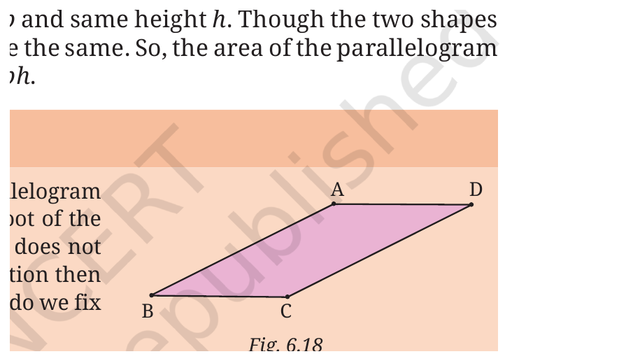
When a parallelogram is very slanted or "thin," dropping a perpendicular straight down from top vertex
- Extend the baseline
𝐴 𝐷 - Mark a point
𝐷 ′ 𝐴 𝐷 𝐷 𝐴 ′ 𝐴 ′ 𝐴 = 𝐷 ′ 𝐷 - If you slice off the right-angled triangle
△ 𝐶 𝐷 𝐷 ′ △ 𝐵 𝐴 𝐴 ′ △ 𝐶 𝐷 𝐷 ′ ≅ △ 𝐵 𝐴 𝐴 ′ - This cutting and shifting creates a new parallelogram
𝐴 ′ 𝐵 𝐶 𝐷 ′ - If the new parallelogram is still too slanted, repeat this slicing and shifting step as many times as needed until the perpendicular falls inside the top side, allowing you to form a standard rectangle.
Section 6.7: Area of a Parallelogram — Think and Reflect (Page 131, Bottom)
The area of a rectangle can be found when we know the lengths of its sides. Is the same true for a parallelogram? That is, can we find the area of a parallelogram when we know the lengths of its sides? Why or why not? (Hint: What happens to the area of a parallelogram if we decrease or increase the angle between the adjacent sides while keeping the lengths fixed?)
No, we cannot find the area of a parallelogram knowing only the lengths of its sides.
- Reasoning: Imagine four wooden strips joined by hinges at the corners to form a parallelogram. If you keep the side lengths completely fixed, you can still push or pull the frame to tilt it at different angles.
- As you lean the parallelogram over and flatten it, the perpendicular height (
ℎ b a s e × h e i g h t
Section 6.8: Area of a Triangle — Think and Reflect (Page 132)
What would we do if angle
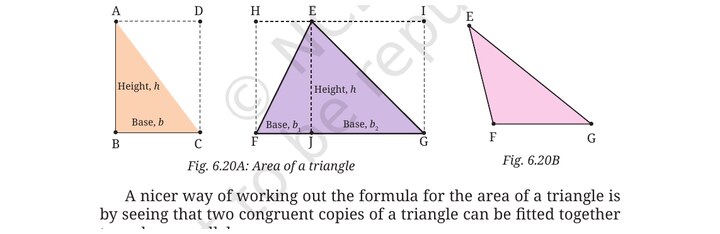
In Fig. 6.20B, triangle
- Extend the baseline
𝐹 𝐺 𝐸 𝐻 𝐸 𝐻 = ℎ - Draw a complete bounding rectangle
𝐻 𝐼 𝐽 𝐺 𝐻 𝐺 = 𝑏 1 + 𝑏 2 ℎ 𝑏 1 𝐻 𝐹 𝑏 2 𝐹 𝐺 - The large right-angled triangle
△ 𝐸 𝐻 𝐺
- The empty outside right-angled triangle
△ 𝐸 𝐻 𝐹
- Subtracting the outside area from the large triangle leaves the area of our obtuse triangle
△ 𝐸 𝐹 𝐺
Thus, the standard formula
Section 6.8: Area of a Triangle — Think and Reflect (Page 133)
Since
Yes, it is absolutely possible! In geometry, a fundamental rule called the Bolyai-Gerwien Theorem proves that any two polygons (straight-sided flat shapes) that have the exact same area can always be sliced into a finite number of triangular pieces and reassembled to form one another. Since median
Section 6.8: Area of a Triangle — Think and Reflect (Page 134, Top)
Suppose we are given two polygons
- A square and non-square rectangle with equal area,
- Two triangles with different shapes but equal area,
- A triangle and a square with equal area.
Formulate a conjecture of your own about this.
- 1. Square and rectangle of equal area: Yes. By stepping through Baudhāyana's ancient squaring method (shown in Section 6.9), you can geometrically cut any rectangle and rearrange its sections into a square of identical area.
- 2. Two differently shaped triangles of equal area: Yes. You can slice each triangle through its height to form a rectangle of half the height. Since both rectangles will have equal area, you can convert one into the other, and thus reassemble the second triangle.
- 3. A triangle and a square of equal area: Yes. By cutting the triangle horizontally at half its height, you can hinge the top piece down to form a rectangle, and then cut that rectangle to form a square.
- My Conjecture: "Any two simple two-dimensional polygons having the same area can be dissected into a finite number of polygonal pieces and reassembled into each other." (As mentioned above, this conjecture is mathematically proven and known as the Bolyai-Gerwien Theorem).
Section 6.8: Area of a Triangle — Think and Reflect (Page 134, Middle)
Think of various rectangles with perimeter
- How many such rectangles are there?
- Among them, is there one whose area is the largest? What are its dimensions?
- Among all these rectangles, is there one whose area is the smallest? What are its dimensions? Do either of these answers come as a surprise to you?
- Number of rectangles: There are infinitely many such rectangles. If length is
𝑙 𝑤 2 ( 𝑙 + 𝑤 ) = 4 0 𝑙 + 𝑤 = 2 0 1 0 1 0 1 5 5 1 9 . 5 0 . 5 - Largest area: Yes, there is a maximum. The area is expressed as
𝐴 = 𝑙 × 𝑤 = 𝑙 ( 2 0 − 𝑙 ) = 2 0 𝑙 − 𝑙 2 𝑙 = 𝑤 = 1 0 1 0 u n i t s × 1 0 u n i t s 1 0 0 s q . u n i t s - Smallest area: No, there is no smallest rectangle with an area greater than zero. If you make the length extremely close to
2 0 1 9 . 9 9 9 0 0 . 0 0 1 4 0 0 . 0 1 9 9 9 s q . u n i t s
- Surprise factor: It often surprises people that shapes with the exact same boundary length (40 units) can enclose vastly different amounts of space—ranging from virtually empty (
0 1 0 0 s q . u n i t s
Section 6.8.1: Worked Examples (Heron's Formula Redone Step-by-Step)
Use Heron's formula to find the area of an equilateral triangle with side
- Find semi-perimeter (
𝑠 𝑎 𝑎 + 𝑎 + 𝑎 = 3 𝑎
- Apply Heron's formula:
Taking the square root of the top and bottom:
- Check using
1 2 × b a s e × h e i g h t
- In an equilateral triangle, dropping a vertical height
ℎ 𝑎 𝑎 2 - By the Baudhāyana-Pythagoras theorem on the right-angled half-triangle:
- Calculating area:
Both formulas yield the exact same result!
Use Heron's formula to find the area of an isosceles triangle with equal sides
- Find semi-perimeter (
𝑠 𝑎 𝑎 2 𝑏
- Apply Heron's formula:
Rearrange the terms to group
Using the difference-of-two-squares identity
- Check using
1 2 × b a s e × h e i g h t
- In an isosceles triangle, the perpendicular height
ℎ 2 𝑏 𝑏 - By the Baudhāyana-Pythagoras theorem:
- Calculating area:
The results match perfectly!
Use Heron's formula to find the area of a triangle with sides
- Find semi-perimeter (
𝑠
- Apply Heron's formula:
- Check using
1 2 × b a s e × h e i g h t
- Notice the relationship between the sides:
3 2 + 4 2 = 9 + 1 6 = 2 5 = 5 2 - By the converse of the Baudhāyana-Pythagoras theorem, this is a right-angled triangle with hypotenuse
5 3 4 - Calculating area:
Both methods confirm the area is 6.
Section 6.8.1: Brahmagupta's Formula — Worked Examples (Pages 138–139)
Verify Brahmagupta's formula for the case of a rectangle.
- Cyclic property: Every rectangle can be inscribed in a circle (its corners touch a circumcircle whose diameter is the rectangle's diagonal), so Brahmagupta's formula applies.
- Define sides and find semi-perimeter (
𝑠 𝑎 , 𝑏 , 𝑎 , 𝑏
- Apply Brahmagupta's formula:
This matches the standard formula for the area of a rectangle (
Verify Brahmagupta's formula for the case of an isosceles trapezium.
- Define sides: An isosceles trapezium has two parallel bases and two equal slanted sides. Let the top base be
2 𝑎 2 𝑏 𝑐 𝑐 - Find semi-perimeter (
𝑠
- Calculate the four bracketed terms for Brahmagupta's formula:
𝑠 − t o p b a s e = ( 𝑎 + 𝑏 + 𝑐 ) − 2 𝑎 = 𝑏 + 𝑐 − 𝑎 𝑠 − b o t t o m b a s e = ( 𝑎 + 𝑏 + 𝑐 ) − 2 𝑏 = 𝑎 + 𝑐 − 𝑏 𝑠 − l e g 1 = ( 𝑎 + 𝑏 + 𝑐 ) − 𝑐 = 𝑎 + 𝑏 𝑠 − l e g 2 = ( 𝑎 + 𝑏 + 𝑐 ) − 𝑐 = 𝑎 + 𝑏
- Substitute into Brahmagupta's formula:
Using the difference-of-two-squares identity on the term under the square root:
- Check against standard trapezium geometry:
- Drop vertical height lines (
ℎ 2 𝑎 2 𝑏 ( 2 𝑏 − 2 𝑎 ) 2 𝑏 − 2 𝑎 2 = 𝑏 − 𝑎 - By the Baudhāyana-Pythagoras theorem on one outer right-angled triangle:
- Standard trapezium area formula is
1 2 ( s u m o f p a r a l l e l s i d e s ) × h e i g h t
Both derivations arrive at the exact same formula!
Section 6.9: Squaring a Rectangle — Think and Reflect (Page 142)
What procedure would you use to square a given triangle? Here, the task is to construct a square whose area is equal to the area of some given triangle. Think carefully. How would you proceed?
To geometrically construct a square that has the exact same area as a given triangle, we combine two major constructions in sequence:
- Step 1: Convert the triangle into a rectangle of equal area.
- Measure the base
𝑏 ℎ - Construct a rectangle that has the same base
𝑏 ℎ 2 - Since the rectangle's area is
𝑏 × ℎ 2 = 1 2 𝑏 ℎ
- Step 2: Convert the rectangle into a square.
- Apply Baudhāyana's ancient squaring construction (detailed in Section 6.9) to this new rectangle. By drawing circular arcs and forming right-angled triangles with side segments
𝑎 + 𝑏 2 𝑎 − 𝑏 2 √ 1 2 𝑏 ℎ
Section 6.9: Exercise Set 6.2 (Pages 142–143)
Find the area of triangle
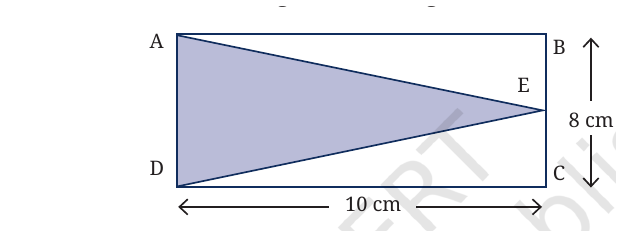
- Analyze Fig. 6.31: The diagram shows a rectangle
𝐴 𝐵 𝐶 𝐷 𝐷 𝐶 = 1 0 c m 𝐵 𝐶 = 8 c m - Identify triangle base and height: The triangle
△ 𝐴 𝐷 𝐸 b a s e 𝐴 𝐷 = 8 c m 𝐸 𝐵 𝐶 𝐸 𝐴 𝐷 h e i g h t = 1 0 c m - Calculate Area:
The parallel sides of a trapezium are
- Find horizontal corner segments: Because the non-parallel sides are equal (
2 6 c m ℎ 2 0 c m 4 0 c m
- Calculate height (
ℎ = 2 6 = 1 0
- Calculate Area:
Find the area of a triangle, given that its sides are
- Find the third side (
𝑐
- Find semi-perimeter (
𝑠
- Apply Heron's formula:
Break into simpler numbers to find the square root:
The sides of a triangular plot are in the ratio
- Find actual side lengths: Let the ratio multiplier be
𝑥
- Side
𝑎 = 3 × 2 0 = 6 0 m - Side
𝑏 = 5 × 2 0 = 1 0 0 m - Side
𝑐 = 7 × 2 0 = 1 4 0 m
- Find semi-perimeter (
𝑠
- Apply Heron's formula:
One diagonal of a rhombus is twice as long as the other diagonal. If the rhombus has area
- Set up diagonal relationship: Let the shorter diagonal be
𝑑 2 𝑑 - Use rhombus area formula: The area of any rhombus is half the product of its diagonals:
- Solve for shorter diagonal (
𝑑
(Note: In the original PDF text, an OCR/printing artifact renders the triangle symbol
Both triangles have the exact same area, so the ratio is
- Reasoning: Both triangles
△ 𝑃 𝐶 𝐷 △ 𝑄 𝐶 𝐷 𝐶 𝐷 𝑃 𝑄 𝐴 𝐵 𝐶 𝐷 ℎ - Since
A r e a = 1 2 × b a s e 𝐶 𝐷 × h e i g h t ℎ
- Identify the common base: Both triangles
△ 𝑃 𝑆 𝑂 △ 𝑃 𝑄 𝑂 𝑃 𝑂 𝑃 𝑅 - Compare heights: In a parallelogram
𝑃 𝑄 𝑅 𝑆 𝑃 𝑅 △ 𝑃 𝑆 𝑅 ≅ △ 𝑃 𝑄 𝑅 ℎ 𝑆 𝑃 𝑅 𝑄 𝑃 𝑅 - Calculate area:
A r e a ( △ 𝑃 𝑆 𝑂 ) = 1 2 × b a s e 𝑃 𝑂 × a l t i t u d e ℎ A r e a ( △ 𝑃 𝑄 𝑂 ) = 1 2 × b a s e 𝑃 𝑂 × a l t i t u d e ℎ
- Conclusion: Since both the base and the perpendicular height are equal,
A r e a ( △ 𝑃 𝑆 𝑂 ) = A r e a ( △ 𝑃 𝑄 𝑂 )
If the mid-points of the sides of a 4-gon (also known as a quadrilateral, but we prefer to call it a '4-gon') are joined in order, prove that the area of the parallelogram thus formed will be half of the area of the given 4-gon.
- Set up the shape: Let the 4-gon be
𝐴 𝐵 𝐶 𝐷 𝐴 𝐵 , 𝐵 𝐶 , 𝐶 𝐷 , 𝐷 𝐴 𝐸 , 𝐹 , 𝐺 , 𝐻 𝐸 𝐹 𝐺 𝐻 - Draw diagonal
𝐴 𝐶 △ 𝐴 𝐵 𝐶 𝐸 𝐹 𝐴 𝐵 𝐵 𝐶 1 2 1 2
- Apply to opposite corner: Similarly, in top triangle
△ 𝐴 𝐷 𝐶 𝐻 𝐺
- Sum the first pair of corners: Adding these two corner areas together:
- Sum the second pair of corners: Draw the other diagonal
𝐵 𝐷 △ 𝐻 𝐴 𝐸 △ 𝐹 𝐶 𝐺
- Combine all four outer corners:
- Conclusion: The inner parallelogram
𝐸 𝐹 𝐺 𝐻
In
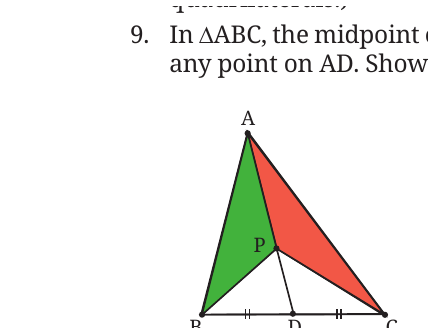
- Use the triangle median theorem: As proven in Section 6.8, a median divides any triangle into two smaller triangles of equal area.
- Analyze the large triangle: In
△ 𝐴 𝐵 𝐶 𝐴 𝐷 𝐷 𝐵 𝐶
- Analyze the small lower triangle: In
△ 𝑃 𝐵 𝐶 𝑃 𝐷 𝐵 𝐶
- Subtract the lower section from the large section:
Since we are subtracting equal quantities from equal quantities,
Given a square
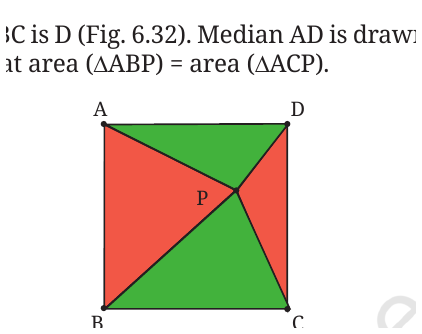
The ratio of the areas of the red region to the green region is
- Step-by-Step Proof:
- Let the side length of square
𝐴 𝐵 𝐶 𝐷 𝑠 𝑠 2 - For the red region, triangle
△ 𝑃 𝐴 𝐵 𝐴 𝐵 = 𝑠 𝑃 𝐴 𝐵 ℎ 1 1 2 𝑠 ℎ 1 - Opposite red triangle
△ 𝑃 𝐶 𝐷 𝐶 𝐷 = 𝑠 𝑃 𝐶 𝐷 ℎ 2 1 2 𝑠 ℎ 2 - Because sides
𝐴 𝐵 𝐶 𝐷 ℎ 1 + ℎ 2 = 𝑠 - Add the two red triangles together:
- Since the red region occupies exactly half the area of the square, the green region must occupy the remaining half (
1 2 𝑠 2 1 : 1
In
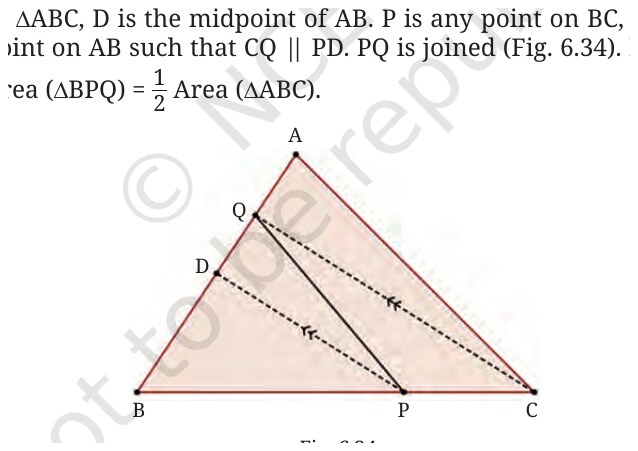
- Start with median
𝐶 𝐷 𝐷 𝐴 𝐵 𝐶 𝐷 △ 𝐴 𝐵 𝐶 △ 𝐵 𝐶 𝐷
- Split
△ 𝐵 𝐶 𝐷 𝑃 𝐷
- Compare parallel-line triangles
△ 𝑃 𝐶 𝐷 △ 𝑃 𝑄 𝐷
- Both triangles share the exact same base segment,
𝑃 𝐷 - Their opposite vertices,
𝐶 𝑄 𝐶 𝑄 𝑃 𝐷 𝐶 𝑄 ∥ 𝑃 𝐷 - Because triangles between the same parallel lines and sharing the same base have equal area:
- Assemble target triangle
△ 𝐵 𝑃 𝑄 △ 𝐵 𝑃 𝑄
Substitute our equal area from Step 3 into this equation:
- Conclusion: Since we established in Step 1 that
A r e a ( △ 𝐵 𝐶 𝐷 ) = 1 2 A r e a ( △ 𝐴 𝐵 𝐶 ) A r e a ( △ 𝐵 𝑃 𝑄 ) = 1 2 A r e a ( △ 𝐴 𝐵 𝐶 )
Section 6.10 (Area of a Circle, Sectors, Segments, and Exercise Set 6.3)
Section 6.10: Area of a Circle — Think and Reflect (Page 144)
Why were human beings so fond of using circular shapes? Was this only for practical reasons, or could there have been other reasons too? What kinds of uses have human beings found for the circular shape?
- Reasons for fondness (Practical & Aesthetic): Human beings favored circular shapes for both practical and symbolic reasons. Practically, a circle encloses the maximum possible area for a given perimeter (boundary length), making it the most efficient shape for building storage structures or fencing cattle. Symbolically, circles represent wholeness, symmetry, the sun, the moon, and the natural cycles of seasons and time.
- Kinds of uses: Throughout history, humans have used circles in:
- Architecture and Storage: Cylindrical grain towers, huts, wells, and circular garden plots.
- Tools and Technology: Wheels for transport, potter's wheels, gears, pulleys, and coins.
- Timekeeping and Astronomy: Sun dials, clocks, and astrolabes for charting celestial bodies.
Section 6.10: Exercise Set 6.3 (Pages 148)
Find the area of a sector of a circle with radius
- Identify the formula: The area of a sector with central angle
𝜃 𝑟
- Substitute given values: Here,
𝑟 = 7 c m 𝜃 = 6 0 ∘
- Simplify step-by-step:
Converting to a mixed number or decimal:
Find the area of a quadrant of a circle whose circumference is
- Find the radius (
𝑟 𝐶 = 2 𝜋 𝑟
- Calculate area of a quadrant: A quadrant is one-fourth (
1 4 𝜃 = 9 0 ∘
- Simplify step-by-step:
The length of the minute hand of a clock is
- Find the angle swept in 10 minutes: A clock face is a full circle of
3 6 0 ∘ 6 0 m i n u t e s 1 m i n u t e 3 6 0 ∘ 6 0 = 6 ∘ 1 0 m i n u t e s 𝜃
- Apply the sector area formula: The length of the minute hand acts as the radius,
𝑟 = 7 c m
- Simplify step-by-step:
A chord of a circle of radius
- (i) Area of the minor sector (
𝜃 = 9 0 ∘
- Substitute
𝑟 = 1 0 c m 𝜃 = 9 0 ∘ 𝜋 = 3 . 1 4
- Simplify:
- (ii) Area of the major sector (
𝜃 = 2 7 0 ∘
- The central angle for the major sector is
3 6 0 ∘ − 9 0 ∘ = 2 7 0 ∘
- Simplify:
(Check: Total area of the circle is
A chord of a circle of radius
- Find the area of the minor sector (
𝜃 = 6 0 ∘
- Find the area of the triangle formed by the chord and radii:
- Since the central angle is
6 0 ∘ 1 5 c m 𝑎 = 1 5 c m - Using the equilateral triangle area formula from Section 6.8.1:
- Calculate the area of the minor segment:
- A segment is the region bounded by an arc and its chord. Subtract the triangle's area from the sector's area:
- Calculate the area of the major segment:
- First, find the total area of the circle:
- Subtract the minor segment from the total circle area:
A car has two wipers which do not overlap. Each wiper has a blade of length
- Find the area swept by ONE wiper: Each wiper sweeps out a circular sector with radius
𝑟 = 2 8 c m 𝜃 = 1 2 0 ∘
- Find the total area cleaned by TWO wipers: Multiply by 2:
A chord of a circle of radius
- Express the minor sector area: For central angle
𝜃 = 6 0 ∘ 6 0 3 6 0 = 1 6
- Express the triangle area: Because the central angle is
6 0 ∘ 𝑟 𝑟
- Subtract triangle area from sector area:
- FLAGGING AN AMBIGUITY/TYPO IN THE TEXTBOOK: The textbook PDF prints this formula as
𝜋 𝑟 2 ( 1 6 − √ 3 4 ) 𝜋 𝑟 2 𝜋 √ 3 4 𝜋 𝑟 2 𝑟 2 ( 𝜋 6 − √ 3 4 ) 𝜋 𝑟 2 ( 1 6 − √ 3 4 𝜋 )
An equilateral triangle is inscribed in a circle of radius
- Find side length
𝑎 𝑟 𝑂 𝑂 3 6 0 ∘ 3 = 1 2 0 ∘ 𝑂 𝑎 𝑎 2 3 0 ∘ − 6 0 ∘ − 9 0 ∘
- Calculate area of the equilateral triangle:
- Form the ratio with the circle's area (
𝜋 𝑟 2
- Evaluate decimal approximation:
A square is inscribed in a circle of radius
- Find side length
𝑎 𝑑 = 2 𝑟
By the Baudhāyana-Pythagoras theorem on two adjacent sides of the square:
- Calculate area of the square: Since the area of a square is side squared (
𝑎 2
- Form the ratio with the circle's area (
𝜋 𝑟 2
- Evaluate decimal approximation:
A hexagon is inscribed in a circle of radius
- Calculate area of an inscribed regular hexagon: As established in Section 6.2, a regular hexagon inscribed in a circle of radius
𝑟 𝑎 𝑎 = 𝑟 𝑟
- Form the ratio with the circle's area (
𝜋 𝑟 2
- Evaluate decimal approximation:
- Why is this exactly twice the answer to Question 8?
In Question 8, the inscribed equilateral triangle had an area of
End-of-Chapter Exercises (Questions 1 to 14)
Question 1 (Page 149)
Identities in algebra can sometimes be shown as area relationships. For example: The figure shown (Fig. 6.41) corresponds to the identity
- How Fig. 6.41 shows
( 𝑎 + 𝑏 ) 2 = 𝑎 2 + 2 𝑎 𝑏 + 𝑏 2
- The large outer square has a total side length of
( 𝑎 + 𝑏 ) ( 𝑎 + 𝑏 ) 2 - The vertical and horizontal dividing lines split this large square into 4 smaller rooms:
- One square in the top-left with side
𝑎 𝑎 2 - One square in the bottom-right with side
𝑏 𝑏 2 - Two rectangles (top-right and bottom-left), each with length
𝑎 𝑏 𝑎 𝑏 - Adding the 4 rooms together equals the total area:
𝑎 2 + 𝑎 𝑏 + 𝑎 𝑏 + 𝑏 2 = 𝑎 2 + 2 𝑎 𝑏 + 𝑏 2
- Figure description for
( 𝑎 + 𝑏 ) ( 𝑎 − 𝑏 ) = 𝑎 2 − 𝑏 2
- To draw: Start by drawing a large square of side
𝑎 𝑎 2 𝑏 𝑏 2 𝑎 2 − 𝑏 2 - How it proves the identity: Make a single straight horizontal cut to divide the remaining L-shape into two rectangles: a vertical rectangle on the left of dimensions
𝑎 × ( 𝑎 − 𝑏 ) 𝑏 × ( 𝑎 − 𝑏 ) ( 𝑎 + 𝑏 ) ( 𝑎 − 𝑏 ) ( 𝑎 + 𝑏 ) ( 𝑎 − 𝑏 ) 𝑎 2 − 𝑏 2
- Figure description for
( 𝑎 + 𝑏 + 𝑐 ) 2 = 𝑎 2 + 𝑏 2 + 𝑐 2 + 2 𝑎 𝑏 + 2 𝑏 𝑐 + 2 𝑐 𝑎
- To draw: Draw a large square with side length
( 𝑎 + 𝑏 + 𝑐 ) 𝑎 𝑏 𝑐 - How it proves the identity: These grid lines slice the large square into 9 smaller regions:
- 3 squares along the main diagonal with side lengths
𝑎 𝑏 𝑐 𝑎 2 , 𝑏 2 , 𝑐 2 - 2 identical rectangles with dimensions
𝑎 × 𝑏 𝑎 𝑏 - 2 identical rectangles with dimensions
𝑏 × 𝑐 𝑏 𝑐 - 2 identical rectangles with dimensions
𝑐 × 𝑎 𝑐 𝑎 - Summing all 9 rooms gives the total area:
𝑎 2 + 𝑏 2 + 𝑐 2 + 2 𝑎 𝑏 + 2 𝑏 𝑐 + 2 𝑐 𝑎
Question 2 (Page 149)
An isosceles triangle has perimeter
- Find the base (
𝑐
- Find semi-perimeter (
𝑠
- Apply Heron's formula:
Question 3 (Page 149)
An isosceles triangle has base
- Find the perpendicular height (
ℎ A r e a = 1 2 × b a s e × h e i g h t
- Find the equal side length (
𝑎 1 0 2 = 5 c m
By the Baudhāyana-Pythagoras theorem on one half-triangle:
The lengths of the equal sides are
Question 4 (Page 149)
The area of a right-angled triangle is
- Find the second perpendicular leg (
𝑏
- Find the hypotenuse (
𝑐
- Calculate perimeter:
Question 5 (Page 149)
The sides of a triangle are in the ratio
- Find side lengths: Let the ratio multiplier be
𝑥
- Side
𝑎 = 2 × 5 = 1 0 c m - Side
𝑏 = 3 × 5 = 1 5 c m - Side
𝑐 = 4 × 5 = 2 0 c m
- Find semi-perimeter (
𝑠
- Apply Heron's formula using fractions for exact calculation:
Question 6 (Page 149)
The sides of a triangle have lengths
- Method 1 (Half base times height):
- Test the sides using the Baudhāyana-Pythagoras theorem:
7 2 + 2 4 2 = 4 9 + 5 7 6 = 6 2 5 2 5 2 = 6 2 5 𝑎 2 + 𝑏 2 = 𝑐 2 - By the converse of the theorem, this is a right-angled triangle with hypotenuse
2 5 c m 7 c m 2 4 c m A r e a = 1 2 × 7 × 2 4 = 7 × 1 2 = 𝟖 𝟒 c m 𝟐
- Method 2 (Heron's Formula):
- Semi-perimeter
𝑠 = 7 + 2 4 + 2 5 2 = 5 6 2 = 2 8 c m - Apply formula:
- Factor into squares:
Question 7 (Page 149)
If the wheel of a bicycle has a diameter of
- Find the distance travelled in ONE rotation (Circumference):
- Multiply by 100 rotations:
- Convert to meters (divide by 100):
Question 8 (Page 150)
Find the area of a quadrant of a circle whose circumference is
- Find the radius (
𝑟
- Calculate area of a quadrant (one-fourth of a circle):
- Simplify step-by-step:
Question 9 (Page 150)
The wheel of a car has an outer radius of
- Distance in ONE complete turn: This equals the circumference of the wheel.
- Number of turns in
1 k m 1 k m 1 k m = 1 0 0 , 0 0 0 c m
*Question 10 (Page 150)
Two rectangles have the same area and the same perimeter. Does this mean that they are congruent to each other?
Yes, they must be congruent to each other.
- Step-by-Step Mathematical Proof:
- Let Rectangle 1 have dimensions
𝑙 1 𝑤 1 𝑙 2 𝑤 2 - Because their perimeters are equal, their half-perimeters are equal:
𝑙 1 + 𝑤 1 = 𝑙 2 + 𝑤 2 = 𝑆 - Because their areas are equal:
𝑙 1 × 𝑤 1 = 𝑙 2 × 𝑤 2 = 𝑃 - In algebra, if you know the sum (
𝑆 𝑃 𝑥 2 − 𝑆 𝑥 + 𝑃 = 0 - Since a quadratic equation has at most one unique pair of roots, the dimensions
{ 𝑙 1 , 𝑤 1 } { 𝑙 2 , 𝑤 2 }
Question 11 (Page 150)
You know that the area of a parallelogram is base
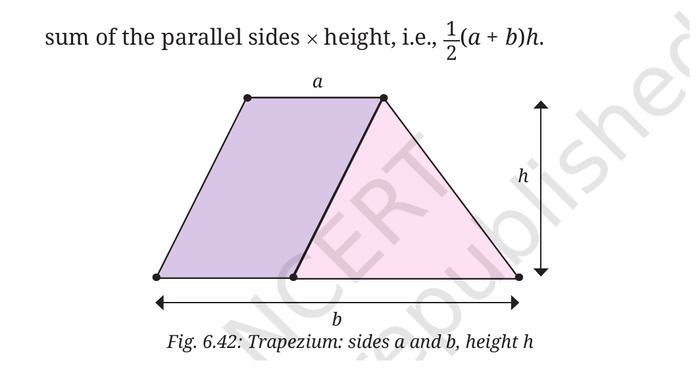
- Analyze Fig. 6.42: The diagram shows a trapezium with top parallel side
𝑎 𝑏 ℎ 𝑏 𝑎 ( 𝑏 − 𝑎 ) - Identify the two internal shapes:
- The left shaded region is a parallelogram with base
𝑎 ℎ - The right shaded region is a triangle with base
( 𝑏 − 𝑎 ) ℎ
- Sum the two areas:
Question 12 (Page 150)
By dividing a trapezium into two triangles show that its area is half the sum of the parallel sides multiplied by the height (the same formula as the one given above).
- Draw a dividing diagonal: Draw a single straight line connecting opposite corners (for example, from the top-left vertex to the bottom-right vertex). This diagonal slices the trapezium into two separate triangles.
- Find the area of the lower triangle: Its bottom base is the lower parallel side (
𝑏 ℎ
- Find the area of the upper triangle: Its top base is the upper parallel side (
𝑎 ℎ
- Sum the two triangles:
Question 13 (Page 150)
Show how we can use two identical copies of a trapezium to make a parallelogram. How will this give us the formula for the area of a trapezium?
- How to make the parallelogram: Take two identical (congruent) paper trapeziums, each having top side
𝑎 𝑏 ℎ 1 8 0 ∘ - Identify dimensions of the new shape: The top edge of the combined shape is now
𝑎 + 𝑏 𝑏 + 𝑎 ( 𝑎 + 𝑏 ) ℎ - Derive the trapezium formula:
- The area of the combined parallelogram is
b a s e × h e i g h t = ( 𝑎 + 𝑏 ) ℎ - Since this large parallelogram is built from exactly two identical trapeziums, the area of one single trapezium must be exactly half of the total:
Question 14 (Page 150)
Show that the area of a kite is half the product of its diagonals. Show this: (i) using algebra, and (ii) using geometry.
- (i) Using Algebra:
- In a kite, the two diagonals cross at right angles (
9 0 ∘ 𝑑 1 𝑑 2 𝑑 2 2 - The main diagonal
𝑑 1 𝑑 1 - The height of the upper triangle is
𝑑 2 2 𝑑 2 2 - Add the areas of the two triangles:
- (ii) Using Geometry (Visual Enclosing Rectangle):
- Draw a tightly fitting box (a bounding rectangle) around the entire kite by drawing horizontal and vertical lines through its 4 outer vertices.
- The length of this outer rectangle equals diagonal
𝑑 1 𝑑 2 𝑑 1 × 𝑑 2 - The internal cross-diagonals of the kite divide the bounding box into 4 smaller rectangular window panes.
- Notice that within every single window pane, the slanted outer boundary of the kite acts as a diagonal line, slicing that small pane into two identical right-angled triangles—one inside the kite, and one outside in the corner.
- Because exactly half of every window pane lies inside the kite, the total area of the kite is exactly half the area of the enclosing box:
1 2 ( 𝑑 1 × 𝑑 2 )
End-of-Chapter Exercises (Questions 15 to 27)
Question 15 (Pages 150–151)
Three problems about fitting congruent shapes together: (i) Rectangle
(Note on accuracy: In the original PDF text, an OCR/printing artifact renders the triangle symbol
- (i) Rectangles with doubled sides:
A r e a ( 𝐴 𝐵 𝐶 𝐷 ) = l e n g t h × w i d t h = 𝑎 𝑏 A r e a ( 𝑃 𝑄 𝑅 𝑆 ) = ( 2 𝑎 ) × ( 2 𝑏 ) = 4 𝑎 𝑏 = 4 × A r e a ( 𝐴 𝐵 𝐶 𝐷 ) - Yes, 4 copies fit perfectly. If you draw one horizontal line and one vertical line directly through the middle of rectangle
𝑃 𝑄 𝑅 𝑆 2 × 2 𝑎 × 𝑏
- (ii) Triangles with doubled sides:
- For
△ 𝐴 𝐵 𝐶 𝑠 = 𝑎 + 𝑏 + 𝑐 2 A r e a = √ 𝑠 ( 𝑠 − 𝑎 ) ( 𝑠 − 𝑏 ) ( 𝑠 − 𝑐 ) - For
△ 𝑃 𝑄 𝑅 2 𝑎 , 2 𝑏 , 2 𝑐 𝑆 = 2 𝑠 - Applying Heron's formula to
△ 𝑃 𝑄 𝑅
- Yes, 4 copies fit perfectly. If you mark the midpoints of the three sides of
△ 𝑃 𝑄 𝑅 𝑎 , 𝑏 , 𝑐
- (iii) Triangles with tripled sides:
- For
△ 𝑃 𝑄 𝑅 3 𝑎 , 3 𝑏 , 3 𝑐 𝑆 = 3 𝑠 - Applying Heron's formula:
- Yes, 9 copies fit perfectly. If you divide each side of
△ 𝑃 𝑄 𝑅 3 × 3 △ 𝐴 𝐵 𝐶
*Question 16 (Page 151)
What fraction of the triangle in Fig. 6.43 is shaded? What fraction of the square in Fig. 6.44 is shaded?
(Note: In the textbook layout, this starred question corresponds to the two geometric fraction puzzles printed above Question 17.)
- Fraction of the triangle shaded (Fig. 6.43):
- In Fig. 6.43 the equal tick marks show that the left side is bisected (divided into
2 3 - Label the large triangle
𝑇 𝐿 𝑅 𝑇 𝐿 𝑅 𝑀 𝑇 𝐿 𝑃 𝑄 𝑇 𝑅 1 : 2 2 : 1 𝑀 𝑃 𝑄 𝐿 - Area ratios in a triangle depend only on the fractional distances along the sides from a common vertex (they are preserved by affine transformations). Place
𝑇 ( 0 , 1 ) 𝐿 ( 0 , 0 ) 𝑅 ( 1 , 0 ) 𝑀 = ( 0 , 1 2 ) , 𝑃 = ( 1 3 , 2 3 ) , 𝑄 = ( 2 3 , 1 3 ) . - The area of
△ 𝑇 𝐿 𝑅 1 2 𝑀 𝑃 𝑄 𝐿 ( 0 , 1 2 ) ( 1 3 , 2 3 ) ( 2 3 , 1 3 ) ( 0 , 0 ) 1 4 - Therefore
S h a d e d f r a c t i o n = 1 / 4 1 / 2 = 𝟏 𝟐 . - (Equivalently: the unshaded top triangle
𝑇 𝑀 𝑃 1 3 𝑇 𝑅 1 2 1 3 ⋅ 1 2 = 1 6 𝐿 𝑄 𝑅 1 3 𝑇 𝑅 𝑅 △ 𝑇 𝐿 𝑅 𝑇 𝑅 1 3 = 1 6 + 1 3 = 1 2 = 1 2
- Fraction of the square shaded (Fig. 6.44):
- In Fig. 6.44 each side of the square is bisected (equal tick marks). From every vertex, lines are drawn to the midpoints of the two sides that do not meet that vertex.
- Place the square as
[ 0 , 1 ] × [ 0 , 1 ] 𝑀 𝑏 𝑜 𝑡 𝑡 𝑜 𝑚 = ( 1 2 , 0 ) 𝑀 𝑟 𝑖 𝑔 ℎ 𝑡 = ( 1 , 1 2 ) 𝑀 𝑡 𝑜 𝑝 = ( 1 2 , 1 ) 𝑀 𝑙 𝑒 𝑓 𝑡 = ( 0 , 1 2 ) - The eight lines intersect in a central diamond (a square rotated
4 5 ∘ ( 1 2 , 1 4 ) , ( 3 4 , 1 2 ) , ( 1 2 , 3 4 ) , ( 1 4 , 1 2 ) . - The diagonals of this diamond are both of length
1 2 1 2 ⋅ 1 2 ⋅ 1 2 = 1 8 . - The large square has area
1 S h a d e d f r a c t i o n = 𝟏 𝟖 .
Question 17 (Page 151)
What fraction of the rectangle in Fig. 6.45 is covered by the circles? What fraction of the rectangle in Fig. 6.46 is covered by the circles?
- Fraction in Fig. 6.45 (3 circles in a row):
- The rectangle is packed with 3 identical circles of radius
𝑟 - Height of the rectangle
= 2 𝑟 = 6 𝑟 A r e a o f r e c t a n g l e = 6 𝑟 × 2 𝑟 = 1 2 𝑟 2 A r e a o f 3 c i r c l e s = 3 𝜋 𝑟 2 F r a c t i o n = 3 𝜋 𝑟 2 1 2 𝑟 2 = 𝜋 4 = 𝟏 𝟏 𝟏 𝟒 ( u s i n g 𝜋 = 2 2 7 )
- Fraction in Fig. 6.46 (4 circles in a row):
- The rectangle contains 4 identical circles of radius
𝑟 - Height
= 2 𝑟 = 8 𝑟 A r e a o f r e c t a n g l e = 1 6 𝑟 2 A r e a o f 4 c i r c l e s = 4 𝜋 𝑟 2 F r a c t i o n = 4 𝜋 𝑟 2 1 6 𝑟 2 = 𝜋 4 = 𝟏 𝟏 𝟏 𝟒
Both arrangements (and any
Question 18 (Page 151)
Use the above to make a conjecture about the area occupied by circles fitted into a rectangle in the manner shown. Test your conjecture for particular cases: 10 circles; 20 circles; 50 circles. Then prove your conjecture!
- Conjecture: When identical circles are packed tightly into a grid inside a rectangle such that each circle touches its neighbors and the walls, the fraction of the rectangle's area covered by the circles is always a constant,
𝜋 4 1 1 1 4 - Testing particular cases:
- 10 circles (
2 × 5 = 1 0 𝜋 𝑟 2 4 0 𝑟 2 = 𝜋 4 - 20 circles (
4 × 5 = ( 4 × 2 𝑟 ) ( 5 × 2 𝑟 ) = 8 0 𝑟 2 = 2 0 𝜋 𝑟 2 = 2 0 𝜋 𝑟 2 8 0 𝑟 2 = 𝜋 4 - 50 circles (
5 × 1 0 = ( 5 × 2 𝑟 ) ( 1 0 × 2 𝑟 ) = 2 0 0 𝑟 2 = 5 0 𝜋 𝑟 2 = 5 0 𝜋 𝑟 2 2 0 0 𝑟 2 = 𝜋 4 - General Proof:
- Let there be
𝑛 𝑅 𝐶 𝑛 = 𝑅 × 𝐶 𝑟 𝑑 = 2 𝑟 - The height of the bounding rectangle is
𝑅 × 𝑑 = 2 𝑅 𝑟 𝐶 × 𝑑 = 2 𝐶 𝑟 T o t a l a r e a o f r e c t a n g l e = ( 2 𝑅 𝑟 ) × ( 2 𝐶 𝑟 ) = 4 𝑅 𝐶 𝑟 2 = 4 𝑛 𝑟 2 T o t a l a r e a o f 𝑛 c i r c l e s = 𝑛 × 𝜋 𝑟 2 - Dividing the area of the circles by the area of the rectangle:
Because the number of circles (
*Question 19 (Page 151)
The figure (Fig. 6.47) shows nine identical rectangles fitted together to make a large rectangle whose area is
- Find the area of one small rectangle: Since 9 identical rectangles make a total area of
7 2 c m 2 𝑙 𝑤
- Relate length and width from Fig. 6.47: Looking at the diagram, the top block consists of 4 rectangles side-by-side with their long lengths horizontal (
4 𝑙 5 𝑤
- Solve for
𝑤 𝑙 𝑙 = 1 . 2 5 𝑤
- Calculate perimeter of one small rectangle:
*Question 20 (Page 152)
In Fig. 6.48, lines are drawn from a vertex to the points of trisection of the opposite side. Show that the areas of the shaded blue triangle and the shaded red triangle are equal. Find a way of cutting up the blue triangle into some number of pieces and rearranging the pieces to cover the red triangle.
- Why the areas are equal: In
△ 𝐴 𝐵 𝐶 ℎ A r e a = 1 2 × b a s e × ℎ A r e a ( B l u e ) = A r e a ( R e d ) - How to cut and rearrange:
- Measure the vertical height
ℎ ℎ 2 - Cut along this line to detach the top small triangle. Rotate this top piece
1 8 0 ∘ ℎ 2 - Perform the exact same half-height horizontal cut on the red triangle to turn it into an identical rectangle (
ℎ 2 × b a s e - Because both rectangular assemblies have identical dimensions, you can directly overlay the puzzle pieces of the blue triangle to perfectly cover the red triangle!
*Question 21 (Page 152)
The figure (Fig. 6.49) shows a quarter circle in a square. Its centre is at one vertex, and it passes through two adjacent vertices. There are two semicircles on two adjacent sides as diameters. They create the shaded regions A and B. Show that A and B have equal area.
- Let the side length of the square be
𝑠 - Area of the quarter circle: Since its radius is
𝑠
- Combined area of the two semicircles: Each semicircle is drawn on a square side of length
𝑠 𝑠 2 1 2 𝜋 ( 𝑠 2 ) 2 = 1 8 𝜋 𝑠 2
- Notice that
A r e a ( Q u a r t e r C i r c l e ) = S u m o f T w o S e m i c i r c l e s = 1 4 𝜋 𝑠 2 - Apply inclusion-exclusion: Both curves lie inside the square. Let the overlapping region where the two semicircles cross each other be called
𝑋
In Fig. 6.49, Region A represents the outer part of the semicircles extending outside the quarter circle, while Region B represents the inner gap of the quarter circle not covered by the semicircles. Because the total area of the semicircles equals the total area of the quarter circle, any extra outer area (A) must be exactly balanced by an equal unfilled inner gap (B). Therefore,
*Question 22 (Page 152)
In Fig. 6.50, four semicircles have been drawn within the given square whose side is
- Find the perimeter of the flower:
- The flower has 4 petals, and each petal is bounded by 2 circular arcs, making 8 curved edges in total.
- Notice that each of the 4 semicircles drawn on the sides of the square (diameter
𝑑 = 2 𝑟 = 1 - Therefore, the total boundary of the flower is simply the combined arc lengths of all 4 semicircles:
Using
- Find the area of the flower:
- Let's find the area of the 4 unshaded (white) corner regions first.
- Look at the top semicircle and bottom semicircle. Each has area
1 2 𝜋 ( 1 2 ) = 𝜋 2 𝜋 - When placed inside the square (total area
𝑠 2 = 2 2 = 4 - Thus,
A r e a o f t w o w h i t e c o r n e r s = 4 − 𝜋 - By symmetry, the top and bottom white corners also have an area of
4 − 𝜋 - Adding all 4 white corners together:
T o t a l W h i t e A r e a = 2 ( 4 − 𝜋 ) = 8 − 2 𝜋 - Finally, subtract the white corners from the total square area to get the blue flower area:
Using
*Question 23 (Page 152)
In Fig. 6.51 we see two concentric circles with a common centre
- Let the radius of the outer circle be
𝑅 𝑟 - The area of the green ring (the annulus) is the difference between the two circle areas:
- Connect center
𝑂 𝐴 𝐶
- Because chord
𝐵 𝐶 𝐴 𝑂 𝐴 ∠ 𝑂 𝐴 𝐶 = 9 0 ∘ - In geometry, a perpendicular line from the center of a circle to a chord always cuts that chord exactly in half. Therefore, half-chord
𝐴 𝐶 = 1 2 𝐵 𝐶 = 𝑙 2
- Look at right-angled triangle
△ 𝑂 𝐴 𝐶 𝑂 𝐴 = 𝑟 𝐴 𝐶 = 𝑙 2 𝑂 𝐶 = 𝑅
By the Baudhāyana-Pythagoras theorem:
- Substitute
( 𝑅 2 − 𝑟 2 ) = 𝑙 2 4
*Question 24 (Page 153)
In Fig. 6.52, semicircles have been drawn on all the sides of a right-angled triangle as shown. Show that
- Let the right-angled triangle have perpendicular legs
𝑎 𝑏 𝑐 - By the Baudhāyana-Pythagoras theorem:
- The area of any semicircle of diameter
𝑑 1 2 𝜋 ( 𝑑 2 ) 2 = 1 8 𝜋 𝑑 2
A r e a ( 𝐴 ) = 1 8 𝜋 𝑎 2 A r e a ( 𝐵 ) = 1 8 𝜋 𝑏 2 A r e a ( 𝐶 ) = 1 8 𝜋 𝑐 2
- Sum the areas of the two smaller semicircles:
- Since
𝑎 2 + 𝑏 2 = 𝑐 2 ( 𝑎 2 + 𝑏 2 ) 𝑐 2
*Question 25 (Page 153)
Fig. 6.53 shows two circles passing through each other's centres. Find the area of the region enclosed by the two circles in terms of the common radius
- Let the centers of the circles be
𝐴 𝐵 𝐶 𝐷 - Because each circle passes through the other's center, distance
𝐴 𝐵 = 𝑟 𝑟 𝐴 𝐶 , 𝐵 𝐶 , 𝐴 𝐷 , 𝐵 𝐷 𝑟 △ 𝐴 𝐵 𝐶 △ 𝐴 𝐵 𝐷 𝐴 𝐵 - In circle
𝐴 𝐶 𝐷 ∠ 𝐶 𝐴 𝐷 = 6 0 ∘ + 6 0 ∘ = 1 2 0 ∘
The area of this circular sector (
- The enclosed lens-shaped region is formed by two identical circular segments overlapping across chord
𝐶 𝐷 𝐴 𝐶 𝐵 𝐷
A r e a o f S e c t o r f r o m C i r c l e 𝐴 = 1 3 𝜋 𝑟 2 A r e a o f S e c t o r f r o m C i r c l e 𝐵 = 1 3 𝜋 𝑟 2 A r e a o f R h o m b u s 𝐴 𝐶 𝐵 𝐷 = 2 × ( √ 3 4 𝑟 2 ) = √ 3 2 𝑟 2
- Combine these to find the enclosed area:
*Question 26 (Page 153)
In Fig. 6.54, we see three triangles within a rectangle. The areas of the triangles are
- Let the bounding rectangle have total horizontal length
𝐿 𝑊 𝑆 = 𝐿 × 𝑊 - In Fig. 6.54, notice how the three triangles meet: Triangle
𝐶 𝑤 1 ℎ 1
- Look at the combined shape of Triangle
𝐴 𝐶 𝐿 ℎ 1
- Look at the combined shape of Triangle
𝐵 𝐶 𝑊 𝑤 1
- Multiply the expression for
( 𝐴 + 𝐶 ) ( 𝐵 + 𝐶 )
- Rearrange the right side by grouping
𝑆 = 𝐿 𝑊 𝐶 = 1 2 𝑤 1 ℎ 1
- Multiply both sides by 2 and divide by
𝐶 𝑆
*Question 27 (Page 153)
In the figure (Fig. 6.55) we see two shaded regions formed by a quarter circle, a semicircle, and a triangle. Show that the areas of the two shaded regions are equal.
In Fig. 6.55, points
Step 1 — Equal building-block areas.
Since
- Area of the large semicircle with diameter
𝐴 𝐶 1 2 𝜋 𝑅 2 - Area of the quarter circle with centre
𝐴 𝐴 𝐵 = 𝑅 √ 2 1 4 𝜋 ( 𝑅 √ 2 ) 2 = 1 4 𝜋 ⋅ 2 𝑅 2 = 1 2 𝜋 𝑅 2 .
So the large semicircle (centre
Step 2 — Equal remainders. These two equal-area regions overlap on a common unshaded (or differently hatched) middle portion. Subtracting that common overlap from each leaves the two non-overlapping remainders — precisely the two shaded regions in the figure. Equal totals minus equal overlap implies equal remainders.
Therefore the two shaded regions have equal area.
Shown: the two shaded areas are equal.