The chapter covers work, energy, power and simple machines.
A. Think It Over
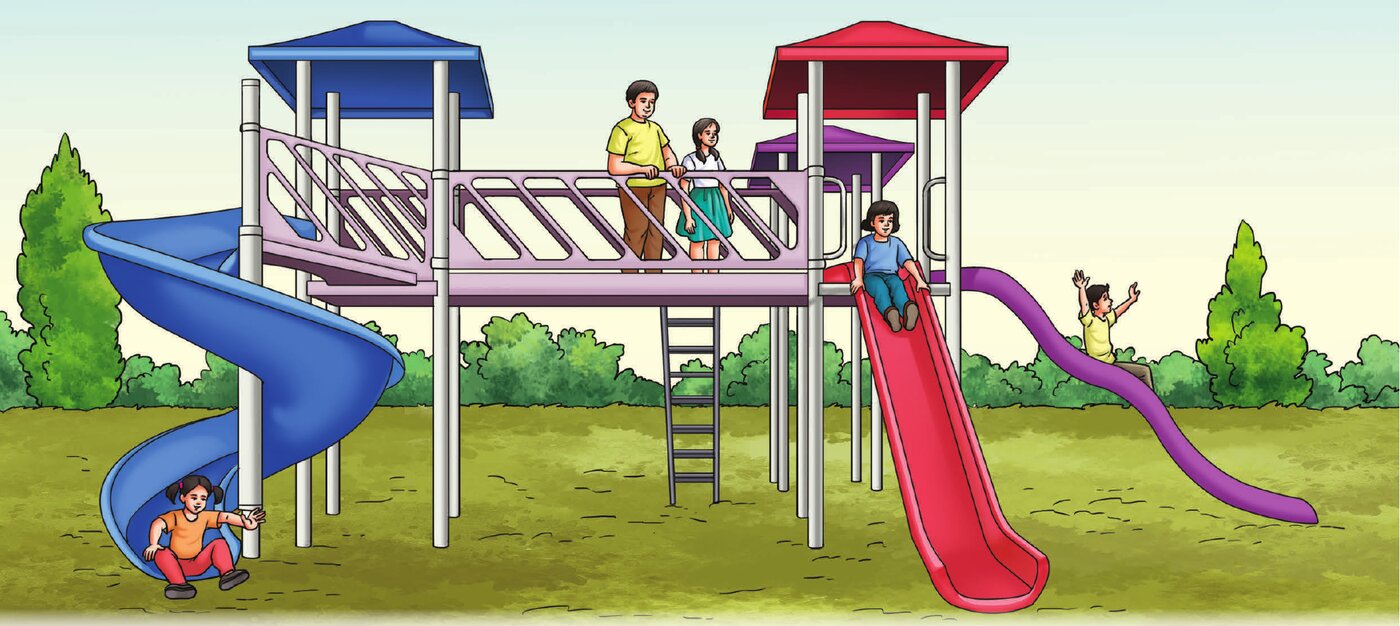
Q1. What will be the magnitude of velocity of the child at the bottom of the blue slide?
Answer:
Suppose the child starts from rest at a height
At the top:
At the bottom:
Ignoring friction,
Cancelling
So, the velocity at the bottom is:
It depends on the vertical height of the slide, not on its shape.
Q2. Will two children of different masses reach the bottom of the same slide with the same velocity?
Answer:
Yes. If both children start from the same height and friction is ignored, they will reach the bottom with the same velocity.
This is because:
The mass of the child does not appear in this formula.
Q3. Which of the slides will result in the largest magnitude of velocity for the child at its bottom?
Answer:
The slide having the greatest vertical drop in height will give the greatest velocity at the bottom.
If all the slides start and end at the same heights, the child will have the same final velocity on all the slides, if friction is ignored.
B. Pause and Ponder - In-text Questions
Q1. In the previous chapter, a weightlifter is shown holding a barbell steady in her hands (Fig. 6.8). Is she doing any work on the barbell while holding it steady?
Answer:
No.
In science,
The barbell does not move, so its displacement is zero.
Therefore,
So, no work is done on the barbell, even though the weightlifter becomes tired.
Q2. Is the work done by friction on the stack of coins that travels on a rough surface (Fig. 6.13c) - positive, negative or zero?
Answer:
The work done by friction is negative.
Friction acts in a direction opposite to the displacement of the coins.
Therefore,
Q3. When you pedal a bicycle on a flat road, your muscles supply energy. In what forms does this muscular energy appear as you ride?
Answer:
The chemical energy stored in our body is changed mainly into:
- mechanical energy to move the bicycle,
- kinetic energy when the bicycle speeds up,
- heat energy due to friction and body activity,
- a small amount of sound energy.
If the bicycle is moving at constant speed, much of the energy supplied by the rider is used to overcome friction and air resistance.
Q4. Two objects A and B of mass 𝑚 4 𝑚
Answer:
Kinetic energy:
For object A:
For object B:
Since their kinetic energies are equal:
Therefore,
Q5. Does the kinetic energy of an object which moves with constant velocity change with its position?
Answer:
No.
Kinetic energy is:
If mass and velocity remain constant, kinetic energy also remains constant.
Therefore, the kinetic energy does not depend on the position of the object.
Q6. Does the potential energy of an object near the surface of the Earth change if it moves with constant velocity in the horizontal direction? What if the object is gradually raised in the vertical direction?
Answer:
If the object moves horizontally at the same height, its potential energy does not change.
Since
If the object is raised vertically, its height increases. Therefore, its potential energy increases.
Q7. For the situation depicted in Fig. 7.19, calculate the mechanical energy of the ball just before it hits the ground and show that even at this position, it is 𝑚 𝑔 ℎ
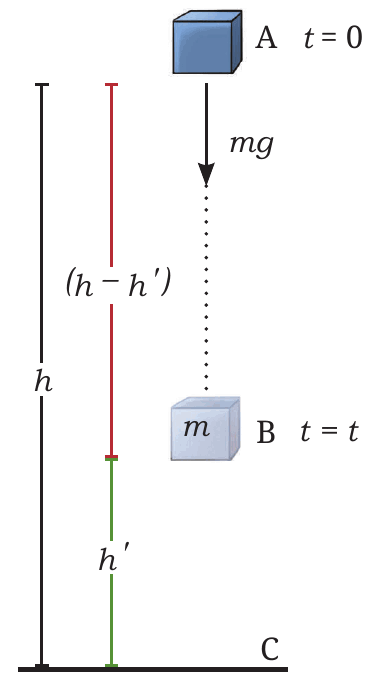
Answer:
At the starting point:
and
So,
Just before the ball reaches the ground, its potential energy becomes nearly zero.
All its potential energy is converted into kinetic energy.
Therefore,
Hence,
Thus, mechanical energy remains conserved if air resistance is ignored.
Q8. You may have seen an exhibit like that in Fig. 7.22 in a science park, where a ball is released from the highest point. Describe how the kinetic energy and potential energy change at points A, B and C. Why do subsequent points, such as C, D and E, usually have lower heights compared to the previous ones? Could it have anything to do with the energy lost due to friction?
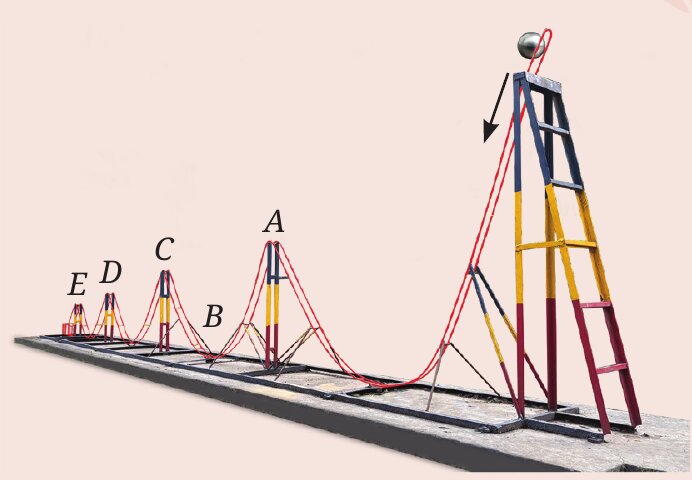
Answer:
At A, the ball is at a high point.
- Potential energy is high.
- Kinetic energy is low.
As the ball moves downward towards B:
- Potential energy decreases.
- Kinetic energy increases.
At B, which is near the bottom:
- Potential energy is low.
- Kinetic energy is high.
As the ball rises towards C:
- Kinetic energy decreases.
- Potential energy increases again.
In a real system, some mechanical energy is changed into heat and sound because of friction and air resistance.
Therefore, the ball cannot rise to exactly the same height each time.
That is why later points such as C, D and E generally become lower.
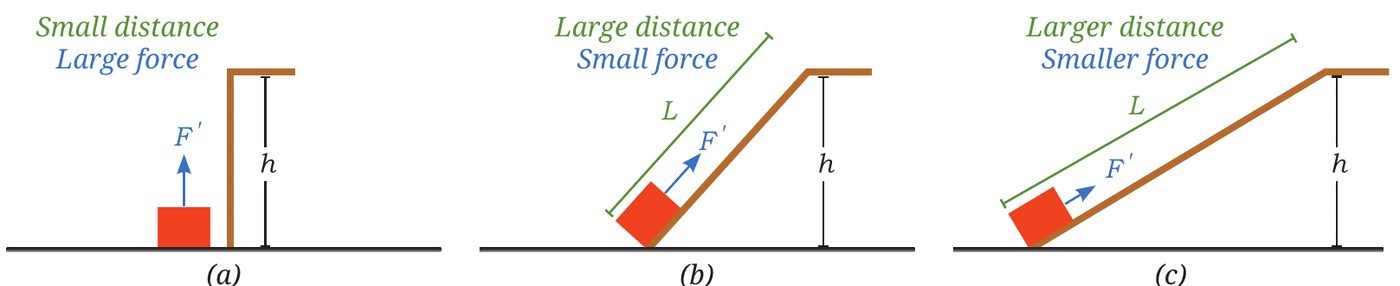
Q9. Explain why roads on hills are built to wind around in gentle slopes rather than going straight up (Fig. 4.26)?
Answer:
A gentle slope acts like a long inclined plane.
A longer and less steep road requires less force to move a vehicle to the same height.
The vehicle travels a longer distance, but the force required is smaller.
Therefore, hill roads are made winding and gently sloping.
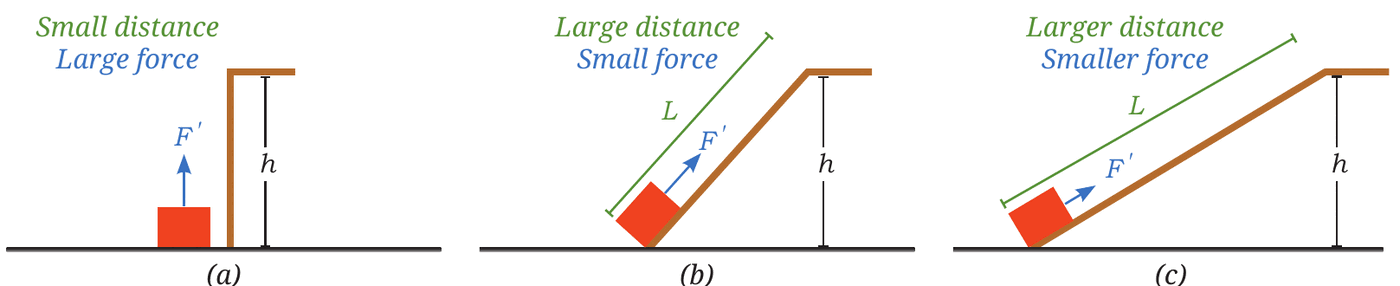
Q10. To reach a higher floor, we find climbing an inclined ladder easier in comparison to climbing a vertical ladder (Fig. 7.30). Explain why.
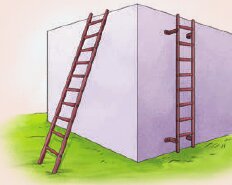
Answer:
An inclined ladder works like an inclined plane.
It allows us to reach the same height by travelling a longer distance.
Because the distance is greater, the force required at a time is smaller.
Therefore, climbing an inclined ladder feels easier than climbing a vertical ladder.
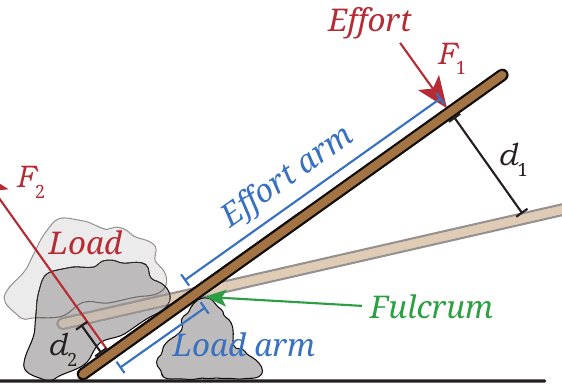
Q11. Why is it easier to open the lid of a can by using a spoon as shown in Fig. 7.35?
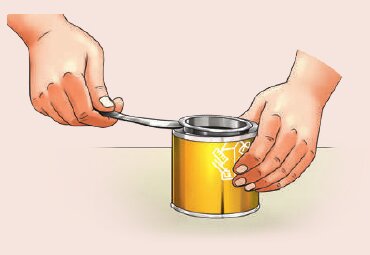
Answer:
The spoon works as a lever.
The edge of the can acts as the fulcrum.
The long handle of the spoon gives a large effort arm. Therefore, a small effort can produce a larger force on the lid.
So, the lid becomes easier to open.
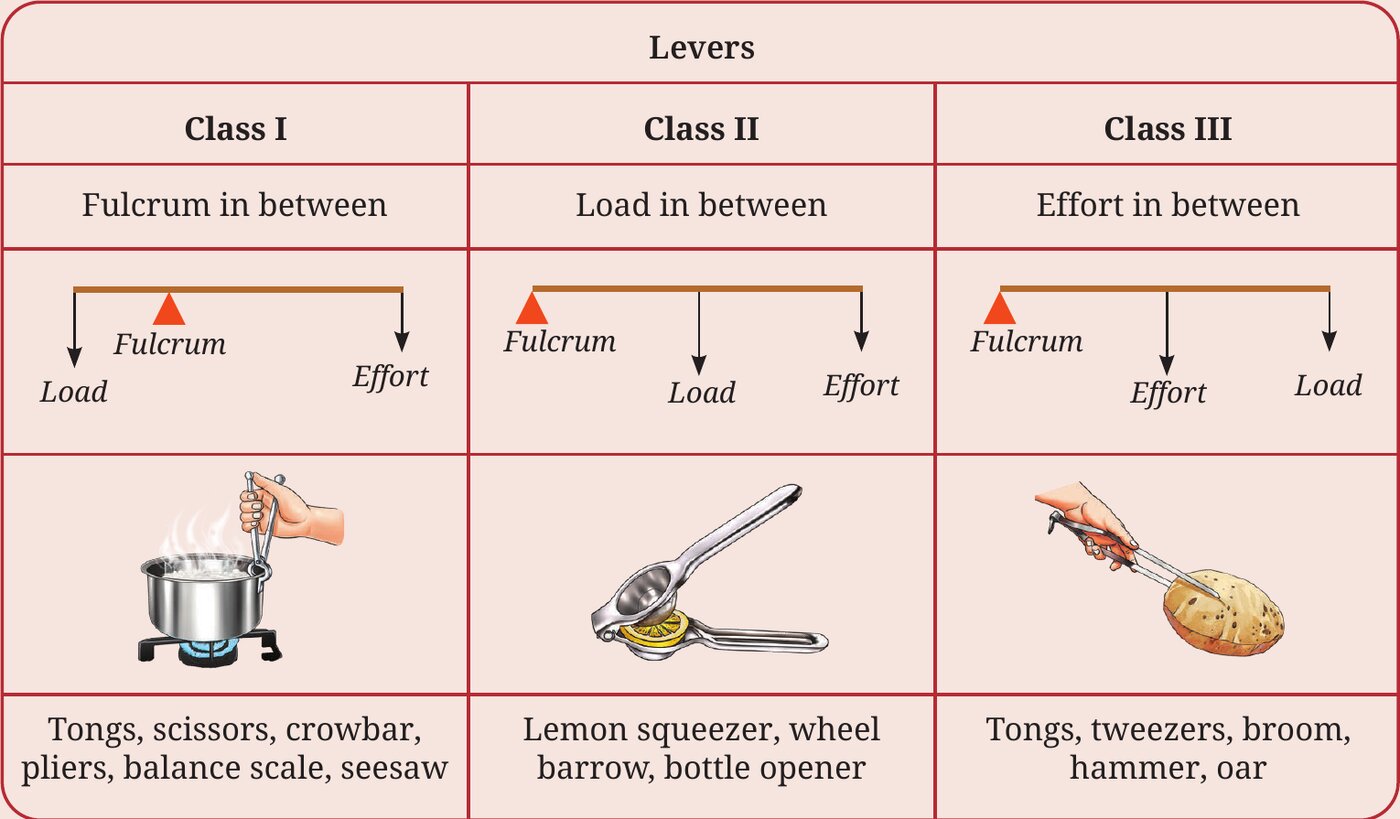
Q12. Why do you push an object closer to scissors fulcrum when you want to cut an object which is hard?
Answer:
When the object is kept closer to the fulcrum, the load arm becomes smaller.
For a lever:
A smaller load arm allows the scissors to produce a larger cutting force.
Therefore, hard objects are easier to cut near the fulcrum.
Q13. Throughout history, many designs of perpetual machines (using wheels, weights or magnets) have been proposed but none actually work. Why do all real machines eventually slow down and stop? Explain in terms of work and energy.
Answer:
Real machines have friction and air resistance.
Because of friction, some mechanical energy is continuously changed into:
- heat energy,
- sound energy.
Therefore, the useful mechanical energy becomes less and less.
Without a new supply of energy, the machine eventually slows down and stops.
A machine cannot create energy by itself.
C. Solved Examples
Example 7.1
Q. While exercising, a girl lifts a dumbbell and slowly lowers it down. Identify when the girl does positive work on the dumbbell and when she does negative work on it.
Answer:
When the girl raises the dumbbell, the force applied by her and the displacement are in the same direction.
Therefore, she does positive work.
When she slowly lowers the dumbbell, her upward force and the downward displacement are in opposite directions.
Therefore, she does negative work.
Example 7.2
Q. While saving a goal (Fig. 7.7b), a goalkeeper’s hand moved back by 15 cm as she stopped a ball while applying a force of 200 N. How much work did the goalkeeper do on the ball in stopping it?
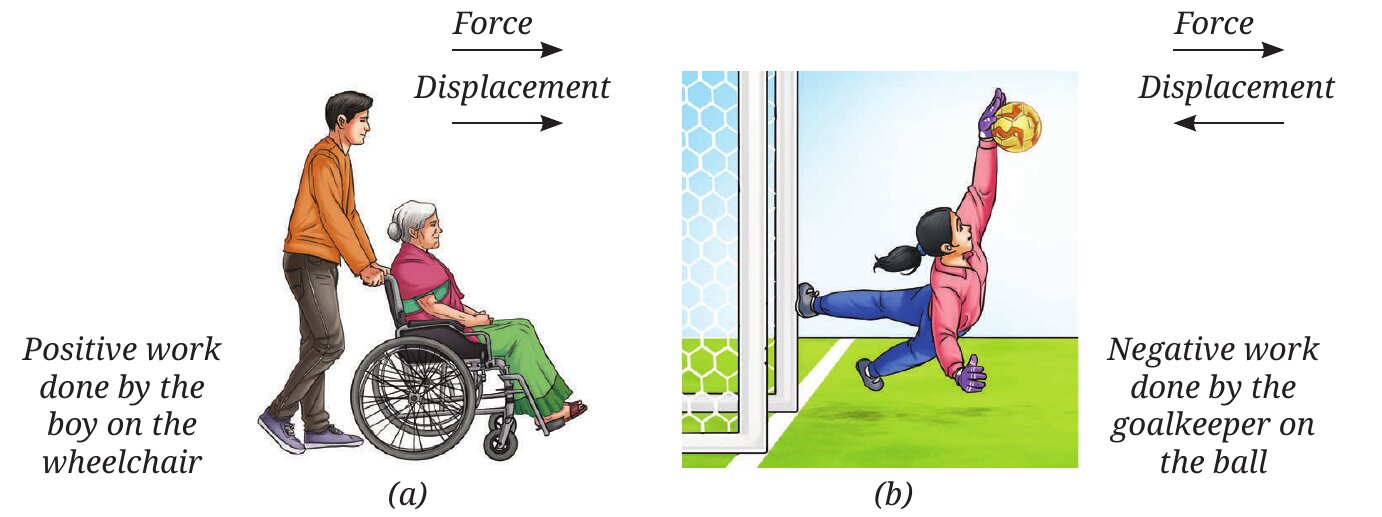
Answer:
Force:
Displacement:
The force is opposite to the displacement, so displacement is taken as negative.
Work done:
The negative sign shows that the goalkeeper did negative work on the ball.
Example 7.3
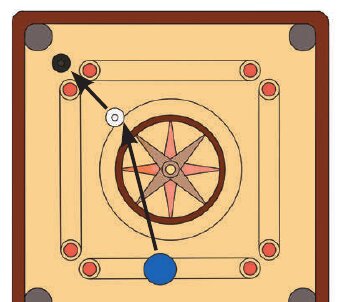
Q. In a game of carrom, a player played the shot shown in Fig. 7.9 to pocket the black coin. Identify who does work, and the changes in energy that occur at each collision.
Answer:
First collision:
- The moving striker hits the white coin.
- The striker does positive work on the white coin.
- The white coin gains energy.
- The white coin does negative work on the striker.
- Therefore, the striker loses some energy.
Second collision:
- The moving white coin hits the black coin.
- The white coin does positive work on the black coin.
- The black coin gains energy.
- The black coin does negative work on the white coin.
- Therefore, the white coin loses some energy.
Thus, energy is transferred from:
Example 7.4
Q. If the velocity of a vehicle doubles in magnitude, what will its kinetic energy be compared to its original value?
Answer:
Original kinetic energy:
If velocity becomes
Therefore,
The kinetic energy becomes four times the original kinetic energy.
Example 7.5
Q. In one of their fastest deliveries, an Indian cricketer bowled a cricket ball with an approximate mass of 0.2 kg at a velocity of about 154.8 km h− 1
Answer:
Mass:
Velocity:
Kinetic energy:
Example 7.6
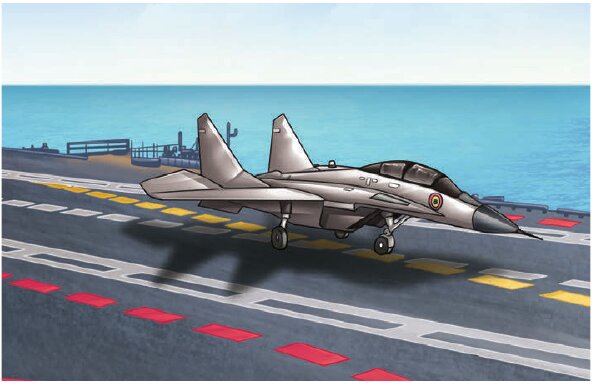
Q. A jet aircraft of mass 15000 kg lands on the deck of an aircraft carrier (Fig. 7.12). To stop the aircraft within the short length of the deck a hook on the aircraft’s tail is caught in a wire stretched across the deck. The wire exerts an approximately constant backward force of 367500 N and stops the jet within 100 m. What was the velocity of the aircraft just before the wire caught the hook?
Answer:
Mass:
Stopping force:
Distance:
The force is opposite to motion.
Work done:
This removes all the kinetic energy of the aircraft.
In km/h:
Therefore,
Example 7.7
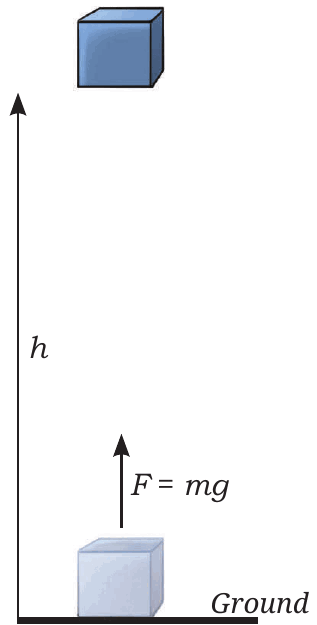
Q. After taking a catch, a fielder threw the cricket ball of mass 200 g high up in the air about 10 m above the ground in celebration. How much potential energy does the ball have when the ball reaches its maximum height? Assume 𝑔 = 1 0 𝑚 𝑠 − 2
Answer:
Mass:
Height:
Potential energy:
Example 7.8
Q. What will be the magnitude of velocity of the child on reaching the bottom of the slide of height ℎ
Answer:
At the top:
At the bottom:
By conservation of mechanical energy:
Cancelling
Therefore,
The final velocity depends on the height, not on the child's mass or the shape of the slide, if friction is ignored.
Example 7.9
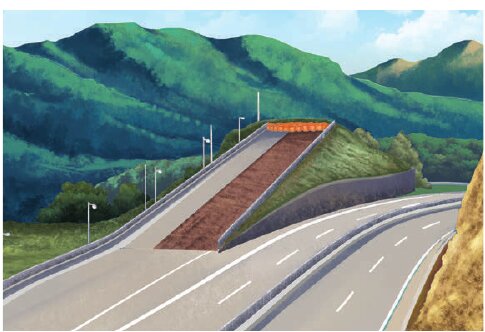
Q. Escape ramps (Fig. 7.21) are inclined planes filled with sand or gravel that help stop trucks when their brakes fail on a highway. A truck of mass 10000 kg is moving at 72 km h− 1 𝑔 = 1 0 𝑚 𝑠 − 2
Answer:
Velocity:
Initial kinetic energy:
Let the distance travelled on the ramp be
Height gained:
Potential energy gained:
Work done against sand:
Therefore,
Therefore,
Example 7.10
Q. A weightlifter lifts a 75 kg mass by 2 m in 5 seconds. How much power would she require for this task?
Answer:
Work done:
Power:
Example 7.11
Q. A car of mass 1000 kg starts from rest and reaches a speed of 72 km h− 1
Answer:
Velocity:
Initial velocity:
Change in kinetic energy:
Power:
or
Example 7.12
Q. A person uses an inclined ramp to raise an object over a step 30 cm high. The ramp has a width of 40 cm. What is the mechanical advantage of the ramp that helps the person achieve the task?
Answer:
The ramp forms a right-angled triangle.
Height:
Base:
Using Pythagoras:
Mechanical advantage:
Example 7.13
Q. For a seesaw having four seats A, B, D, E and fulcrum at C (Fig. 7.34), AC = EC = 2 m and BC = DC = 1 m. On which seats should children of masses 15 kg and 30 kg sit to make the seesaw balanced?
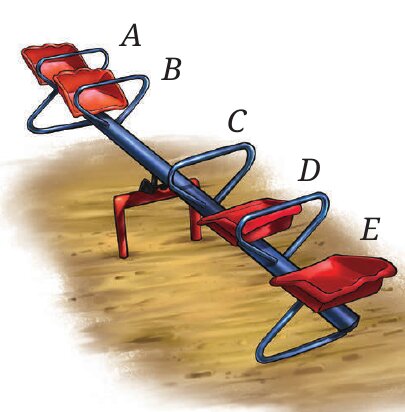
Answer:
Let the 15 kg child sit at A.
Distance from fulcrum:
For balance:
Seat D is 1 m from the fulcrum.
Therefore:
The opposite arrangement, 15 kg at E and 30 kg at B, would also balance the seesaw.
D. Activities
The chapter contains five main numbered activities.
Activity 7.1 - Let Us Investigate
Simple explanation of the activity
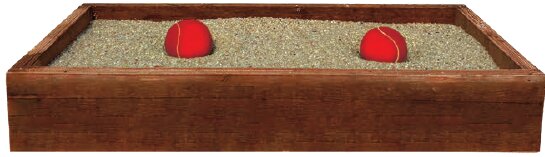
Take a heavy ball and a container filled with loose sand.
First drop the ball from about 1 m above the sand and observe the depression.
Then drop it from about 2 m and compare the depressions.
The activity shows how the potential energy of an object increases when its height increases.
Q1. Raise the ball over the sand bed to a height of about 1 m and drop it. Is a depression created in the sand? Why does the ball create a depression?
Answer:
Yes, a depression is created.
At a height, the ball has gravitational potential energy.
When the ball falls:
When the ball strikes the sand, it uses this kinetic energy to move the sand and make a depression.
Q2. Compare the depths of the depressions. Is there any difference? In which case is the depression deepest and in which case the shallowest?
Answer:
Yes, there is a difference.
The ball dropped from the greater height makes a deeper depression.
Therefore:
- From 2 m → deeper depression.
- From 1 m → shallower depression.
A ball at a greater height has more gravitational potential energy.
Activity 7.2 - Let Us Experiment
Simple explanation of the activity
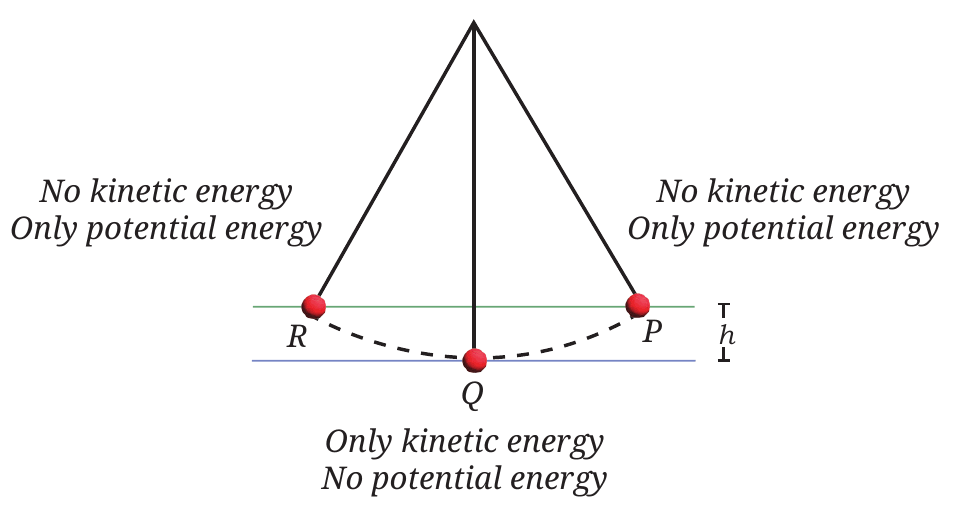
Make a simple pendulum.
Draw a horizontal line behind it at the height from which you release the bob.
Pull the bob to point P and release it.
Observe how high it rises on the opposite side.
This activity shows the conversion between potential energy and kinetic energy.
Q. Take the bob to one side to a point P, which is at the level of the horizontal line and let it go. Observe it at the extreme points of the first couple of oscillations. Does the bob almost reach the level of the horizontal line?
Answer:
Yes. During the first few oscillations, the bob reaches almost the same height on the opposite side.
At P:
- potential energy is maximum,
- kinetic energy is zero.
At the lowest point Q:
- kinetic energy is maximum,
- potential energy is minimum.
At R:
- kinetic energy becomes zero again,
- potential energy becomes large again.
Thus:
The pendulum does not continue forever because some energy is lost due to air resistance and friction.
Activity 7.3 - Let Us Experiment
Simple explanation of the activity
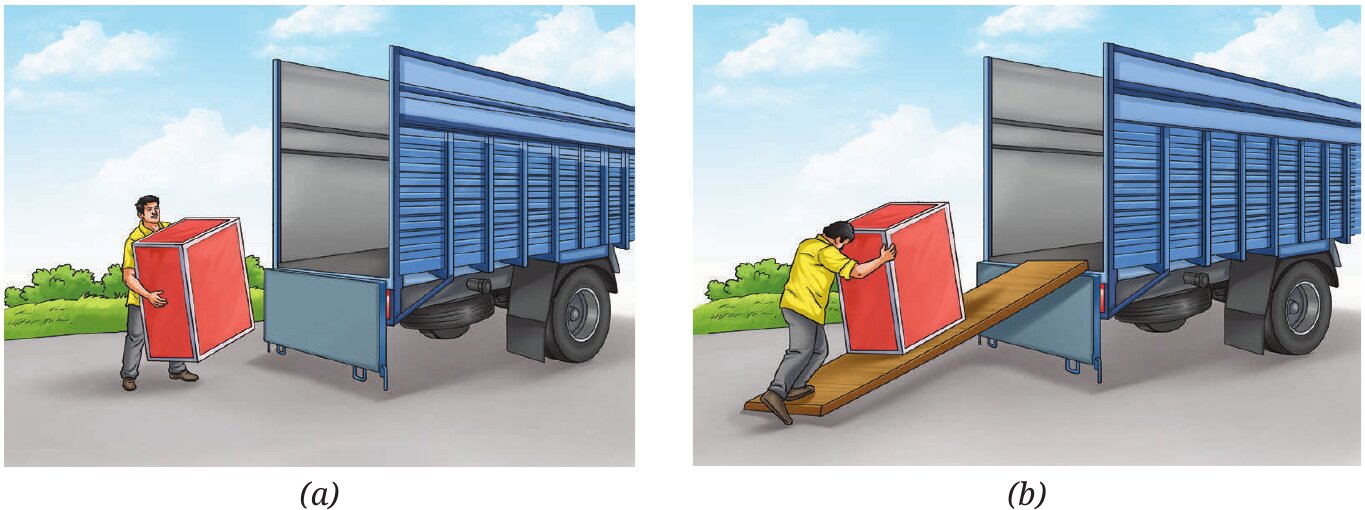
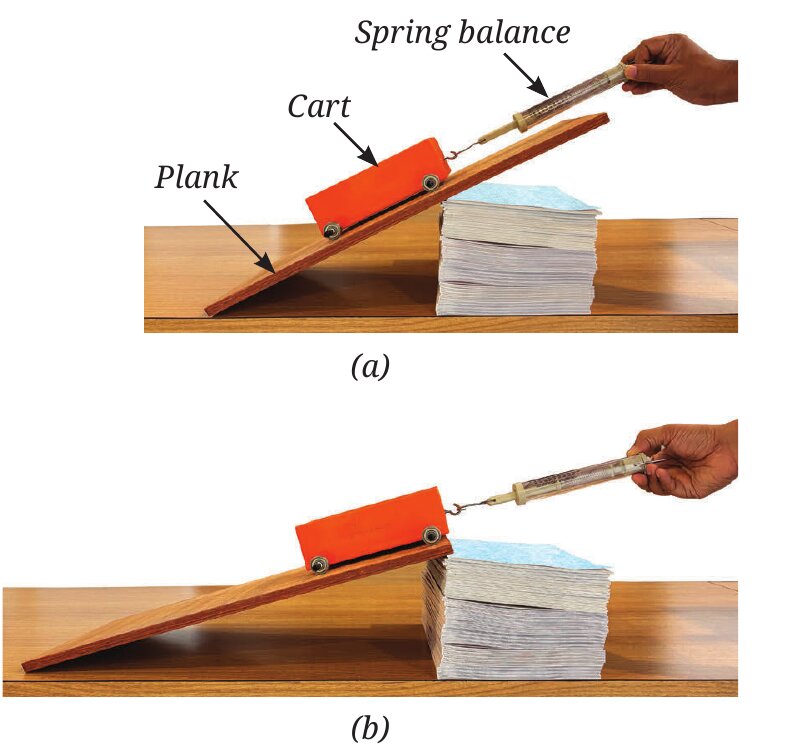
Attach a spring balance to a toy cart.
First lift the cart straight upward and note the force.
Then pull it up an inclined plank.
After that, make the plank less steep and compare the force again.
This shows how an inclined plane reduces the force needed to raise a load.
Q1. Pull the cart along the plank slowly and steadily. Is the reading of the spring balance, that is, the force required, smaller than that of Step 2?
Answer:
Yes.
The force required to pull the cart along the inclined plane is less than the force required to lift it vertically.
Q2. Now, reduce the angle between the plank and the base and repeat Step 3. Observe how the force required changes as the plank becomes less steep.
Answer:
As the plank becomes less steep, the force required becomes smaller.
However, the cart must travel a longer distance.
So:
The total work remains nearly the same if friction is ignored.
Activity 7.4 - Let Us Investigate
Simple explanation of the activity
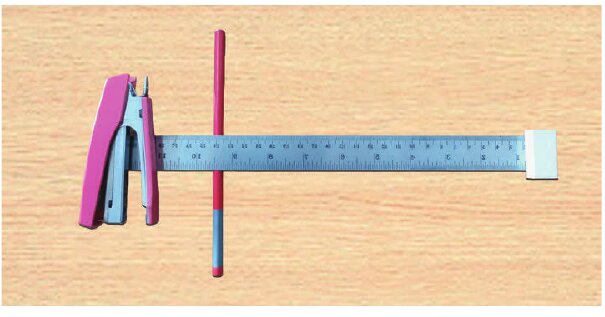
Place a scale over a pencil.
The pencil acts as the fulcrum.
Keep a heavy stapler near the fulcrum at one end.
Place one or more light erasers at the farther end.
This demonstrates how a lever can allow a small force to lift a larger load.
Q. On the other end of the scale, place one eraser. Does the stapler lift up? If not, add one more eraser.
Answer:
The exact result depends on the masses and their distances from the pencil.
If one eraser is not enough, adding another eraser can lift the stapler.
The important observation is that a relatively small effort acting farther from the fulcrum can lift a heavier object placed closer to the fulcrum.
This is the principle of a lever.
Activity 7.5 - Let Us Experiment
Simple explanation of the activity
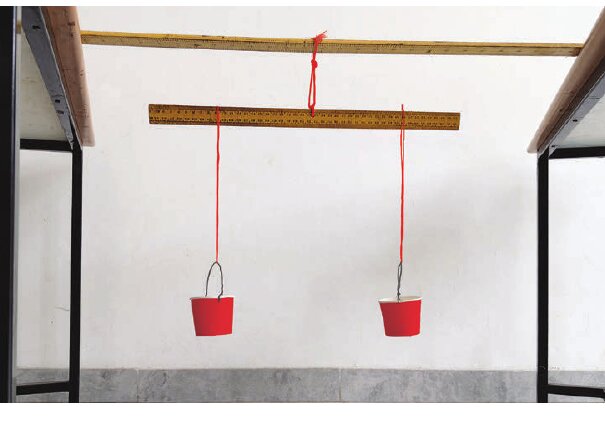
Make a simple beam balance using:
- a long scale,
- a string,
- two paper cups,
- identical coins.
Hang the scale from its middle.
Put coins in the two cups.
Change the number of coins and move one cup closer to the centre until the scale balances.
This activity helps us discover the law of a lever.
Q1. What happens when one identical coin is placed in each pan at equal distances from the fulcrum?
Answer:
The beam remains horizontal and balanced because:
- both loads are equal,
- both distances from the fulcrum are equal.
Q2. What should be done when two coins are placed in the right pan and only one coin is kept in the left pan?
Answer:
The pan with two coins should be moved closer to the fulcrum until the beam balances.
If the left pan is at distance
Q3. What relation is obtained from the observations?
Answer:
The beam balances when:
Therefore:
Q4. Complete the observation table.
Answer:
The actual distances depend on the scale used.
If the single coin on the left is kept at a distance
| Coins on left | Left distance | Coins on right | Right distance |
|---|---|---|---|
| 1 | 1 | ||
| 1 | 2 | ||
| 1 | 4 | ||
| 1 | 8 |
For example, if
| Coins on left | Left distance | Coins on right | Right distance |
|---|---|---|---|
| 1 | 20 cm | 1 | 20 cm |
| 1 | 20 cm | 2 | 10 cm |
| 1 | 20 cm | 4 | 5 cm |
| 1 | 20 cm | 8 | 2.5 cm |
Thus, as the load becomes larger, it must be placed closer to the fulcrum.
E. What If...?
Q. What if it were possible to build a perpetual motion machine, which once started, could continue doing useful work forever, without any fuel or electricity?
Answer:
Such a machine cannot work in real life.
Every real machine loses some useful mechanical energy because of:
- friction,
- air resistance,
- heat,
- sound.
Also, energy cannot be created from nothing.
Therefore, a machine cannot continue doing useful work forever without receiving energy from somewhere.
F. The Journey Beyond - Activity Question
Activity: Rubber-band Pen Launcher
Simple explanation of the activity
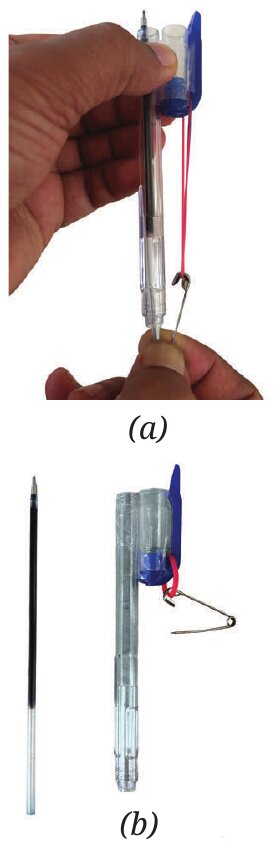
A rubber band is connected to a pen refill.
Stretching the rubber band stores elastic potential energy.
When it is released, this energy changes into kinetic energy and shoots the refill forward.
Q. Repeat with different amounts of stretch, and observe how the distance travelled changes. Is there a relationship between the stretch and the distance travelled?
Answer:
Yes.
Generally, a greater stretch stores more elastic potential energy.
Therefore, when released, the refill gets more kinetic energy and usually travels farther.
So:
G. End-of-Chapter Exercise - Revise, Reflect, Refine
The end exercise begins with True/False and continues through numerical and graph-based questions.
Q1. State whether True or False.
(i) Work is said to be done when a force is applied, even if the object does not move.
Answer: False
Work requires displacement.
If displacement is zero:
(ii) Lifting a bucket vertically upward results in positive work done on the bucket.
Answer: True
The applied force and displacement are both upward.
(iii) The SI unit for both work and energy is joule (J).
Answer: True
Both work and energy are measured in joules (J).
(iv) A motionless stretched rubber band has kinetic energy.
Answer: False
A motionless stretched rubber band has elastic potential energy, not kinetic energy.
(v) Energy can change from one form to another.
Answer: True
For example:
Q2. Fill in the blanks.
(i) Work done = ______ × ______ (in the direction of force).
Answer:
(ii) 1 joule of work is done when a force of ______ newton displaces an object by 1 metre in the direction of the force.
Answer:
(iii) The expression for kinetic energy of a body of mass 𝑚 𝑣
Answer:
(iv) The potential energy of an object of mass 𝑚 ℎ
Answer:
(v) Power is defined as the ______ at which work is done.
Answer:
Q3. When a ball thrown upwards reaches its highest point, tick which of the following statement(s) are correct?
(i) The force acting on the ball is zero.
(ii) The acceleration of the ball is zero.
(iii) Its kinetic energy is zero.
(iv) Its potential energy is maximum.
Answer:
Correct statements are:
At the highest point:
- velocity = 0,
- therefore kinetic energy = 0,
- potential energy is maximum,
- gravitational force still acts downward,
- acceleration due to gravity is still present.
Q4. For each of the following situations, identify the energy transformation that takes place: (i) a truck moving uphill, (ii) unwinding of a watch spring, (iii) photosynthesis in green leaves, (iv) water flowing from a dam, (v) burning of a matchstick, (vi) explosion of a fire cracker, (vii) speaking into a microphone, (viii) a glowing electric bulb, and (ix) a solar panel.
Answer:
(i) A truck moving uphill
Mainly:
If a vehicle is simply coasting uphill, some kinetic energy is also changed into potential energy.
(ii) Unwinding of a watch spring
(iii) Photosynthesis in green leaves
(iv) Water flowing from a dam
(v) Burning of a matchstick
(vi) Explosion of a fire cracker
(vii) Speaking into a microphone
(viii) A glowing electric bulb
(ix) A solar panel
Q5. A student is slowly lifted straight up in an elevator from the ground level to the top floor of a building. Later, the same student climbs the staircase, all the way to the top. Given that the height of the building is ℎ = 7 2 . 5 𝑚 𝑔 = 1 0 𝑚 𝑠 − 2 𝑚 = 5 0 𝑘 𝑔
(i) Find the gain in the potential energy if the student is lifted straight up to the top.
Answer:
(ii) Find the gain in the potential energy when the student climbs the stairs to the same top.
Answer:
The starting and final heights are the same.
Therefore:
(iii) What do you conclude about the dependence of the potential energy on the path taken?
Answer:
Potential energy depends on the change in height, not on the path taken.
Therefore, whether the student uses the elevator or stairs, the gain in gravitational potential energy is the same.
Q6. A crane lifts a mass 𝑚
Answer:
Let the height of the 10th floor be
Energy needed:
The 20th floor is twice as high:
Therefore:
So, twice as much energy is required.
For power:
The second task takes twice the time:
Therefore:
So, the energy required is doubled, but the power required remains the same.
Q7. Which factors determine the energy required to raise a flag from the ground to the top of a tall flagpole using a pulley? Does raising the flag slowly or quickly change the amount of work done? If the speed at which the flag is raised is doubled, how does the power requirement change? Explain your answers.
Answer:
The energy required is:
Therefore, it depends on:
- mass of the flag,
- gravitational acceleration
𝑔 - height through which the flag is raised.
Raising the flag slowly or quickly does not change the total work done, if friction is ignored.
However, power depends on time:
If the speed is doubled, the time required becomes half.
Therefore:
Q8. A man of mass 60 kg rides a scooter of mass 100 kg. He accelerates the scooter to a velocity 𝑣
Answer:
First day
Total mass:
Kinetic energy:
Second day
Total mass:
Fuel used is proportional to energy required.
Therefore:
So, the ratio of fuel used on the first day to the second day is:
Q9. On a seesaw with sliding seats, a child is sitting on one side and an adult on the other side. The adult weighs twice that of the child. The seesaw however is balanced. Draw a figure which depicts this situation showing the distances from the fulcrum where the child and the adult are seated.
Answer:
For balance:
Let the child's weight be
Adult's weight:
Therefore:
Thus, the child must sit twice as far from the fulcrum as the adult.
For example:
So, if the adult sits 1 m from the fulcrum, the child should sit 2 m away.
Q10. A ball of mass 2 kg is thrown up with a velocity of 20 m s− 1
(i) Identify the sign of the work done by gravity on the ball during its upward motion and its downward motion.
Answer:
During upward motion:
- displacement is upward,
- gravitational force is downward.
Therefore:
During downward motion:
- force and displacement are both downward.
Therefore:
(ii) If the ball reaches a height of 19.4 m, how much work was done by air resistance? Assume 𝑔 = 1 0 𝑚 𝑠 − 2
Answer:
Initial kinetic energy:
At the highest point:
Potential energy:
Initial mechanical energy:
Final mechanical energy:
Energy lost:
Therefore, the work done by air resistance is:
The negative sign means air resistance removes mechanical energy from the ball.
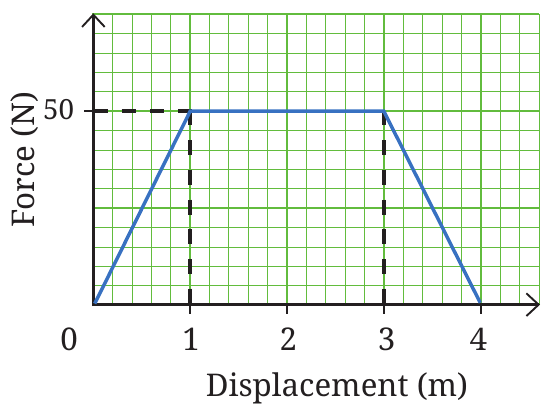
Q11. A 10.0 kg block is moving on horizontal floor with negligible friction. As shown in Fig. 7.37, a variable force is applied on the block in its direction of motion from its position at 0 m till 4 m. If the block had a kinetic energy of 180 J when it was at 0 m, find the block’s speed (i) at 0 m, and (ii) at 4 m. Does the block have negative acceleration in any portion of its motion?
Answer:
(i) Speed at 0 m
(ii) Speed at 4 m
Work done is the area under the force-displacement graph.
From 0 to 1 m:
From 1 to 3 m:
From 3 to 4 m:
Total work:
Using the work-energy theorem:
Now:
Does the block have negative acceleration in any portion of its motion?
No.
The applied force is always in the direction of motion or becomes zero.
The force decreases between 3 m and 4 m, but it does not become negative.
Therefore:
Q12. The gravitational attraction on the surface of the Moon (lunar surface) is about 1 6
Answer:
For the same starting velocity, the initial kinetic energy is the same.
On Earth:
On the Moon:
Therefore:
But:
So:
Cancelling
Therefore:
Q13. A 1000 kg car is moving along a road at a constant speed. Suddenly, the driver notices some obstruction ahead and applies the brakes to come to a complete stop. The graphical representation of motion of the car starting from the instant the driver spots the traffic ahead is shown in Fig. 7.38.
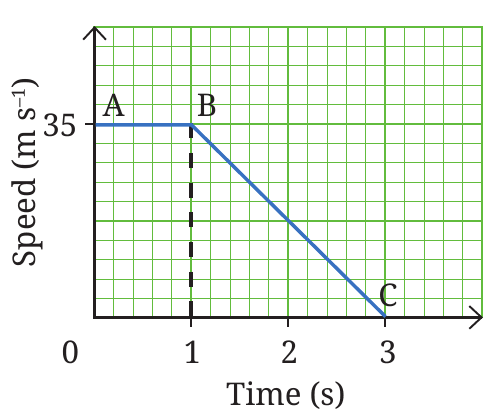
(i) Describe how the car moves between positions A and B.
Answer:
Between A and B, the graph is horizontal at:
Therefore, the car moves at a constant speed of 35 m/s.
(ii) Calculate the kinetic energy of the car at A.
Answer:
Mass:
Speed:
Kinetic energy:
(iii) State the work done by the brakes in bringing the car to a halt between B and C.
Answer:
Initial kinetic energy at B:
Final kinetic energy at C:
Work done:
The work is negative because the brakes remove kinetic energy from the car.
(iv) What does the kinetic energy of the car transform into?
Answer:
Most of the kinetic energy changes into heat energy because of friction in the brakes, tyres and road.
A small amount may also become sound.
Q14. The potential energy-displacement graph of a 0.5 kg ball moving along a frictionless track is shown in Fig. 7.39. At O, the velocity of the ball is 0 m s− 1
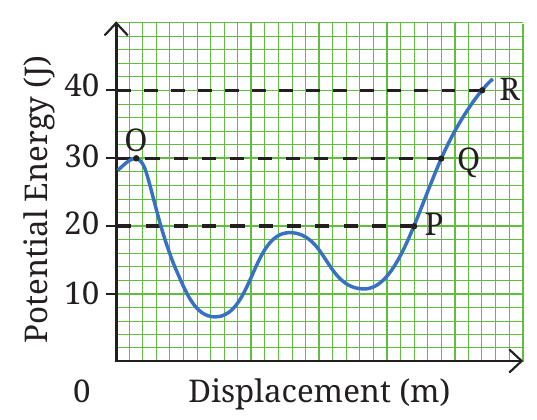
Answer:
At O:
Therefore, total mechanical energy:
Since the track is frictionless, total energy remains:
At P
From the graph:
Therefore:
At Q
From the graph:
Therefore:
At R
From the graph:
But the ball has a total energy of only 30 J.
Therefore, the ball cannot reach R without receiving extra energy.
Q15. A coconut of mass 1.5 kg falls from the top of a coconut tree onto the wet sand on a beach. The height of the tree is 10 m. On impact, the coconut comes to rest by making a depression in the sand.
(i) Calculate the velocity of the coconut just before it hits the sand.
Answer:
At the top:
Just before impact:
Therefore:
Cancelling
(ii) Assume that the average resistive force of sand is 3000 N and all of the coconut’s energy is used to create the depression in the sand. Calculate the depth of the depression the coconut makes in the sand. Assume 𝑔 = 1 0 𝑚 𝑠 − 2
Answer:
Energy of the coconut just before impact:
This energy is used to do work against the sand.
Therefore, the coconut makes a depression about 5 cm deep.