A. Think It Over
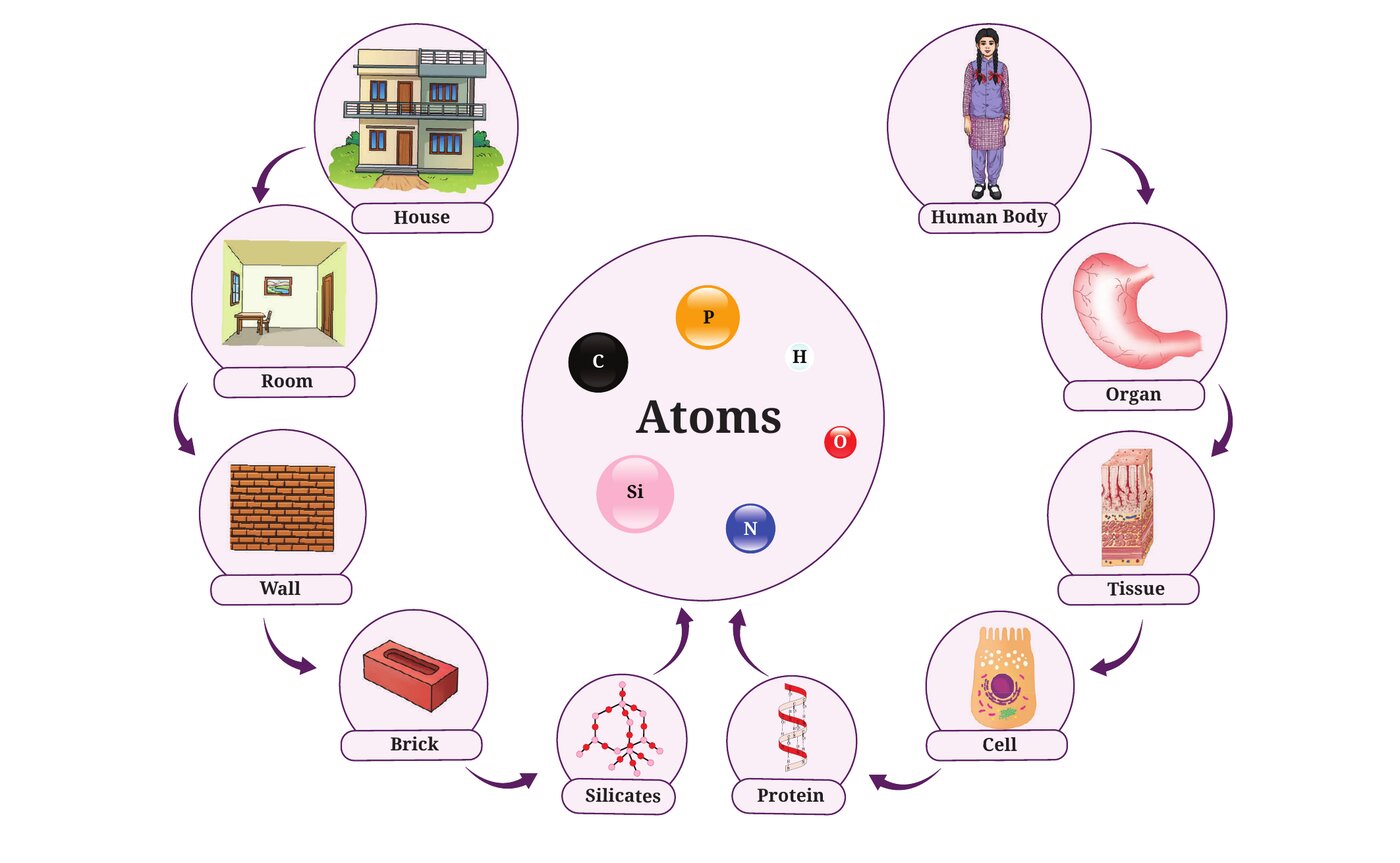
Q1. Are atoms the smallest indivisible particles?
Answer:
No. Atoms are not indivisible. They are made up of smaller particles called subatomic particles. The three main subatomic particles are:
- Electrons - negatively charged
- Protons - positively charged
- Neutrons - have no charge
Q2. Why do electrons not fall into the nucleus even though they are attracted to protons in it?
Answer:
According to Bohr's model, electrons move around the nucleus only in certain fixed energy levels or shells.
While an electron moves in an allowed shell, it does not lose energy. Therefore, it does not spiral inward and fall into the nucleus.
Q3. Why did scientists keep modifying atomic models?
Answer:
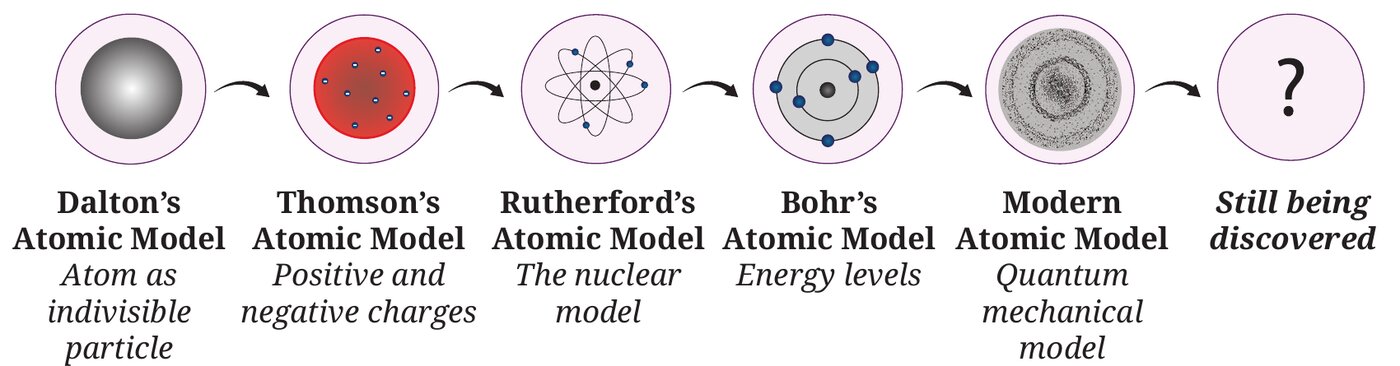
Scientists modified atomic models because new experiments gave new evidence about atoms.
Older models could not explain all observations. Therefore, scientists improved the models whenever new discoveries were made.
For example:
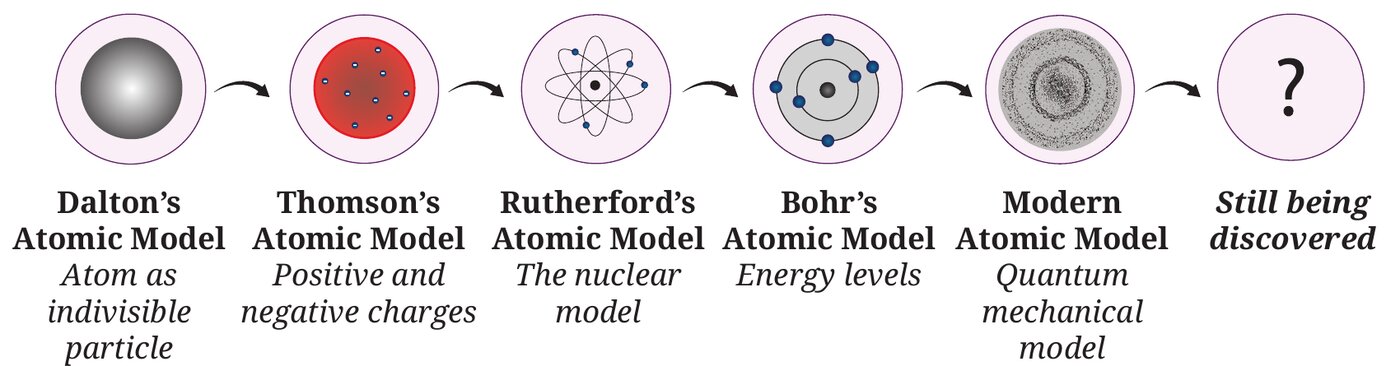
Dalton → Thomson → Rutherford → Bohr → Modern atomic model
This shows that scientific knowledge improves with new experiments and evidence.
B. Introductory In-text Questions
Q1. Is an atom truly the smallest unit of matter, or can it be divided even further?
Answer:
An atom can be divided further. It contains smaller particles such as electrons, protons and neutrons.
Q2. What are atoms made up of?
Answer:
Atoms are mainly made up of three subatomic particles:
- Protons
- Neutrons
- Electrons
Protons and neutrons are present inside the nucleus, while electrons are found around the nucleus.
Q3. What would atoms look like if we could see them?
Answer:
An atom would have:
- a very small and dense nucleus at the centre,
- protons and neutrons inside the nucleus,
- electrons present around the nucleus in different energy levels,
- a large amount of empty space.
Q4. What makes the atoms of one element different from the atoms of another element?
Answer:
The number of protons makes one element different from another.
The number of protons is called the atomic number.
For example:
- Hydrogen has 1 proton.
- Helium has 2 protons.
- Carbon has 6 protons.
Therefore, each element has a unique atomic number.
C. Pause and Ponder - Thomson's Model
Q1. Suppose you made up your own ‘atom’, as Thomson described, using clay for the positive charge and small beads for the electrons spread through it. What will happen if:
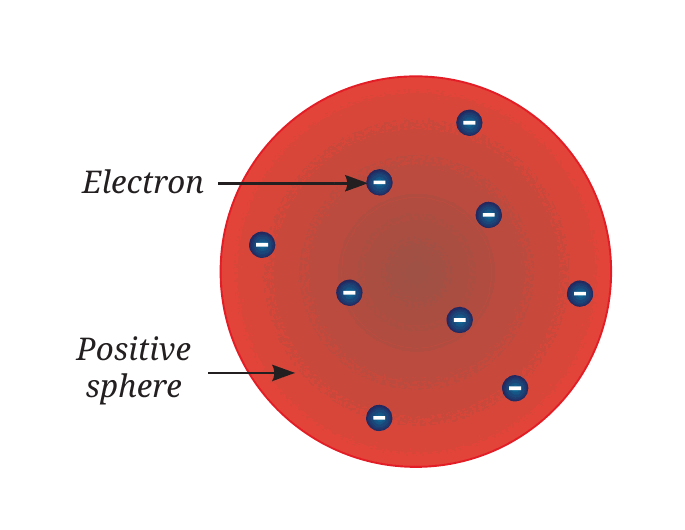
(i) the positive charge on the clay is lesser than the total negative charge of the beads?
Answer:
The atom would have more negative charge than positive charge.
Therefore, it would become negatively charged and would not represent a neutral atom.
(ii) by mistake, the clay itself carries a bit of negative charge? Would your model still represent a neutral atom?
Answer:
No.
The clay is supposed to represent the positive charge of the atom. If the clay also carries negative charge, the positive and negative charges will not balance properly.
Therefore, the model would not represent a neutral atom unless the total positive and negative charges were exactly equal.
Q2. Could an orange or a lemon, which also contain seeds inside soft pulp, be a good comparison? In what ways does it match Thomson’s idea and where does it fall short?

Answer:
Yes, an orange or lemon can be used as a simple comparison.
In Thomson's model:
- the soft pulp can represent the positive charge,
- the seeds can represent the electrons spread inside it.
However, the comparison is not perfect because:
- real fruit pulp does not carry positive charge,
- seeds are much larger than electrons,
- an actual atom does not really look like a fruit.
So, the comparison only helps us understand Thomson's basic idea.
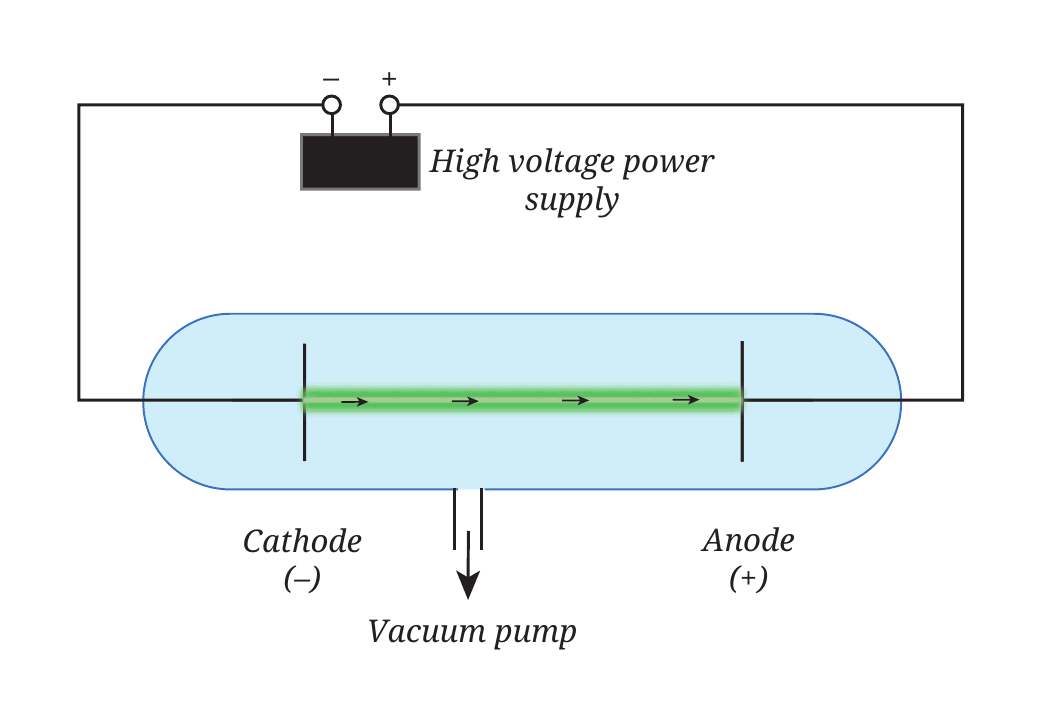
Q3. Why did Thomson conclude that electrons are present in all atoms?
Answer:
Thomson found that the nature of cathode rays was the same even when he changed:
- the material of the cathode, and
- the gas inside the tube.
This showed that the particles in cathode rays were present in all kinds of atoms.
These particles were called electrons.
D. Worked Example - Size of an Atom
Q. Can you calculate how many atoms would be needed to make a sheet of paper that is 0.1 mm thick, like the one in your textbook?
Given:
Diameter of one atom
=
Thickness of paper
= 0.1 mm
=
Answer:
Number of atoms
Therefore, about one million atoms would have to be stacked together to make a sheet 0.1 mm thick.
E. Think as a Scientist Activity - Gold Foil Experiment
Activity Explanation
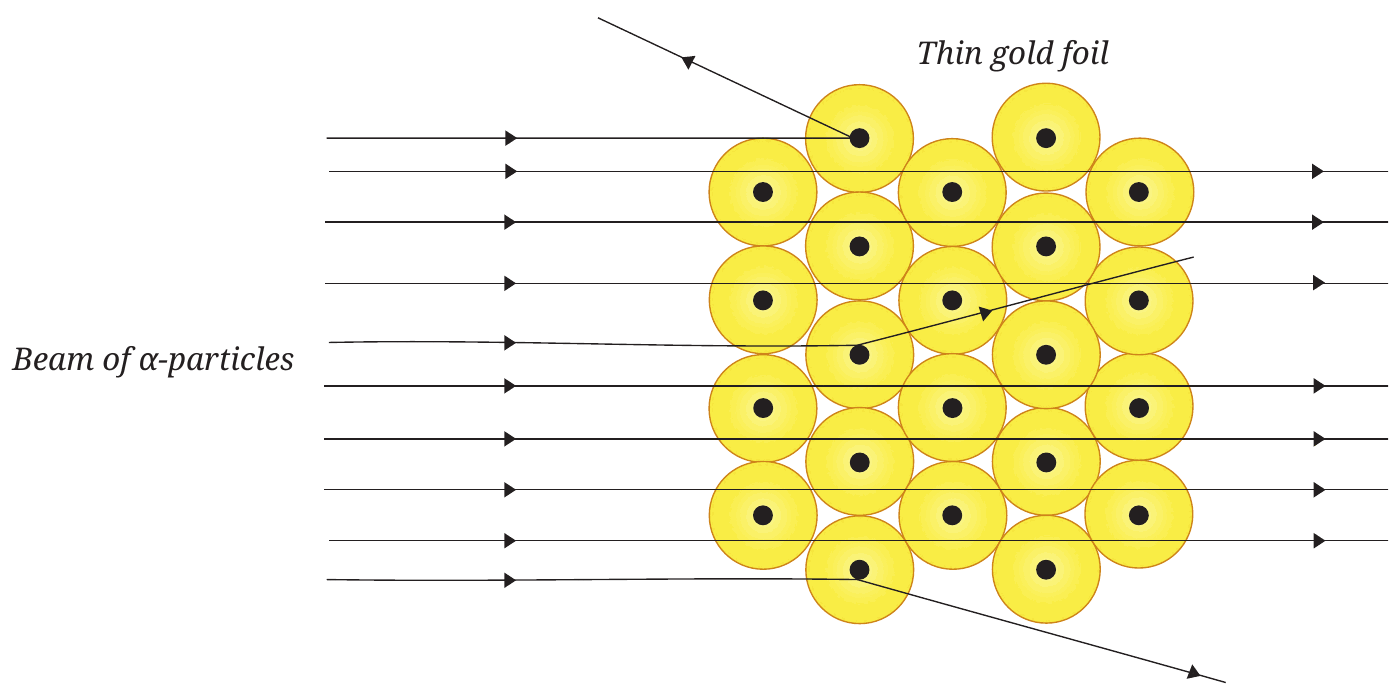
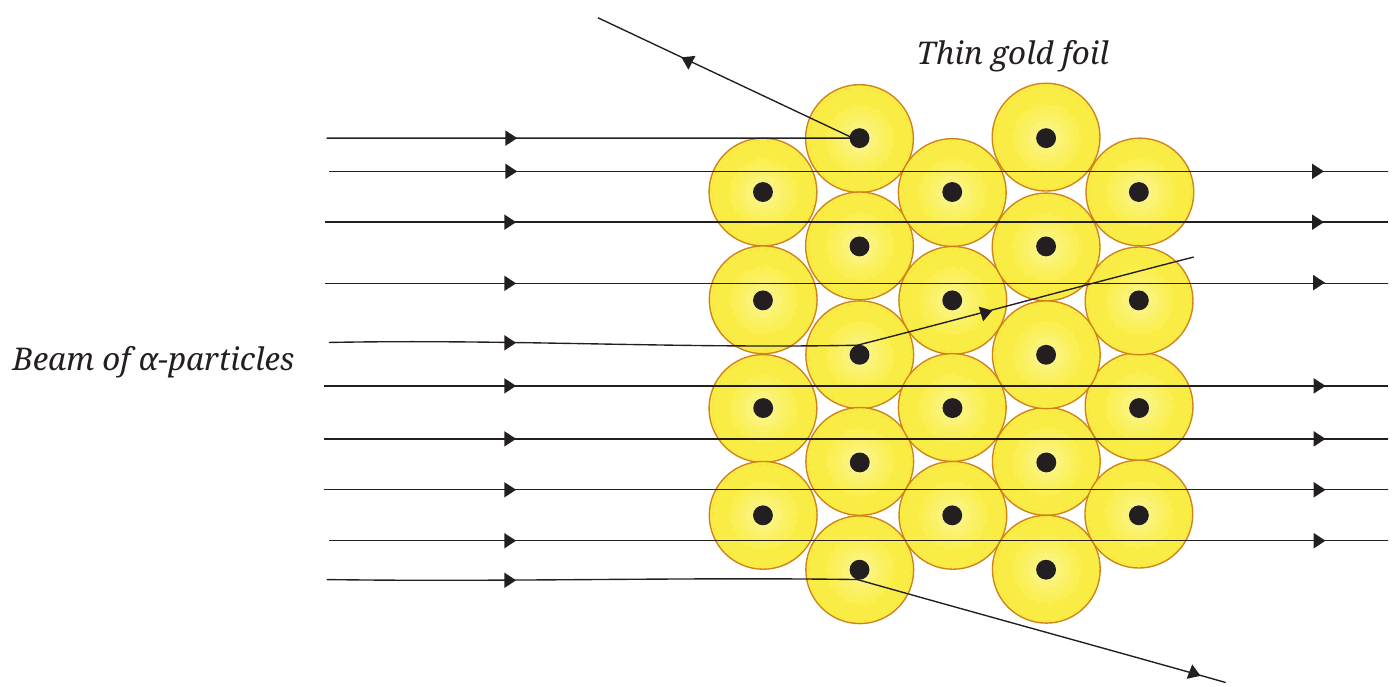
In Rutherford's experiment, alpha particles were sent towards a very thin gold foil.
Most passed straight through, while some were deflected.
In this activity, we have to imagine what would happen if the gold foil were made thicker.
A thicker foil contains more layers of atoms. Therefore, an alpha particle has a greater chance of coming close to a nucleus.
Q. Observe Fig. 8.4 of the gold foil experiment. Predict the observations you would expect if the gold foil in the experiment were made thicker. Also, draw a simple diagram to show the observations you expect.
Answer:
If the gold foil were made thicker:
- Fewer alpha particles would pass straight through.
- More alpha particles would be deflected.
- Some particles might be deflected through larger angles.
- The chance of an alpha particle coming close to a nucleus would increase.
Simple diagram
The thicker foil gives the alpha particles more chances to interact with nuclei.
F. Pause and Ponder - Rutherford's Experiment
Q4. What do you think would happen if α-particles were replaced with negatively charged particles in Rutherford’s gold foil experiment?
Answer:
Alpha particles are positively charged, so they are repelled by the positively charged nucleus.
If negatively charged particles were used instead, they would be attracted towards the positively charged nucleus.
Therefore, their paths and pattern of deflection would be different from those of alpha particles.
Q5. Rutherford found that a few α-particles bounced back sharply. How does this single surprising result completely rule out Thomson’s ‘plum pudding model’ of the atom?
Answer:
According to Thomson's model, positive charge was spread evenly throughout the atom.
If this were true, alpha particles should not bounce back strongly.
However, a few alpha particles bounced back. This showed that:
- the positive charge is concentrated in a very small region,
- this region is very dense,
- most of the atom's mass is present there.
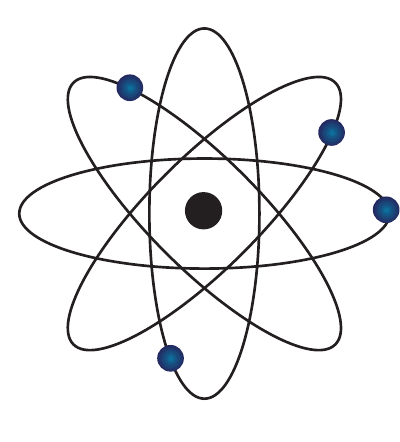
This small central region was called the nucleus.
Therefore, Thomson's model could not explain the result.
Q6. If you could ask Rutherford one question about his work, what would it be?
Answer:
One possible question is:
“How did you realise from the gold foil experiment that most of an atom is empty space?”
Another acceptable answer can also be written because this is an open-ended question.
G. Pause and Ponder - Assertion and Reason
Q7. Assertion (A): Rutherford concluded that most of the mass of an atom is concentrated in a small region at the centre called the nucleus.
Reason (R): According to Thomson’s model, electrons are embedded in a uniformly distributed positive charge sphere.
Choose the correct option:
(i) Both A and R are true, and R is the correct explanation of A.
(ii) Both A and R are true, but R is not the correct explanation of A.
(iii) A is true, but R is false.
(iv) A is false, but R is true.
Answer:
(ii) Both A and R are true, but R is not the correct explanation of A.
Reason: Rutherford concluded that most of the mass and positive charge are concentrated in the nucleus from the gold foil experiment.
Thomson's model is correctly described in the Reason, but it does not explain Rutherford's conclusion.
H. Bohr's Model - In-text Questions
Q1. How does Bohr’s model explain the stability of an atom?
Answer:
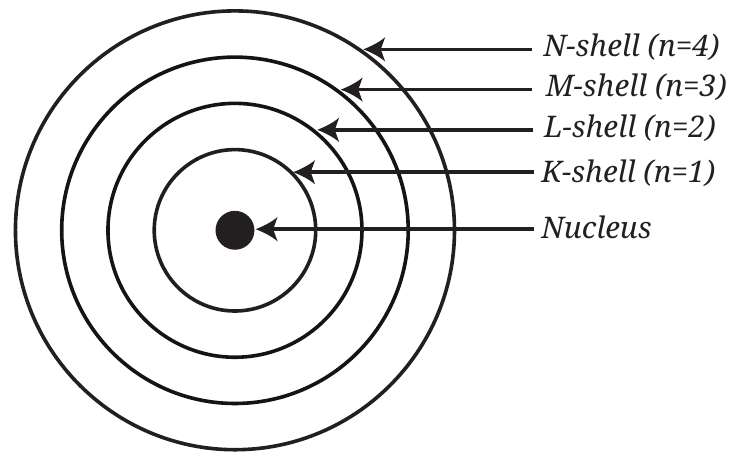
Bohr said that electrons move only in certain fixed shells or stationary energy levels.
When an electron moves in one of these allowed shells, it does not lose energy.
Therefore, the electron does not fall into the nucleus and the atom remains stable.
Q2. Why do electrons not lose energy while moving around the nucleus according to Bohr's model?
Answer:
According to Bohr, an electron in an allowed stationary energy level has a fixed amount of energy.
It does not lose energy while remaining in that shell.
Q3. Why are Bohr’s shells called K, L, M, N... and not A, B, C, D?
Answer:
The names came from the work of physicist Charles Barkla.
During X-ray experiments, Barkla named the first observed X-ray line K. He did not start from A because he wanted to leave space for any earlier series that might later be discovered.
Bohr later used the same names:
K, L, M, N...
for electron shells.
I. Neutrons and Atomic Mass - In-text Questions
Q1. What components contribute mainly to the mass of an atom?
Answer:
The mass of an atom comes mainly from the:
- protons, and
- neutrons
present inside its nucleus.
The mass of electrons is very small and can normally be ignored.
Q2. Is there something in the nucleus besides protons that adds mass without adding charge?
Answer:
Yes. The particle is called the neutron.
A neutron:
- has almost the same mass as a proton,
- has no electrical charge,
- is found inside the nucleus.
James Chadwick discovered the neutron in 1932.
Q3. Since all protons have positive charge, why do they not push each other out of the nucleus?
Answer:
Protons do repel each other because they have the same positive charge.
However, inside the nucleus, a very strong force called the nuclear force holds the particles together.
Neutrons also help in keeping the nucleus stable. Heavier nuclei therefore generally contain more neutrons.
Q4. What if an atom had no empty space? How would this have affected the size of various objects?
Answer:
If atoms had no empty space, atoms would be much smaller.
Therefore:
- objects made from them would occupy much less space,
- matter would become extremely compact and dense.
Most of the size of an atom comes from the large space between the nucleus and electrons.
J. Activity - Research Dhruva
Activity Explanation
The activity asks us to learn about Dhruva, which is connected with neutron research at BARC in Mumbai.
We have to understand why neutron research is useful.
Q. Research and explore more about Dhruva.

Answer:
Dhruva is associated with the Bhabha Atomic Research Centre (BARC), Mumbai.
Scientists use neutron-scattering experiments there to study different materials.
According to the chapter, such research has helped scientists understand materials such as:
- superconductors,
- battery electrodes,
- drug molecules,
- industrial alloys.
This research can help in the development of:
- better medicines,
- better energy-storage systems,
- improved industrial materials.
K. Symbols of Elements - Pause and Ponder
Q8. Imagine you are a scientist who has discovered a new element. Name this element after yourself and justify that the symbol you have chosen follows the IUPAC rules.
Answer:
Example:
Suppose my name is Aarav.
I can name the new element Aaravium and give it the symbol Aa.
The symbol follows the rules because:
- the first letter A is a capital letter,
- the second letter a is a small letter.
Note: Students can make their own answer using their own name.
Q9. What problems could arise if every scientist used different symbols for the same element?
Answer:
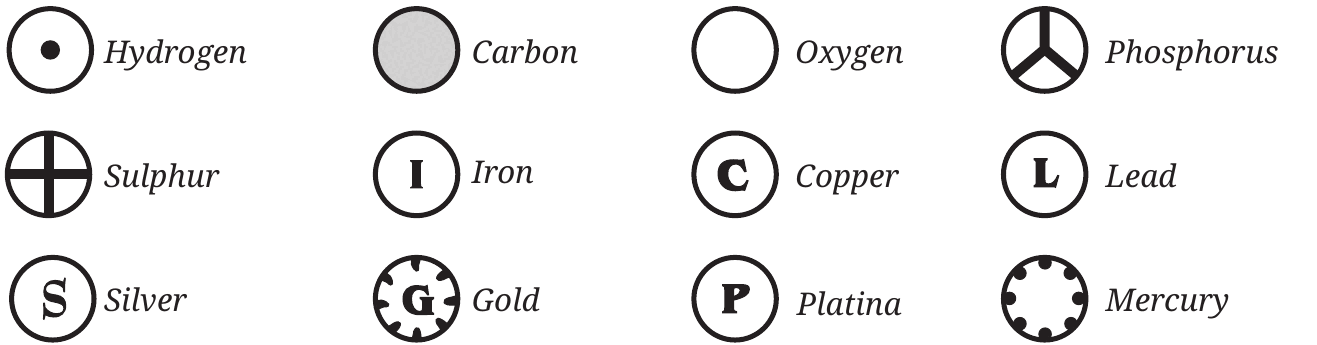
If scientists used different symbols for the same element:
- There would be a lot of confusion.
- Chemical formulas could be misunderstood.
- Scientists from different countries would find communication difficult.
- Mistakes could occur in experiments and calculations.
Therefore, internationally accepted symbols are necessary.
L. Atomic Number - In-text Questions
Q1. Can you now say that elements with different atomic numbers are distinct from each other, and the atomic number uniquely identifies an element?
Answer:
Yes.
Every element has its own fixed atomic number, which is equal to its number of protons.
Therefore, the atomic number uniquely identifies an element.
Q2. How many neutrons and protons are present in a lithium atom, and what is its atomic number?
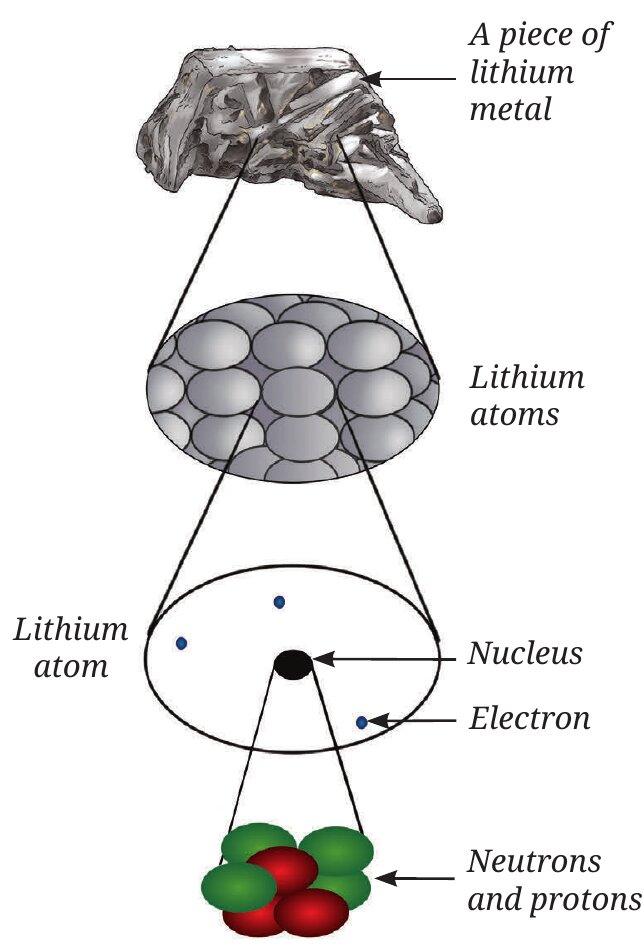
Answer:
For lithium:
- Number of protons = 3
- Number of neutrons = 4
- Atomic number = 3
M. Pause and Ponder - Atomic Number and Mass Number
Q10. An atom with an atomic number of 26 has 56 nucleons. Find out its number of electrons, protons and neutrons.
Answer:
Atomic number = 26
Therefore,
Number of protons = 26
For a neutral atom:
Number of electrons = 26
Mass number = number of nucleons = 56
Final Answer:
- Protons = 26
- Electrons = 26
- Neutrons = 30
Q11. The nucleus of an atom contains 20 protons. If its mass number is 41, find the number of neutrons in it.
Answer:
Answer:
21 neutrons
Q12. An atom has 18 neutrons and an atomic number of 17. What is its mass number?
Answer:
Atomic number = number of protons = 17
Neutrons = 18
Answer:
Mass number = 35
Q13. An atom 2 3 𝐴
Answer:
For a neutral atom:
Number of protons = number of electrons
Therefore,
Protons = 11
Mass number = 23
Answer:
12 neutrons
N. Electron Distribution - In-text Question
Q. Helium contains two protons in its nucleus and two electrons. In which way will the two electrons be arranged in its atomic shell?
Answer:
The first shell or K-shell can hold a maximum of 2 electrons.
Therefore, both electrons of helium will be present in the K-shell.
Electronic configuration of helium = 2.
O. Pause and Ponder - Electronic Configuration
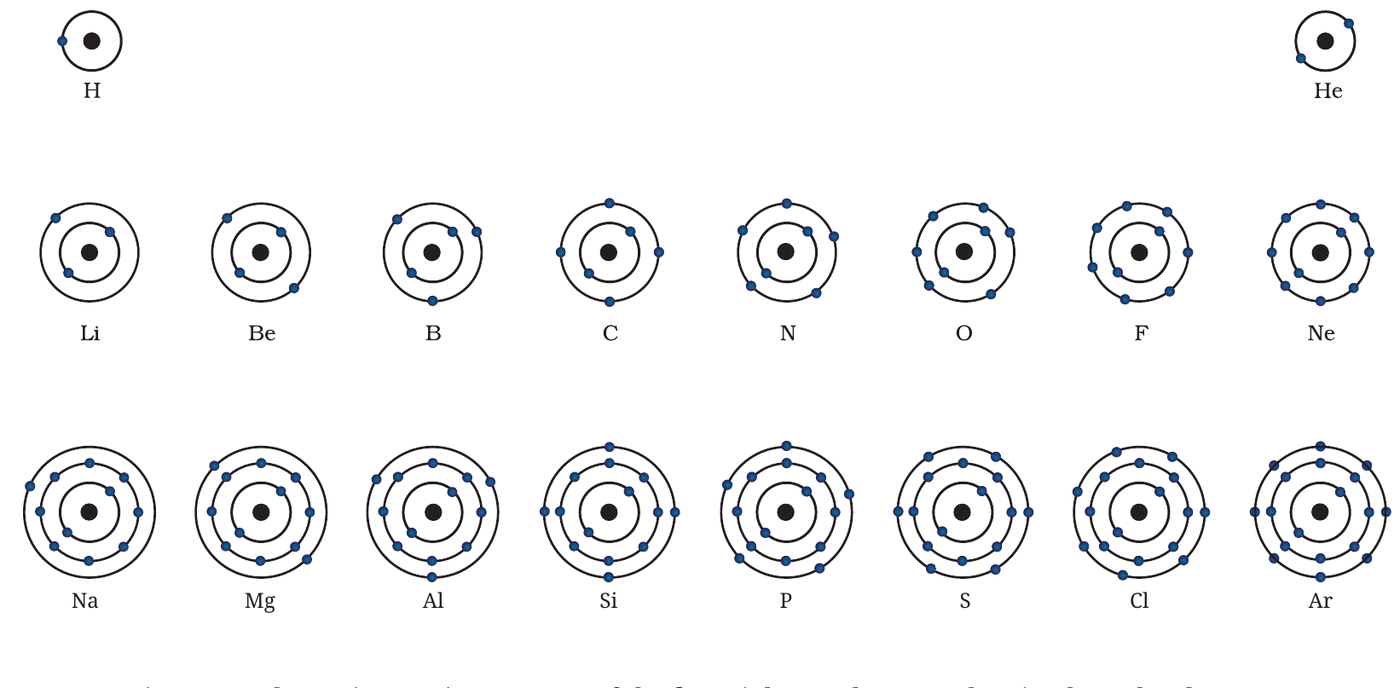
Q14. Identify the number of electrons in the outermost shell of the following elements:
(i) 1 2 6 𝐶
Atomic number = 6
Electronic configuration = 2, 4
Answer:
4 electrons
(ii) 1 9 9 𝐹
Atomic number = 9
Electronic configuration = 2, 7
Answer:
7 electrons
(iii) 2 8 1 4 𝑆 𝑖
Atomic number = 14
Electronic configuration = 2, 8, 4
Answer:
4 electrons
Q15. Write the electronic configuration of the elements having atomic numbers 12, 16 and 18.
Answer:
| Atomic number | Electronic configuration |
|---|---|
| 12 | 2, 8, 2 |
| 16 | 2, 8, 6 |
| 18 | 2, 8, 8 |
Q16. Solve this riddle: I am an atom with a mass number of 23 and 11 protons. I am a soft metal and react vigorously with water. Who am I and how many neutrons do I have? You can also create one such riddle.
Answer:
Number of protons = 11
Therefore, atomic number = 11.
The element with atomic number 11 is sodium (Na).
Mass number = 23
Answer:
The element is sodium and it has 12 neutrons.
One more riddle
Q. I have 8 protons and a mass number of 16. I am necessary for breathing. Who am I and how many neutrons do I have?
Answer:
I am oxygen.
I have 8 neutrons.
P. Valency - In-text Questions
Q1. In NH₃ (ammonia) and MgCl₂ (magnesium chloride), what are the combining capacities of nitrogen and magnesium respectively?
Answer:
In NH₃, one nitrogen atom combines with 3 hydrogen atoms.
Therefore:
Valency of nitrogen = 3
In MgCl₂, one magnesium atom combines with 2 chlorine atoms.
Therefore:
Valency of magnesium = 2
Q2. What happens to atoms that already have eight electrons in their outermost shell? Will they still try to lose or gain electrons?
Answer:
No.
Atoms having a complete outermost shell are already stable.
They normally do not need to gain, lose or share electrons.
Their valency is generally zero.
Examples:
- Neon = 2, 8
- Argon = 2, 8, 8
Helium is also stable with 2 electrons in its first shell.
Q3. Examine Table 8.4. Add one more column to it, and write down the common valency of each element.
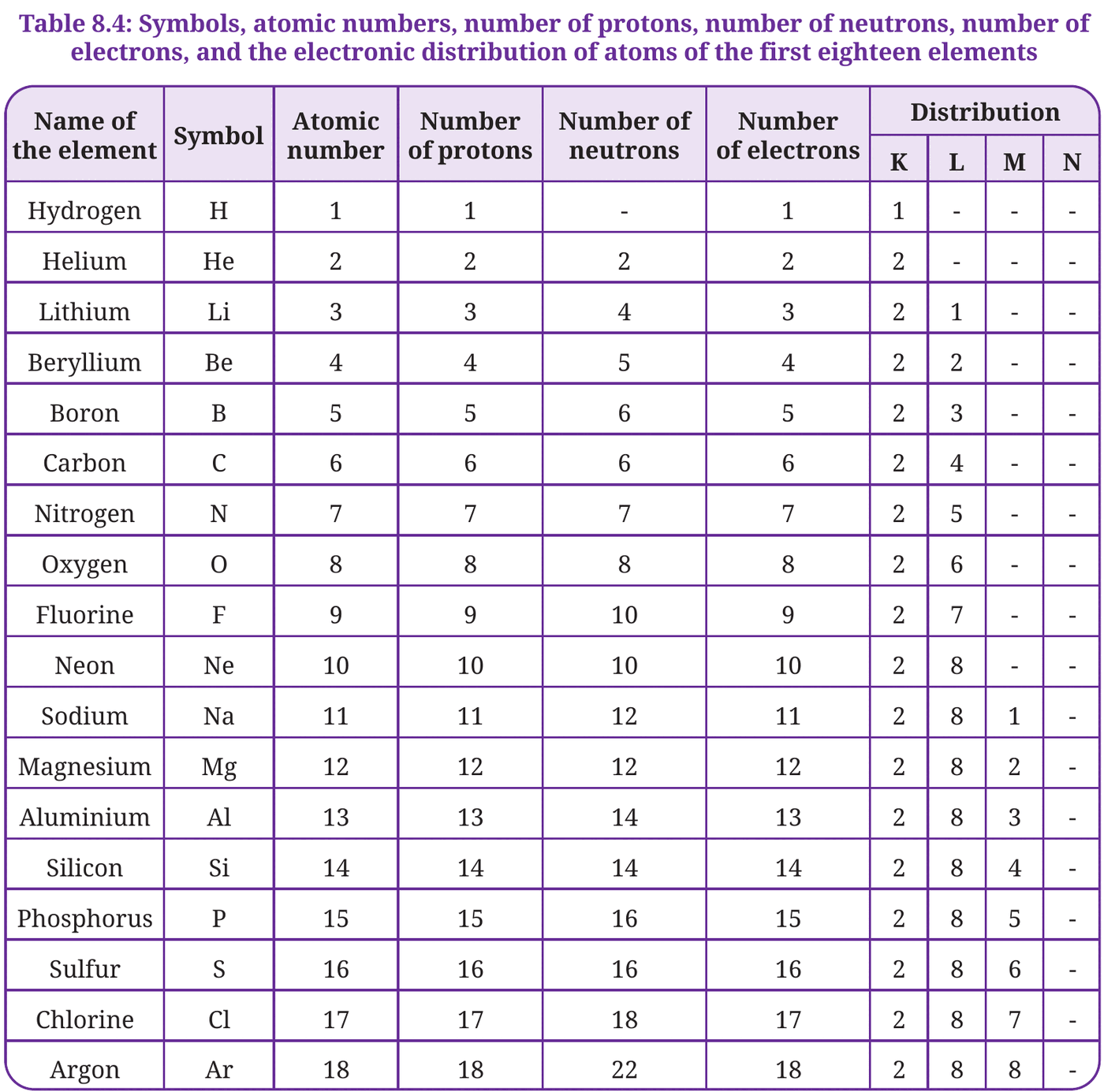
Answer:
| Element | Electronic configuration | Valency |
|---|---|---|
| Hydrogen | 1 | 1 |
| Helium | 2 | 0 |
| Lithium | 2, 1 | 1 |
| Beryllium | 2, 2 | 2 |
| Boron | 2, 3 | 3 |
| Carbon | 2, 4 | 4 |
| Nitrogen | 2, 5 | 3 |
| Oxygen | 2, 6 | 2 |
| Fluorine | 2, 7 | 1 |
| Neon | 2, 8 | 0 |
| Sodium | 2, 8, 1 | 1 |
| Magnesium | 2, 8, 2 | 2 |
| Aluminium | 2, 8, 3 | 3 |
| Silicon | 2, 8, 4 | 4 |
| Phosphorus | 2, 8, 5 | 3 |
| Sulfur | 2, 8, 6 | 2 |
| Chlorine | 2, 8, 7 | 1 |
| Argon | 2, 8, 8 | 0 |
Q4. All the atoms of an element have the same number of electrons and protons. Can you say the same regarding the number of neutrons too?
Answer:
No.
Atoms of the same element can have different numbers of neutrons.
Such atoms are called isotopes.
Q5. What effect does a difference in the number of neutrons have on the properties of the atom?
Answer:
Isotopes of an element have:
- similar chemical properties because they have the same number of electrons,
- different physical properties because their masses are different.
For example, their melting points and boiling points may be different.
Q. Isotopes - In-text Questions
Q1. Hydrogen has three isotopes: protium, deuterium and tritium. How many electrons does each isotope have?
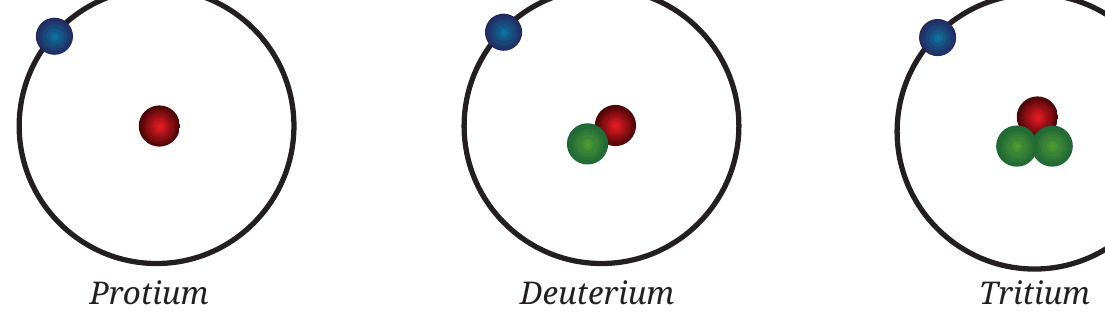
Answer:
All three isotopes of hydrogen have one proton.
Since the atoms are neutral, each also has one electron.
Therefore:
- Protium = 1 electron
- Deuterium = 1 electron
- Tritium = 1 electron
Q2. Why are the chemical properties of isotopes similar?
Answer:
Isotopes have the same:
- atomic number,
- number of electrons,
- electronic configuration,
- number of valence electrons.
Chemical properties mainly depend on the electrons, especially the valence electrons.
Therefore, isotopes of the same element have similar chemical properties.
R. Worked Example - Carbon Isotopes
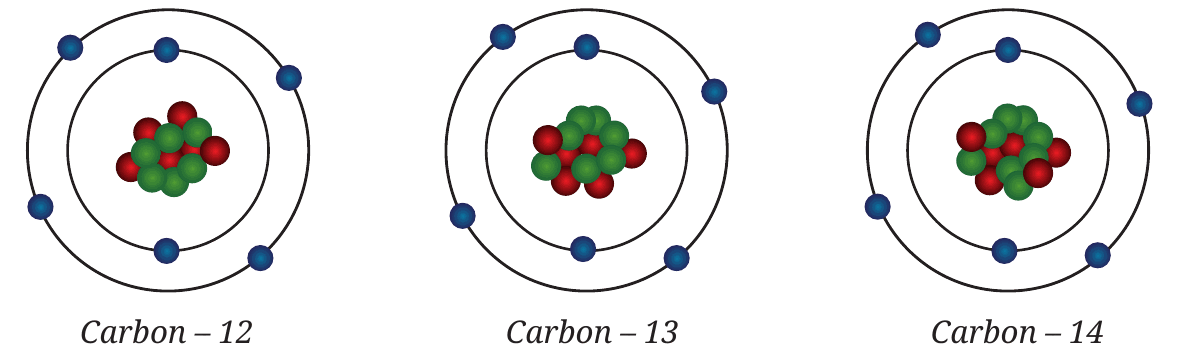
Q. How many neutrons are present in the three isotopes of carbon: 1 2 6 𝐶 1 3 6 𝐶 1 4 6 𝐶
Answer:
Formula:
Carbon-12
6 neutrons
Carbon-13
7 neutrons
Carbon-14
8 neutrons
S. Worked Example - Average Atomic Mass of Chlorine
Q. Chlorine occurs as two isotopes of masses 35 u and 37 u. Should the atomic mass of chlorine be taken as 35 u or 37 u?
Answer:
Neither value alone gives the correct average mass because both isotopes occur naturally.
About:
- 75% is chlorine-35,
- 25% is chlorine-37.
Therefore:
Answer:
Average atomic mass of chlorine = 35.5 u
This does not mean that one chlorine atom has a mass of 35.5 u. It is the weighted average of a large number of chlorine atoms.
T. Pause and Ponder - Isotopes
Q17. Two different atoms have 11 protons each, but one has 12 neutrons, and the other has 13 neutrons. How do their atomic numbers and mass numbers compare? Are they the same element or different elements?
Answer:
Both atoms have 11 protons.
Therefore:
Atomic number of both = 11
First atom
Protons = 11
Neutrons = 12
Second atom
Protons = 11
Neutrons = 13
So:
- Atomic numbers are the same: 11
- Mass numbers are different: 23 and 24
They are the same element, because their atomic numbers are the same.
They are isotopes of the same element.
Q18. If a bromine atom is available in the form of, say two isotopes, 7 9 3 5 𝐵 𝑟 8 1 3 5 𝐵 𝑟
Answer:
Therefore:
Answer:
Approximately 80.0 u
U. Isobars - In-text Question
Q. What if two atoms have the same mass number but different atomic numbers? What are such atoms called?
Answer:
Such atoms are called isobars.
Isobars are atoms of different elements having:
- the same mass number,
- different atomic numbers.
Example:
- Calcium-40: atomic number 20
- Potassium-40: atomic number 19
- Argon-40: atomic number 18
All have mass number 40, so they are isobars.
V. END-OF-CHAPTER EXERCISE - REVISE, REFLECT, REFINE
Q1. Choose the correct options and explain the reason for the correct and incorrect options in the context of Ernest Rutherford’s gold foil experiment:
(i) The experiment clearly showed the existence of neutrons in the nucleus.
(ii) The results disproved the plum pudding model and led to the idea of a nucleus at the centre of the atom.
(iii) The large deflection of a few alpha particles indicated that most of the mass of the atom and positive charge are packed into a tiny centre.
(iv) The way alpha particles were deflected showed that electrons move around the nucleus.
Answer:
The correct statements are (ii) and (iii).
(i) Incorrect
Rutherford's experiment did not discover neutrons.
James Chadwick discovered the neutron later.
(ii) Correct
The experiment showed that Thomson's plum pudding model could not explain the large deflections of alpha particles.
It led Rutherford to propose a small central nucleus.
(iii) Correct
A few alpha particles were strongly deflected or bounced back.
This showed that most of the positive charge and mass are concentrated in a very small, dense nucleus.
(iv) Incorrect
The scattering experiment showed the presence of the nucleus. It did not directly show that electrons were moving around it.
Q2. Which of the following statements are correct or incorrect according to Bohr’s atomic model? Give a reason for each statement.
(i) Electrons lose energy while moving in fixed orbits and slowly fall into the nucleus.
Answer:
Incorrect.
According to Bohr, electrons do not lose energy while moving in their allowed fixed shells.
(ii) Electrons can exist anywhere around the nucleus with no fixed energy.
Answer:
Incorrect.
According to Bohr, electrons can exist only in certain fixed energy levels or shells.
(iii) Electrons revolve around the nucleus in orbits of fixed energy without losing energy.
Answer:
Correct.
This is one of the main ideas of Bohr's atomic model.
(iv) Electrons can be found between energy levels as they move around the nucleus.
Answer:
Incorrect.
Bohr proposed that electrons cannot remain between two allowed energy levels.
They can move from one level to another only by absorbing or releasing a fixed amount of energy.
Q3. The composition of the nuclei of three atomic species X, Y and Z are given as follows:
| X | Y | Z | |
|---|---|---|---|
| Number of protons | 18 | 17 | 17 |
| Number of neutrons | 19 | 18 | 20 |
Explain the relation between the following:
(i) Y and Z
Answer:
For Y:
For Z:
Both have atomic number 17, but their mass numbers are different.
Therefore, Y and Z are isotopes of the same element.
(ii) Z and X
Answer:
For Z:
For X:
They have the same mass number 37, but different atomic numbers.
Therefore, Z and X are isobars.
Q4. What conclusion did Rutherford draw about the position and characteristics of the atom’s positively charged part based on the few alpha particles that bounced back or were deflected at large angles in the gold foil experiment?
Answer:
Rutherford concluded that the positive charge of an atom is:
- concentrated in a very small region,
- located at the centre of the atom,
- very dense,
- and contains most of the atom's mass.
This central region is called the nucleus.
Q5. Explain and arrange the following statements in the correct chronological order to show how atomic models have evolved over time.
(i) Bohr’s model proposed that electrons move in fixed orbits around the nucleus, each with a definite energy.
(ii) Thomson’s model depicted the atom as a ‘plum pudding’ with electrons embedded in a sphere of positive charge.
(iii) Rutherford’s model proposed that atoms have a dense central nucleus.
(iv) Dalton’s model described atoms as indivisible particles.
Answer:
The correct chronological order is:
1. Dalton's model - (iv)
Dalton said atoms were indivisible particles.
2. Thomson's model - (ii)
After discovering electrons, Thomson proposed that electrons were embedded in a sphere of positive charge.
3. Rutherford's model - (iii)
Rutherford showed that the atom has a small and dense nucleus.
4. Bohr's model - (i)
Bohr proposed that electrons move around the nucleus in fixed energy levels.
Q6. Electrons move around the nucleus in orbits. Why do they not fly away from the atom? Explain what keeps them attracted to the nucleus.
Answer:
Electrons have a negative charge, while protons in the nucleus have a positive charge.
Opposite charges attract each other.
Therefore, the electrostatic attraction between the negatively charged electrons and the positively charged nucleus keeps electrons connected to the atom.
According to Bohr's model, electrons remain in fixed energy levels around the nucleus.
Q7. Assertion (A): The discovery of subatomic particles helped in understanding the atomic structure.
Reason (R): The number of electrons is equal to the number of protons in an atom.
Choose the correct option:
(i) Both A and R are true, and R is the correct explanation of A.
(ii) Both A and R are true, but R is not the correct explanation of A.
(iii) A is true, but R is false.
(iv) A is false, but R is true.
Answer:
(ii) Both A and R are true, but R is not the correct explanation of A.
Explanation: Discovery of electrons, protons and neutrons helped scientists understand the structure of atoms.
It is also true that a neutral atom has equal numbers of protons and electrons.
However, this fact alone does not explain why the discovery of subatomic particles helped us understand atomic structure.
Q8. Magnesium is essential for many biological processes, including muscle contraction. For an atom of magnesium with a mass number of 24 and atomic number 12, determine the number of (i) protons, (ii) neutrons, (iii) electrons, and also illustrate the arrangement of electrons in a magnesium atom.
Answer:
Atomic number = 12
Therefore:
(i) Number of protons
(ii) Number of neutrons
(iii) Number of electrons
For a neutral atom:
Electronic arrangement
- K-shell = 2 electrons
- L-shell = 8 electrons
- M-shell = 2 electrons
Final Answer:
- Protons = 12
- Neutrons = 12
- Electrons = 12
- Electronic configuration = 2, 8, 2
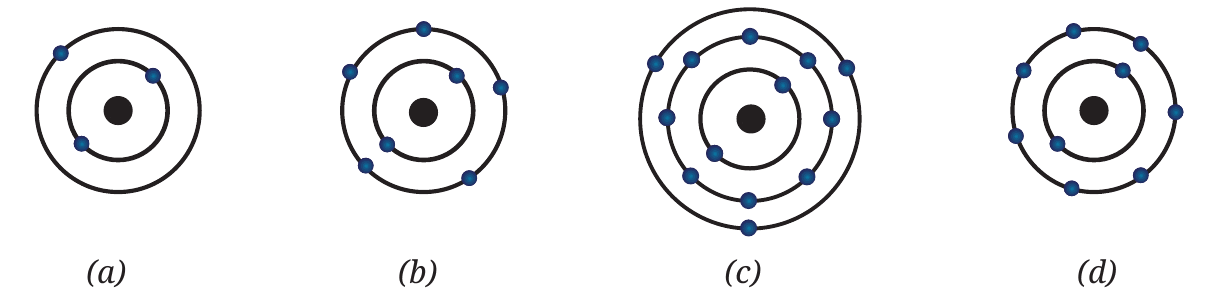
Q9. Find the following information for the elements shown in Fig. 8.17:
(i) Name of the element
(ii) Symbol
(iii) Total number of electrons
(iv) Number of valence electrons
(v) Valency of the element
(vi) Number of protons
(vii) Atomic number
Answer:
From the electron arrangements shown in Fig. 8.17:
| Figure | Element | Symbol | Total electrons | Valence electrons | Valency | Protons | Atomic number |
|---|---|---|---|---|---|---|---|
| (a) | Lithium | Li | 3 | 1 | 1 | 3 | 3 |
| (b) | Nitrogen | N | 7 | 5 | 3 | 7 | 7 |
| (c) | Aluminium | Al | 13 | 3 | 3 | 13 | 13 |
| (d) | Fluorine | F | 9 | 7 | 1 | 9 | 9 |
The diagrams on page 159 show the electronic arrangements 2,1; 2,5; 2,8,3; and 2,7 respectively.
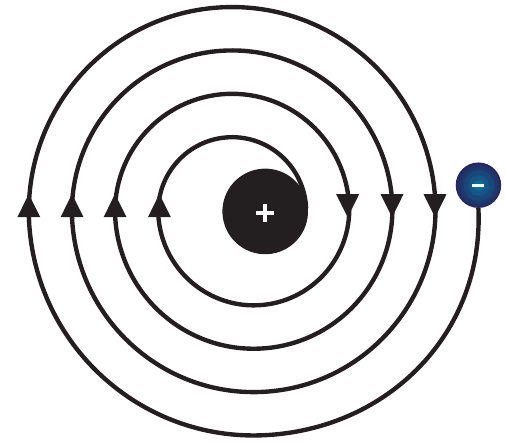
Q10. Both Rutherford’s and Bohr’s models have electrons orbiting the nucleus. Why did Rutherford’s model fail to explain atomic stability, while Bohr’s model succeeded?
Answer:
In Rutherford's model, a moving electron should continuously lose energy.
If it lost energy, it should:
- move closer and closer to the nucleus,
- finally fall into the nucleus,
- cause the atom to collapse.
But atoms do not collapse.
Therefore, Rutherford's model could not explain atomic stability.
Bohr proposed that electrons move in special fixed energy levels.
While moving in these allowed shells, electrons do not lose energy.
Therefore, Bohr's model could explain why atoms remain stable.
Q11. An atom 7 0 𝑋
Answer:
Number of electrons = 31
For a neutral atom:
Number of protons = 31
Mass number = 70
Answer:
39 neutrons
Q12. An atom has 79 protons and a mass number of 197. Calculate:
(i) the number of neutrons
Answer:
118 neutrons
(ii) the number of electrons
For a neutral atom:
Answer:
79 electrons
Q13. Complete Table 8.5.
Answer:
| Atomic number | Mass number | Number of neutrons | Number of protons | Number of electrons | Name of element |
|---|---|---|---|---|---|
| 5 | 11 | 6 | 5 | 5 | Boron |
| 7 | 14 | 7 | 7 | 7 | Nitrogen |
| 12 | 24 | 12 | 12 | 12 | Magnesium |
| 15 | 31 | 16 | 15 | 15 | Phosphorus |
| 1 | 1 | 0 | 1 | 1 | Hydrogen |
Q14. Aman was discussing the structure of atom with his classmates. During the discussion, he learnt that an element X has a mass number of 35 and contains 18 neutrons. Based on this information, answer the following questions:
(i) How many electrons and protons does element X have?
Mass number = 35
Neutrons = 18
For a neutral atom:
Electrons = 17
Answer:
17 protons and 17 electrons
(ii) What is its atomic number?
Atomic number = number of protons
Answer:
17
(iii) Identify the element X.
The element with atomic number 17 is chlorine.
Answer:
Chlorine (Cl)
(iv) Write its electronic configuration.
Chlorine has 17 electrons.
Answer:
2, 8, 7
(v) How many valence electrons does it have?
The outermost shell contains 7 electrons.
Answer:
7 valence electrons
(vi) What will be the mass number if two neutrons are added to its nucleus?
Original mass number = 35
Two neutrons are added.
Answer:
37
(vii) What will be the relation of X with the new atom?
The number of protons remains 17, but the number of neutrons changes.
Therefore:
- atomic number remains the same,
- mass number changes from 35 to 37.
So the two atoms are isotopes of chlorine.
Answer:
They are isotopes of the same element.
Q15. In an atom, there are 12 protons and 12 neutrons in the nucleus. Now, imagine that all the electrons are replaced with some hypothetical particles that have the same charge as electrons but are 500 times heavier. What effect will this replacement have on the atom’s:
(i) Atomic number
Answer:
The atomic number will not change.
Atomic number depends only on the number of protons.
There are still 12 protons.
(ii) Atomic mass
Answer:
The atomic mass will increase because the new negatively charged particles are much heavier than normal electrons.
(iii) Mass number
Answer:
The mass number will not change.
Mass number counts only:
Therefore:
(iv) Overall charge
Answer:
The overall charge will remain neutral.
There are:
- 12 positively charged protons,
- 12 negatively charged replacement particles.
The positive and negative charges still balance each other.
Answer:
Overall charge = zero or neutral.
W. THE JOURNEY BEYOND - ACTIVITIES
Activity 1 - Atomic Prediction Board
Activity Explanation
In this activity, you have to make a game in which students are given clues about an atom.
The clues may include:
- atomic number,
- mass number,
- protons,
- neutrons,
- electrons,
- valency.
Students have to identify the element.
Q. Create an ‘Atomic Prediction Board’ game based on atomic number, mass number, number of electrons, protons, neutrons and valency. Students may predict elements using atomic clues.
Answer:
Make cards with clues like these:
Card 1
Clues:
- Atomic number = 8
- Mass number = 16
- Protons = 8
- Electrons = 8
- Neutrons = 8
- Valency = 2
Answer:
Oxygen (O)
Card 2
Clues:
- Atomic number = 11
- Mass number = 23
- Protons = 11
- Neutrons = 12
- Electrons = 11
- Valency = 1
Answer:
Sodium (Na)
Card 3
Clues:
- Atomic number = 6
- Mass number = 12
- Electrons = 6
- Neutrons = 6
- Valency = 4
Answer:
Carbon (C)
Card 4
Clues:
- Atomic number = 17
- Mass number = 35
- Protons = 17
- Neutrons = 18
- Valency = 1
Answer:
Chlorine (Cl)
Students can take turns picking cards and identifying the element.
Activity 2 - Report on Atoms in Everyday Life
Activity Explanation
In this activity, we have to explain how our knowledge of atoms and isotopes is useful in different areas of life.
The chapter mainly gives examples from:
- healthcare,
- energy,
- research,
- technology.
Q. Prepare a report on how the properties of atoms impact us in everyday life across fields such as healthcare, energy, agriculture and technology.
Answer:
Atoms in Everyday Life
Atoms and their properties are very useful in our daily lives.
1. Healthcare
Some radioactive isotopes are used in medicine.
- Cobalt-60 is used in radiation treatment for cancer.
- Iodine-131 is used in the treatment of thyroid diseases, including thyroid cancer.
2. Energy
Uranium-235 is used as a fuel in nuclear reactors.
Nuclear power plants use atomic energy to generate electricity.
3. Agriculture
Atomic research is also used to support developments in agriculture. Scientific institutions study the peaceful uses of atomic energy in different fields, including agriculture.
4. Technology
Neutron-scattering experiments help scientists study:
- battery materials,
- superconductors,
- industrial alloys,
- drug molecules.
Modern microscopes can even produce images showing materials at the atomic level.
Conclusion
Understanding atoms has helped humans develop better medicines, energy systems and new technologies.
Activity 3 - Role-play: Journey Inside the Atom
Activity Explanation
Students have to perform a short play showing how our understanding of the atom changed over time.
Different students can act as different scientists.
Q. Create a role-play, stage play or story about the ‘Journey Inside the Atom’, and the scientists who discovered and contributed to the identification of atomic structure.
Answer:
Characters
- Narrator
- Acharya Kanada
- John Dalton
- J. J. Thomson
- Ernest Rutherford
- Niels Bohr
- James Chadwick
Short Role-play
Narrator: For thousands of years, people have wondered what matter is made of.
Acharya Kanada: I believe that if matter is divided again and again, we finally reach very tiny particles called parmanus.
Dalton: I proposed a scientific atomic theory. I said that matter is made of tiny particles called atoms.
Thomson: I discovered the electron. Therefore, atoms cannot be indivisible. I suggested that electrons are present inside a positively charged sphere.
Rutherford: My gold foil experiment showed that most of an atom is empty space. I discovered that positive charge and most of the mass are concentrated in a tiny nucleus.
Bohr: I explained that electrons move in fixed energy levels or shells around the nucleus. They do not lose energy while remaining in these shells.
Chadwick: I discovered the neutron, a particle with no electrical charge present in the nucleus.
Narrator: Each discovery improved our understanding of the atom. Even today, scientists continue to learn more about atomic structure.
Activity 4 - Animation of Atomic Models
Activity Explanation
In this activity, students have to use a computer or digital tool to show how atomic models changed over time.
Q. Use selected software or digital tools and try to create animations or simulations of various atomic models, and share them in the class.
Answer:
The animation can be made in five stages:
Scene 1 - Dalton's Model
Show an atom as a small solid sphere.
Scene 2 - Thomson's Model
Show a positively charged sphere with small electrons inside it.
Scene 3 - Rutherford's Model
Show:
- a tiny central nucleus,
- electrons moving around it,
- large empty space.
Scene 4 - Bohr's Model
Show electrons moving in fixed shells:
- K
- L
- M
- N
Scene 5 - Modern Model
Show electrons as an electron cloud around the nucleus instead of fixed circular paths.
Add the name of each scientist and his main contribution.
Activity 5 - Documentary on Atomic Structure
Activity Explanation
In this activity, you have to watch an educational film or documentary about atoms and write a small report.
A sample answer is given below. You can replace the documentary name with the one you actually watch.
Q1. Which film or documentary did you watch, and what was its main idea or topic?
Answer:
I watched an educational documentary on “The Structure of the Atom.”
Its main topic was how scientists gradually discovered the structure of the atom and developed different atomic models.
Q2. What did the film or documentary teach you about the structure of the atom and the atomic model(s)?
Answer:
It taught me that an atom contains:
- a nucleus at the centre,
- protons and neutrons inside the nucleus,
- electrons around the nucleus.
It also showed how atomic models changed from Dalton's model to Thomson's, Rutherford's and Bohr's models.
Q3. Which scientists were mentioned in the film or documentary, and what were their contributions?
Answer:
John Dalton: Proposed an early scientific atomic theory.
J. J. Thomson: Discovered the electron and proposed the plum pudding model.
Ernest Rutherford: Discovered the nucleus and proposed the nuclear model.
Niels Bohr: Proposed fixed energy levels for electrons.
James Chadwick: Discovered the neutron.
Q4. What part of the film or documentary did you find most interesting, and what question do you still have?
Answer:
I found Rutherford's gold foil experiment most interesting because a few alpha particles bounced back and helped scientists discover the nucleus.
One question I still have is:
“What exactly happens inside the nucleus at the smallest level?”
Activity 6 - Bar Graph of Electrons in Energy Levels
Activity Explanation
Choose any three elements.
Find how many electrons are present in their:
- K-shell,
- L-shell,
- M-shell.
Then draw a bar graph.
Q. Draw a bar graph showing the number of electrons in each energy level for any three elements.
Answer:
We can choose hydrogen, carbon and sodium.
| Element | K-shell | L-shell | M-shell |
|---|---|---|---|
| Hydrogen | 1 | 0 | 0 |
| Carbon | 2 | 4 | 0 |
| Sodium | 2 | 8 | 1 |
Simple representation
Students can copy these values onto graph paper and draw similar vertical bars.
X. The Quest Continues
Q. Is it possible to completely understand everything that happens inside an atom?
Answer:
Scientists have learnt a great deal about atoms, but our understanding is still developing.
Earlier models were changed when new experiments gave better evidence.
Even Bohr's model was later improved by the quantum mechanical model.
Therefore, science continues to explore what happens inside atoms, and new discoveries may improve our understanding further.